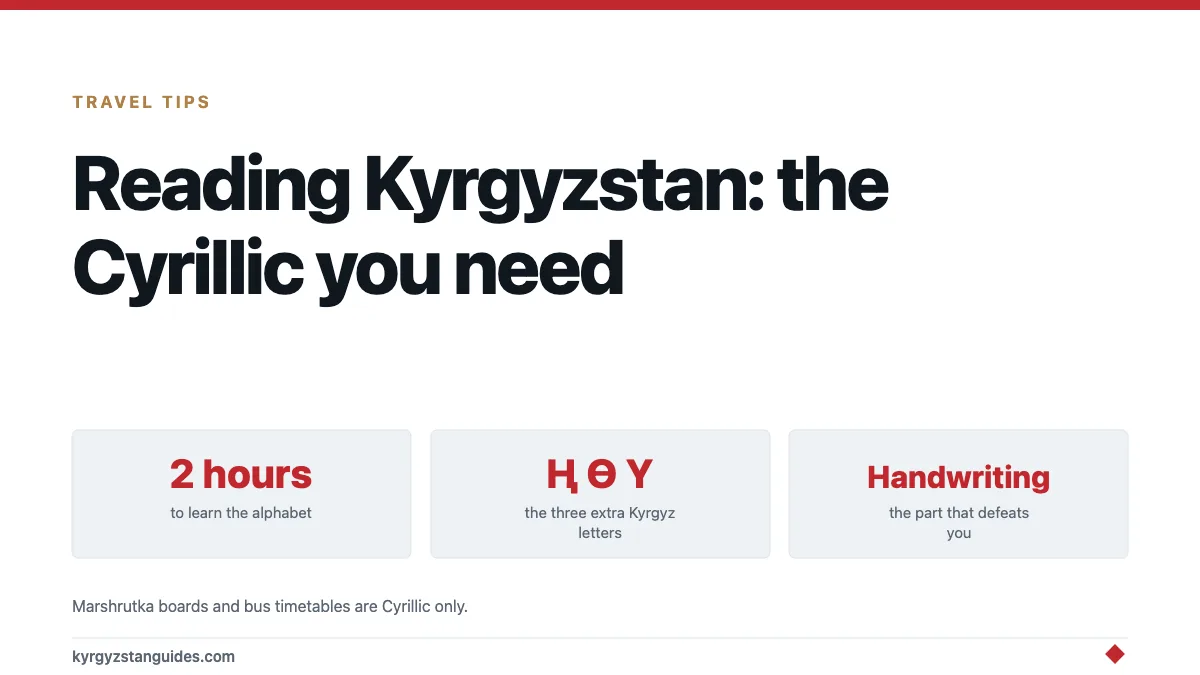
Kyrgyzstan writes both its languages in Cyrillic, and that single fact will affect your trip more than any phrasebook. Marshrutka destination boards, street names, menus outside the tourist streets, bus station timetables, all of it's in an alphabet most visitors can't read, and learning it takes about two hours.
The country is also, quietly, the last of its neighbours not to have switched to Latin script. That argument is worth understanding, but the two hours comes first.
Learn the letters, not the language
This is the single highest-return thing you can do before arriving, and travellers consistently skip it in favour of memorising greetings.
Roughly a third of Cyrillic letters look and sound like their Latin equivalents. Another third look familiar but sound different — Р is r, С is s, В is v, Н is n, Х is kh. The last third are new shapes: Ж zh, Ш sh, Щ shch, Ы a sound English doesn't have, Ю yu, Я ya.
Kyrgyz adds three letters Russian doesn't have: Ң (ng), Ө (like German ö) and Ү (like German ü). You'll see them in place names constantly — Ош is Osh, Бишкек is Bishkek, Каракол is Karakol, Сөңкөл is Song-Kul.
Once you can sound out a word, a marshrutka windscreen stops being a mystery and becomes a sign. You don't need to know what it means. You need to recognise Каракол when it drives past.
Our Kyrgyz phrases guide covers what to actually say. This page is about what to read.
The words you'll actually be reading
You don't need vocabulary. You need about fifteen recurring words, and after that most signage decodes itself.
| Cyrillic | Sounds like | Means |
|---|---|---|
| АПТЕКА | apteka | pharmacy |
| БАНК | bank | bank |
| БАЗАР | bazar | market |
| КАФЕ | kafe | cafe |
| МАГАЗИН | magazin | shop |
| ВОКЗАЛ | vokzal | station |
| АВТОВОКЗАЛ | avtovokzal | bus station |
| ГОСТИНИЦА | gostinitsa | hotel |
| БОЛЬНИЦА | bolnitsa | hospital |
| ТУАЛЕТ | tualet | toilet |
| ОТКРЫТО | otkryto | open |
| ЗАКРЫТО | zakryto | closed |
| ВХОД | vkhod | entrance |
| ВЫХОД | vykhod | exit |
| МИЛИЦИЯ / ПОЛИЦИЯ | politsiya | police |
Notice how many are borrowed words you already know once you can sound them out. АПТЕКА is not a Russian word you have to learn; it's apotheke, and half of European languages have it. That pattern holds for a surprising amount of signage.
Which language is on the sign?
Both, usually, and they share the alphabet, which is why it doesn't matter much.
Kyrgyz is the state language, Turkic, related to Kazakh and more distantly to Turkish. Russian is an official language and dominates Bishkek, business, and most written administration.
In practice, the north runs more on Russian and the south more on Kyrgyz and Uzbek. In the mountains, in villages, and with older people in the south, Kyrgyz is what's spoken. Our guide to north and south Kyrgyzstan sets out the wider divide.
For a traveller: Russian gets you further in Bishkek and on Issyk-Kul. Kyrgyz is more appreciated everywhere, and even two words of it changes a conversation.
The bit that will actually defeat you
Handwriting.
Printed Cyrillic is learnable in an afternoon. Handwritten Cyrillic is a different alphabet wearing the same name, and the cursive forms of several letters look nothing like their printed versions — т written by hand resembles an m, д resembles a g, and a run of и, ш and м becomes a row of identical humps that native readers disambiguate from context and you can't.
Where this bites: the destination card taped inside a marshrutka windscreen, chalked daily specials outside a cafe, a price scribbled on a bag of apricots, the note a guesthouse owner writes to tell a driver where you're going.
There's no shortcut. Ask someone to read it aloud, or ask them to type it into your phone. Handing over your phone with the keyboard open is a gesture everyone here understands, and it solves the problem in about four seconds.
The alphabet argument
Here's where the region's politics show up in its typography.
Uzbekistan moved to Latin script in 1993, and more than thirty years later the conversion is only partly done — you'll still see Cyrillic on Uzbek signage. Kazakhstan announced a switch with a target of 2025, then pushed the deadline out to as late as 2031. Turkmenistan and Azerbaijan made the change earlier.
The five members of the Organization of Turkic States have since agreed a common Latin alphabet of 34 letters, settling years of argument over which diacritics to use.
Kyrgyzstan is the one member that has not committed. A draft Latin-based Kyrgyz alphabet has been prepared and is waiting on a political decision. Eurasianet has covered the recurring bursts of enthusiasm for making the change.
The arguments run both ways, and they aren't really about letters:
For Latin, alignment with the Turkic world, distance from Russia, easier interface with the internet and with Turkish, a break with the Soviet script imposed in 1940.
Against — cost, the near-universal literacy the country already has in Cyrillic, the risk of cutting a generation off from everything published in the last eighty years, and the Uzbek example of a transition that stalls halfway and leaves a country reading two alphabets badly.
We're not going to tell you which side is right. It's their language.
What this means practically
Nothing changes for your trip in the near term. Cyrillic is what's on the signs and will be for years, whatever gets decided.
What it does mean is that if you're looking at old guidance suggesting you'll manage with Latin transliteration, ignore it. Transliterated place names appear on tourist-facing signage in Bishkek and at a handful of major sites. Everywhere else — bus stations, shop fronts, price lists, the side of a marshrutka — is Cyrillic only.
Offline maps handle this better than they used to. 2GIS shows both scripts in cities, and Organic Maps and Maps.me handle transliteration reasonably. Neither helps you read a handwritten destination card taped inside a windscreen, which is the situation that actually arises.
Two hours, honestly
Write the alphabet out. Read the signs in photographs of Bishkek. Practise on place names you already know — Ала-Арча, Ысык-Көл, Нарын, Талас.
By the time you land you will be slow but functional, and slow-but-functional is the difference between standing at Osh Bazaar's marshrutka stand asking every driver where they're going, and reading it off the glass.
FAQ
What alphabet does Kyrgyzstan use?
Cyrillic, for both Kyrgyz and Russian. Kyrgyz uses the Russian Cyrillic set plus three extra letters — Ң, Ө and Ү — which appear constantly in place names.
Do I need to read Cyrillic to travel in Kyrgyzstan?
It isn't essential but it's the single most useful preparation you can make. Marshrutka boards, bus timetables, street names and most menus outside tourist areas are Cyrillic only. Learning the letters takes a couple of hours.
Is Kyrgyzstan switching to the Latin alphabet?
Not yet. A draft Latin-based Kyrgyz alphabet exists and awaits a political decision. Kyrgyzstan is the only Organization of Turkic States member not to have committed to a switch, while Uzbekistan, Kazakhstan, Turkmenistan and Azerbaijan have.
Is Russian or Kyrgyz more useful for travellers?
Russian gets you further in Bishkek, on Issyk-Kul and in business settings. Kyrgyz is dominant in the south, in villages and in the mountains, and a couple of words of it's warmly received anywhere.
What are the extra Kyrgyz letters?
Ң for the ng sound, Ө roughly like German ö, and Ү roughly like German ü. They show up in names like Ысык-Көл (Issyk-Kul) and Сөңкөл (Song-Kul).
Why does Kyrgyzstan still use Cyrillic?
Cyrillic was introduced in 1940 and the country now has near-universal literacy in it. Arguments against switching centre on cost, on cutting people off from eighty years of published material, and on Uzbekistan's transition having stalled halfway.