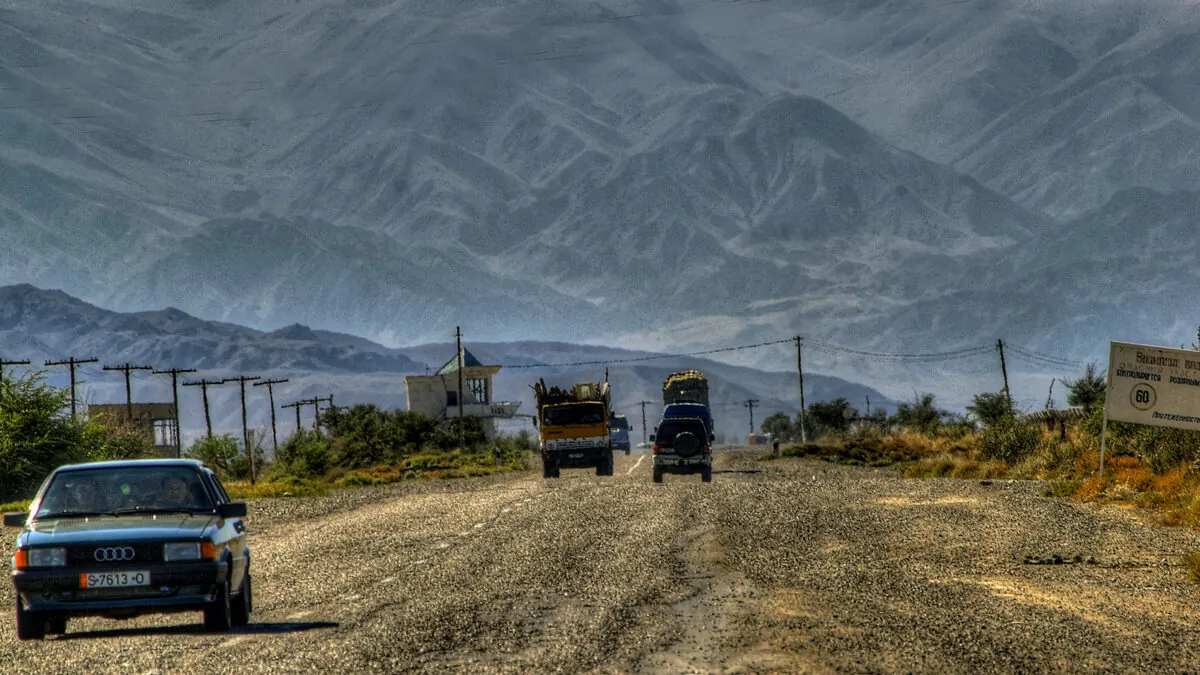
Kyrgyzstan splits down the middle, and not just on the map. The north (Bishkek, Lake Issyk-Kul, and the Tian Shan treks) is the polished, easy, mountain-lake half most visitors see. The south — Osh, Arslanbob, and the old Silk Road towns — is hotter, more traditional, and more Central Asian in feel, with tougher logistics and fewer tourists. Which half suits you depends on whether you came for alpine hiking or for culture, bazaars, and a slower, older rhythm.
The two are separated by a spine of high mountains that makes crossing between them a genuine journey — a full day by road or a short flight. That divide is why so many trips pick one side and go deep. But if you have the time, combining them gives you the country’s fullest picture: glacial lakes and walnut forests, ski-town cafes and Silk Road mosques, in a single loop.
The North: Lakes, Treks, and Easy Logistics
The north is Kyrgyzstan’s front door and its greatest hits. Bishkek is the capital and arrival point, a leafy Soviet grid of parks and bazaars where most trips begin. From there the north opens into the alpine terrain the country is famous for: Lake Issyk-Kul, the vast blue inland sea ringed by beaches, canyons, and hot springs; Karakol, the eastern trekking base; and the Tian Shan valleys that hold the classic routes.
This is where the trekking lives. The Ala-Kul lake trek over its turquoise-lake pass, the yurt-ringed shore of Song-Kul, and the hot-spring valleys near Karakol are all northern. So is the best transport infrastructure, frequent marshrutkas, good asphalt around Issyk-Kul, and the densest network of guesthouses and CBT coordinators. If you want mountains and want them accessible, the north delivers with the least friction.
The South: Silk Road, Walnut Forests, and Deep Tradition
The south feels like a different country, and in cultural terms it nearly is. It is centered on Osh, one of Central Asia’s oldest cities, with a bazaar that has traded for two thousand years and the sacred Sulaiman-Too mountain rising from its middle. The south is lower, hotter, more densely populated, and more traditionally Muslim and Uzbek-influenced than the north. Our Osh travel guide covers the city itself.
Beyond Osh, the south’s headline is Arslanbob, an Uzbek village wrapped in the largest walnut forest on earth, where autumn brings a communal harvest that has run for centuries. There are the Silk Road remnants, caravanserais, old trade routes, the caves and shrines of Sulaiman-Too — and the approach to the Pamir Highway for those heading on to Tajikistan. What the south lacks is the north’s density of alpine day-trips and its easy transport; distances are longer, roads rougher, and English rarer. You trade convenience for authenticity.
Which Half Suits Which Traveler
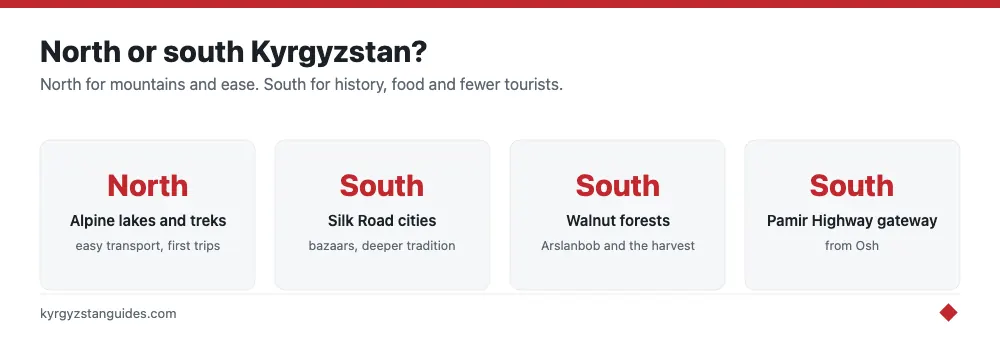
| You want | Go |
|---|---|
| Alpine lakes and multi-day treks | North |
| Easy transport, first trip | North |
| Silk Road cities and bazaars | South |
| Deep tradition, fewer tourists | South |
| Walnut forests and harvest culture | South (Arslanbob) |
| A gateway to the Pamir Highway | South (Osh) |
Put simply: the north is for hikers and first-timers who want mountains without much friction. The south is for travelers who prize culture, markets, and off-the-trail character, and who do not mind working a little harder to reach it. Neither is objectively better — they answer different questions.
Getting Between North and South
The mountains between Bishkek and Osh are the whole reason this is a real journey. You have two ways across.
The flight is the easy answer: Bishkek to Osh takes about 50 minutes and costs roughly $40–60, with several departures a day. For most travelers short on time, this is the sensible choice. It turns a grueling overland day into a coffee break. The road, by contrast, is an experience in itself: the Bishkek–Osh highway climbs over two high passes on a 10-to-14-hour drive by shared taxi or marshrutka. It's spectacular and exhausting in equal measure, subject to weather closures in the shoulder seasons, and best treated as a scenic adventure rather than mere transit. Many travelers fly one direction and, if they have a spare day and strong nerves, drive the other. Our getting around Kyrgyzstan guide covers the practicalities of both.
How to Combine Both in One Trip
If you have around two weeks, don't choose, link them. The cleanest loop flies you into Bishkek, works the north first (Issyk-Kul, Karakol, a trek or Song-Kul), then either flies or drives south to Osh, adds Arslanbob and the southern bazaars, and either flies back to Bishkek or continues onward into Tajikistan via the Pamir Highway.
Doing the north first is deliberate: it lets you acclimatize gently, get used to the country’s informal rhythm, and save the harder southern logistics for when you have found your feet. A rough split that works is eight to nine days north, four to five days south, with a flight between them to protect your time. If you would rather see it all mapped out day by day, our 2-week Kyrgyzstan itinerary runs a version of exactly this loop.
With only a week, pick one side. Nearly everyone should pick the north for a first visit. It packs more into short drives. Save the south for a return trip, or for the moment the north’s polish starts to feel too easy and you want the rawer half.
The Bottom Line
Go north if you want alpine lakes, big treks, and the smoothest possible trip. It is the right call for first-timers and for anyone whose Kyrgyzstan is really about the mountains. Go south if Silk Road cities, walnut forests, and lived-in tradition pull harder than another glacial lake, and you'll accept longer, bumpier days for it. And if you can spare two weeks, run the two together, north first, and let the flight or the high road between them be the trip’s hinge rather than a decision you had to make.
Frequently Asked Questions
Is north or south Kyrgyzstan better to visit?
It depends on what you want. The north, Bishkek, Issyk-Kul, and the Tian Shan treks, is better for alpine scenery, hiking, and easy logistics, making it the usual pick for first-timers. The south, centered on Osh and Arslanbob, is better for Silk Road culture, bazaars, and traditional life, with tougher transport and fewer tourists.
How do you get from north to south Kyrgyzstan?
Two ways: a 50-minute flight from Bishkek to Osh for about $40–60 with several departures daily, or a 10-to-14-hour drive over two high passes by shared taxi or marshrutka. Most travelers fly to save time, and some drive one direction for the scenery.
Can you visit both north and south in one trip?
Yes, and around two weeks is ideal. A common loop flies into Bishkek, covers the north first, then flies or drives south to Osh and Arslanbob before flying back or continuing into Tajikistan. Doing the north first helps you acclimatize before the harder southern logistics.
What is the south of Kyrgyzstan known for?
The south is known for Silk Road heritage — Osh’s ancient bazaar and the sacred Sulaiman-Too mountain. And for Arslanbob, the largest walnut forest on earth with its centuries-old harvest tradition. It is hotter, more traditional, and more Uzbek-influenced than the north, and forms the gateway to the Pamir Highway.
Is northern or southern Kyrgyzstan better for a first trip?
The north, for most first-timers: Bishkek, Issyk-Kul, Karakol, and the classic Tian Shan treks come with the best transport, good asphalt, and the densest network of guesthouses and CBT coordinators. Pick the south first only if culture, bazaars, and Silk Road history matter more to you than alpine hiking.
How do you travel between Bishkek and Osh?
Fly or drive. The flight takes about 50 minutes, costs roughly $40–60, and runs several times a day. The Bishkek–Osh highway crosses two high passes in a 10-to-14-hour shared-taxi or marshrutka ride — spectacular, exhausting, and weather-prone in shoulder seasons. Many travelers fly one way and drive the other.