Picture the trip: you land in Bishkek, your hotel wifi loads email but chokes on a video call, the cafe down the street is somehow faster than both, and then four days later you are on a jailoo where the nearest bar of signal is a hilltop twenty minutes’ walk away. That, compressed, is the entire Kyrgyzstan connectivity story, perfectly workable in towns, genuinely offline in the mountains, with cheap mobile data doing most of the heavy lifting in between.
The one-line strategy: buy a local SIM at the airport or in town, treat wifi as a bonus rather than a plan, and download everything you need offline before leaving the valley floor. Mobile data here is among the cheapest in the world, a few dollars buys tens of gigabytes, and 4G in populated areas is faster than most hotel wifi you'll encounter.
Wifi in Cities: Present, Unreliable, Beside the Point
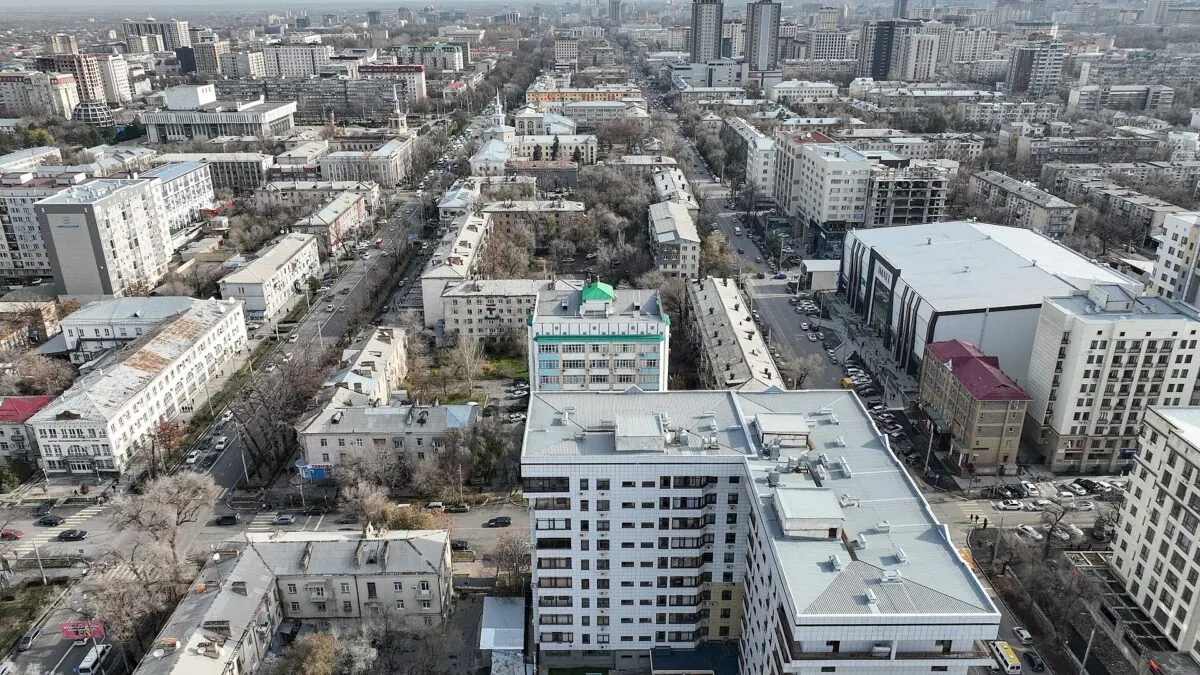
Nearly every guesthouse, hostel, and hotel in Bishkek, Osh, and Karakol advertises wifi, and nearly all of it works — until the evening, when every guest gets online at once and speeds crater. Expect anywhere from 5 to 50 Mbps in the capital on a good connection, less in smaller towns, with routers that reach the lobby convincingly and your third-floor room theoretically. Power cuts in smaller towns take the router down with them.
Cafes are the pleasant surprise. Bishkek has a genuine coffee-shop culture, Sierra, Adriano, and dozens of independents, where wifi is free, fast, and nobody hurries you out. Karakol’s traveler cafes follow suit. Our honest advice, though: stop auditing wifi networks. A local SIM makes the question mostly irrelevant.
Mobile Data Is the Real Internet Here
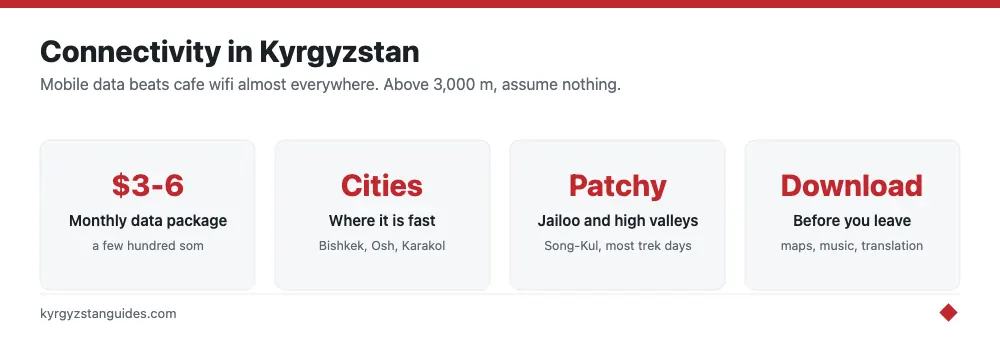
Kyrgyzstan runs on mobile data. Packages from the main operators — Beeline, O!, and MegaCom — cost a fraction of Western prices; think a few hundred som, roughly $3-6, for a monthly bundle measured in tens of gigabytes. 4G covers Bishkek, Osh, the Issyk-Kul shore towns, and the main road corridors well, and speeds in the capital regularly beat hotel wifi. Registration requires your passport and takes minutes at any branded shop.
Coverage between towns tracks the roads: the Bishkek-Karakol route around the lake is mostly covered, the Bishkek-Osh highway has gaps in the high passes, and side valleys drop signal fast. When comparing operators, the short version is that coverage outside cities varies more than price does. The full breakdown, including which operator does best around Issyk-Kul versus the south, is in our SIM guide linked at the end.
The Dead Zones: Treks, Jailoos, and High Valleys
Now the part that surprises people. Once you leave the road network, Kyrgyzstan goes dark quickly and completely. Multi-day treks — Ala-Kul, the Alay, anything in the interior, are offline for days at a time. Summer pastures where yurt stays happen mostly sit in valleys with zero signal; at some camps the owners can point you to the one ridge where a bar of Beeline appears, and that ridge becomes a small social scene at sunset. Remote destinations like Kel-Suu are entirely off-grid, drivers included.
Treat this as a feature with logistics attached rather than a problem. Tell people at home your silent windows in advance, so a three-day gap reads as an itinerary item rather than an emergency. If your situation requires constant reachability (family circumstances, on-call work) a satellite communicator like a Garmin inReach is the only honest answer, and serious trekking groups increasingly carry one anyway for safety.
Offline Prep: The 30 Minutes That Save Your Trip
Do this on your first night’s wifi, before any mountain leg:
- Download offline maps of the whole country — Organic Maps or Maps.me for trails, Google Maps offline areas for driving. Trail coverage on the OSM-based apps is remarkably good.
- Download the Russian offline pack in Google Translate (and Kyrgyz if offered). Camera translate works offline and rescues you at pharmacies and bus stations.
- Save your bookings, e-visa, insurance, and passport scans locally, not just in email.
- Cache music, podcasts, and reading: drives like Bishkek to Osh run 10-12 hours, as our transport guide explains.
- Note emergency numbers and your embassy contact somewhere paper.
Remote Work From Kyrgyzstan: A Frank Summary
Can you work remotely from Kyrgyzstan? From Bishkek, comfortably: fast home fiber in modern rentals, workable cafes, a small but real coworking scene, and time zones that overlap decently with both Europe and India. Karakol works for a lighter load — plan around mobile data with wifi as backup. Everywhere else, assume you are on hotspot from your phone, and that the mountains are for time off, not deadlines. Run video calls on 4G rather than guesthouse wifi and you'll have solved 80% of the problem.
Where Kyrgyzstan actually ranks
The Ookla global index for August 2026 puts Kyrgyzstan 79th in the world for mobile, with a median download of 51.77 Mbps, upload 13.70 and latency 20 ms. Fixed broadband ranks 91st at 89.17 Mbps down.
Regionally that is mid-table and falling behind: Kazakhstan 52nd at 89.11 Mbps, Uzbekistan 72nd at 65.27, Kyrgyzstan 79th at 51.77, Tajikistan 90th. Mobile subscriptions passed 7.8 million at the end of 2025, 1,060 per 1,000 people — more phones than inhabitants.
There is no 5G, whatever you read
Kyrgyzstan has no commercial domestic 5G network. Neither O! nor Beeline lists 5G among its deployed technologies; both run GSM, 3G and LTE only.
The history explains why. In March 2021 the communications agency shelved 5G trials and auctioned 2300 MHz licences to MegaCom instead. A Cabinet order of January 2024 planned 5G in the 3400-3750 MHz band via an auction to be held before October 2024; as of August that year the spectrum was still unsold, with around 350 MHz idle for eighteen months.
The confusion comes from roaming. Beeline launched 5G international roaming in August 2024 — that is 5G for Kyrgyz subscribers abroad, not 5G at home. Claims that an operator launched 5G domestically in 2024 appear on aggregator sites and are contradicted by the operators’ own technology lists.
Registration: the rule that changed in 2024
Two different registrations exist and they are easy to mix up.
SIM registration is by passport, at any branded shop, and takes minutes. If a number is not registered within 30 days of activation it goes onto a paid reservation at 20 som a day and is eventually disconnected.
Handset registration is the newer one. Since 25 June 2024, devices must be registered in the state identification system to work on a Kyrgyz network. The important exemption for visitors: a phone roaming on a foreign SIM does not need registering. It only applies if you put a Kyrgyz SIM in a handset brought from abroad, and it is done at imei.kg, with status checkable by dialling *5656#.
No biometric requirement exists in Kyrgyzstan. Biometric SIM registration from August 2025 is a Kazakh rule and gets transferred across the border in travel writing. It does not apply here.
O! offers an eSIM you can buy through its app before arriving, though it activates only once you are in the country, with a 30 GB signup bonus. Beeline offers 30 GB for seven days.
Coverage, and the gap nobody maps
Coverage is better than the terrain suggests. As of the first quarter of 2026, 13 of Kyrgyzstan’s 2,236 settlements had no mobile coverage at all. O! claims over 99.8% of population, MEGA over 99% of populated territory, and operators visibly upgrade for the Issyk-Kul season — O!’s July 2026 programme covered more than 200 settlements including Balykchy, Karakol, Cholpon-Ata, Tamga and Bokonbaevo.
But read that carefully: those are settlements. Operator coverage maps show villages and roads, not trails. No official source maps coverage on trekking routes, jailoos or high passes. Treat that as a documented gap rather than as reassurance, and plan a multi-day trek on the assumption of no signal.
One structural change worth knowing: Beeline Kyrgyzstan is no longer a VEON company. VEON completed the sale of its 50.1% indirect stake to state-owned Eldik Bank on 12 August 2025. MEGA is already 100% state-owned. Two of the three operators are now effectively state entities.
Starlink is live
This is new and genuinely changes the picture for remote work and remote valleys. Starlink operates under a presidential decree of 3 October 2025 on a pilot for non-geostationary satellite systems. Kyrgyzstan has shown as available on Starlink’s own map since 23 May 2026, with local infrastructure partner Elcat and the full active phase from 25 May.
The first connected site tells you what it is for: the school in the high-mountain village of Enilchek in Issyk-Kul region. Pricing and hardware cost in Kyrgyzstan I could not establish — Starlink’s own site serves nothing readable to an automated request — so check directly before planning around it.
Frequently Asked Questions
Is there wifi in yurt camps?
Almost never, and mobile signal is rare too. Most jailoo valleys are complete dead zones. A few commercial camps near Song-Kul advertise a signal point nearby, but plan every yurt night as fully offline and you'll never be caught out.
How fast is the internet in Bishkek really?
Good fixed connections and 4G both commonly test in the 20-50 Mbps range, plenty for video calls and streaming. The variance is the issue: evening congestion and aging routers can drag hotel wifi to a crawl while your phone’s 4G sails along.
Do WhatsApp, Instagram, and Google services work?
Yes. Kyrgyzstan doesn't operate a China-style firewall; WhatsApp is effectively the national communication channel, used by guesthouses, drivers, and guides alike. No VPN is needed for everyday services, though one is sensible on shared wifi anyway.
Should I buy a SIM at Manas Airport or wait?
Airport kiosks are legitimate and open for most arrivals, at a small markup over city shops. If you land at 3 a.m, grab one — the convenience beats the som you save waiting for a branded store in town the next day.
Will my foreign eSIM or roaming plan work?
Travel eSIMs (Airalo and similar) cover Kyrgyzstan but cost several times local prices for a fraction of the data, and roaming from Western carriers is worse still. They are fine as a landing bridge; switch to a local SIM for the trip itself.
Next step: sorting out that local SIM properly. Which operator, what it costs, and how registration works — is its own small topic, and we have covered it in detail in our Kyrgyzstan SIM card guide. Read that before you fly and your connectivity planning is done.