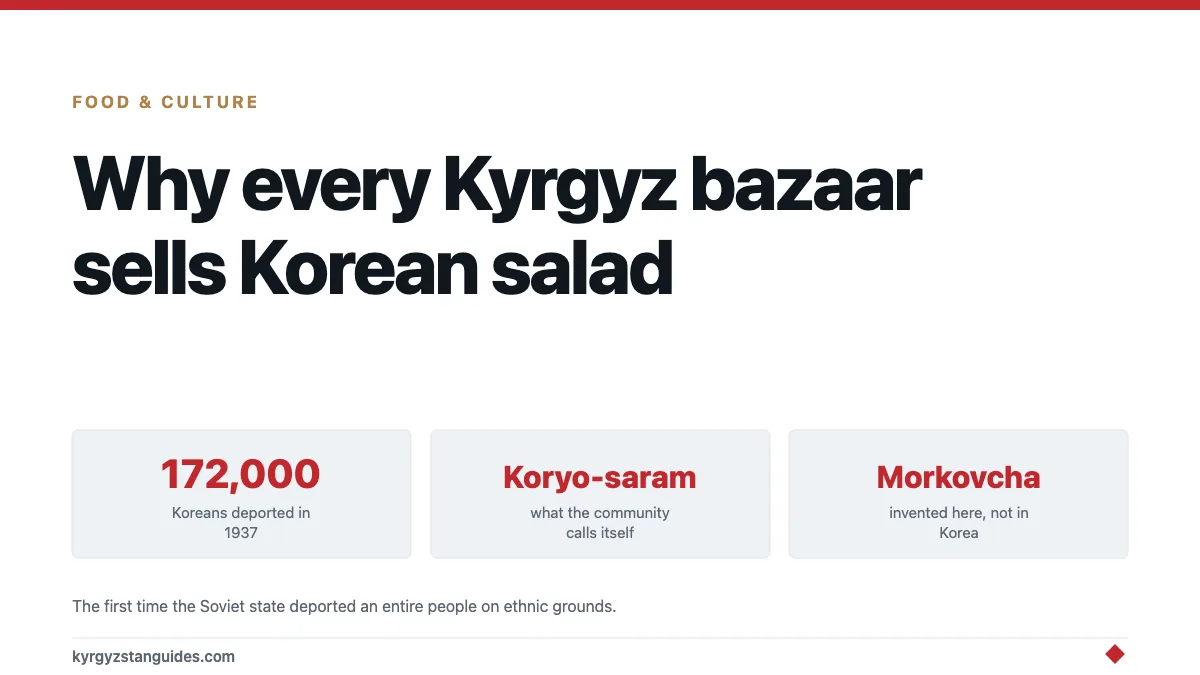
Walk into any bazaar in Kyrgyzstan and somewhere along the food rows there will be a stall of shredded carrot in chilli and garlic, seasoned aubergine, pickled cabbage, spiced beans, sold by the scoop, eaten by everyone, and universally called Korean salad. It's not a recent food trend. It's the visible remainder of a deportation that emptied the Soviet Far East of its Korean population in 1937.
Around 172,000 people were moved. The salad is what is left where the story is not told.
What happened
Koreans began settling in the Russian Far East from the 1860s, leaving drought and famine at home for farming and fishing ground in Primorsky and Khabarovsk. By the 1930s these were established communities, several generations deep, and Soviet citizens.
In 1937 a joint Soviet government and Party decree ordered them removed. The stated reasoning was strategic: Japan was already skirmishing with the Soviet Union along the Manchurian border, and an ethnically Korean population on that frontier was recast as a potential channel for Japanese espionage. The deportation moved 171,781 people — 36,442 families, carried in 124 trains. From the Far East into the Kazakh and Uzbek Soviet republics, under a decree dated 21 August 1937.
Historians identify it as the first time the Soviet state deported an entire people on the basis of ethnicity alone. Others followed (Chechens, Crimean Tatars, Volga Germans, Meskhetian Turks) and Central Asia is where most of them arrived.
They were put down, in many cases, on open steppe before winter, and told to farm it.
What happened after the trains stopped
The deportation is the part that gets told. What came next is the part that explains why these communities are where they're now.
Arrivals were settled on land nobody was farming, given little, and placed under restrictions on movement that were not lifted for years. A great many died in the first winters. Those who came through it did so by farming, and specifically by being very good at it, since rice and irrigated vegetable growing were skills the Far East communities already had and the steppe republics badly needed.
Korean collective farms in Central Asia became known for their output, which is a bleak sort of success: a people deported as a security threat then held up as model Soviet workers. The Times of Central Asia's account of the deportation works through what the record does and doesn't support about that period.
Education was the other route, and the community's concentration in professions (medicine, engineering, academia) dates from that generation's decision about what would be portable if everything else could be taken away again.
Koryo-saram
The community calls itself Koryo-saram — Koryo people, after an older name for Korea. The name matters because it marks them as something distinct from both Koreans in Korea and the Soviet state that moved them.
Their language, Koryo-mar, descends from the northeastern Hamgyong dialects rather than from modern standard Korean, and it has been steadily displaced by Russian across the generations. Most Koryo-saram today speak Russian as a first language.
After 1991 a community that had existed inside one country found itself divided between Kazakhstan, Uzbekistan, Kyrgyzstan, Russia and the rest, as Novastan's account of how Central Asia became home sets out. Kyrgyzstan's Korean population is smaller than Uzbekistan's or Kazakhstan's, concentrated around Bishkek and the Chuy valley.
The food, and why it isn't Korean food
This is the part travellers actually encounter, and it's worth getting right.
What's sold as Korean salad in a Kyrgyz bazaar — morkovcha, the carrot one, above all — wouldn't be recognised in Seoul. It was developed in Central Asia by people making do: Korean technique and palate applied to what the Soviet supply chain actually provided. No napa cabbage for proper kimchi, so carrots. Limited access to Korean chilli, fish sauce, the rest.
So morkovcha is a Central Asian dish invented by Koreans, which is a more interesting thing than a transplanted one. It spread far beyond the community, and it is now simply what people here eat, sold in Russian and Kyrgyz markets from Bishkek to Moscow.
You'll meet it at every bazaar on our Kyrgyz food guide route, and alongside the Dungan and Uighur cooking that arrived by other routes, our Dungan guide covers a migration with a similar shape and an earlier date.
The new connection
Since the 1990s the traffic has partly reversed.
South Korea's economy pulled labour migrants from across the former Soviet space, Koryo-saram included, on visa arrangements that recognise ethnic ancestry. Families that hadn't seen Korea for a century began sending people back to work in it: as factory hands and care workers, mostly, and often finding themselves treated as foreigners with an awkward accent rather than as returning kin.
Korean churches, businesses and language schools have come the other way into Bishkek. So has the food, which is why the city now has both kinds of Korean cooking: the bazaar salads that were invented here, and restaurants serving what Seoul actually eats.
There is a whole identity argument running inside the community about which of those is theirs, and it isn't settled.
What there's to see
Very little that is packaged, which is true of most of these communities.
There's no Korean quarter in Bishkek, no museum, no heritage trail. What exists is a community integrated into the city, businesses, restaurants, a cultural association, churches, and the bazaar stalls.
Korean restaurants in Bishkek are worth seeking out and are a different proposition from the bazaar salads: proper Korean cooking, often run by more recent arrivals from South Korea rather than by Koryo-saram, and among the better non-Central Asian eating in the city.
The bazaars are the real encounter. Osh Bazaar in Bishkek has the salad rows, and so does every regional market of any size.
Ask, carefully. Koryo-saram families are not hard to meet in Bishkek and the history isn't a secret, but it is family history involving deportation and it isn't small talk.
Why this belongs in a travel guide
Because it changes what you're looking at.
Kyrgyzstan gets described as a nomadic country, and that is true of the Kyrgyz. But the population you actually move through includes Uzbeks in the south, Russians in the north, Dungans and Uighurs from China, Koreans from the Pacific coast, and what remains of German settlements — most of them here because of movements they didn't choose.
Our history for travellers puts the sequence together. The short version is that a bowl of carrot salad on a market counter is a hundred and fifty years of somebody else's displacement, and it costs about 50 som.
FAQ
Why are there Koreans in Kyrgyzstan?
Because of the 1937 Soviet deportation, when around 172,000 Koreans were forcibly moved from the Russian Far East to Central Asia on Stalin's orders. Communities ended up across Kazakhstan, Uzbekistan and Kyrgyzstan, and were divided between countries when the USSR dissolved.
What is Koryo-saram?
The self-description of post-Soviet Koreans — Koryo people, from an older name for Korea. Their language, Koryo-mar, derives from northeastern Korean dialects, though most speakers now use Russian as a first language.
Is Korean carrot salad actually Korean?
No. Morkovcha was created in Central Asia by deported Korean communities using what Soviet supply chains provided — carrots instead of napa cabbage, local chilli and garlic. It's a Central Asian dish of Korean origin, and it wouldn't be recognised in Korea.
Where can I try Korean food in Kyrgyzstan?
Bazaar stalls everywhere sell the salads by weight. For proper Korean cooking, Bishkek has restaurants, many run by more recent arrivals from South Korea, and they're among the better non-Central Asian options in the city.
Why did Stalin deport the Koreans?
The official justification was strategic — fear that an ethnically Korean population on the Manchurian frontier could aid Japanese espionage during Soviet-Japanese tensions. Historians treat it as the first Soviet deportation of an entire people on ethnic grounds.
Is there a Korean neighbourhood in Bishkek?
No. The community is integrated across the city rather than concentrated, with businesses, restaurants and cultural organisations rather than a defined quarter. The bazaars are where most visitors encounter the legacy.