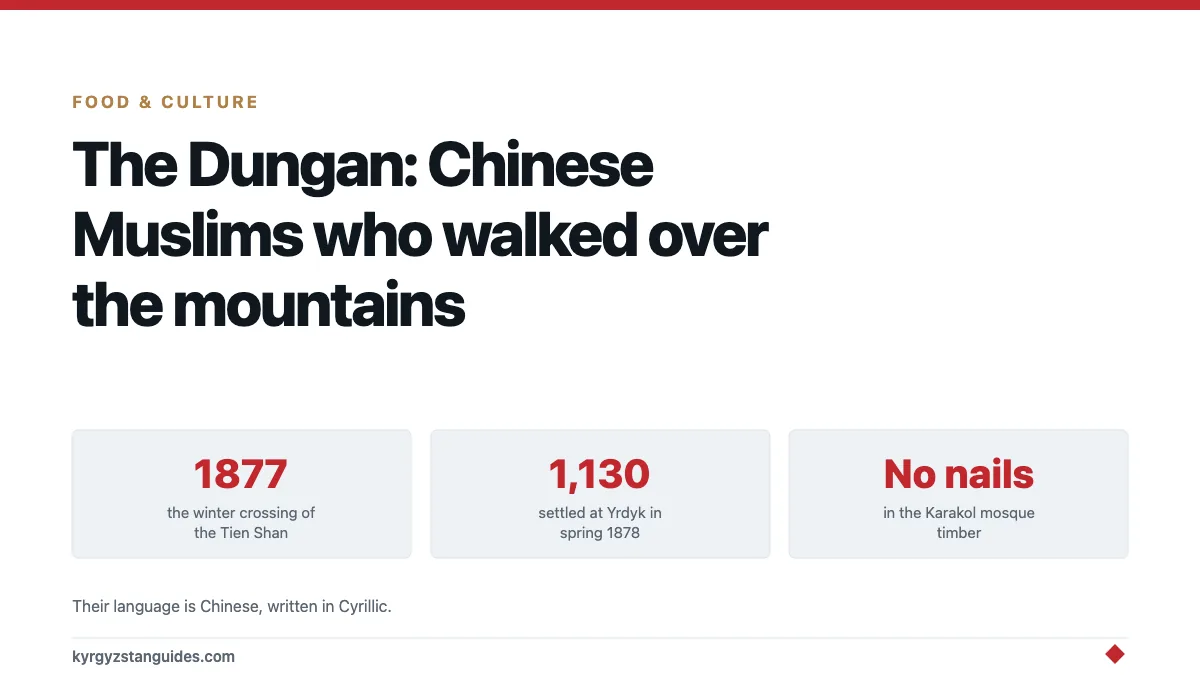
The Dungan are Chinese-speaking Muslims whose ancestors crossed the Tien Shan on foot in the winter of 1877–78, fleeing the collapse of a failed revolt against the Qing empire, and their descendants still farm the valleys east of Karakol. If you eat ashlan-fu in Kyrgyzstan, or stand in the mosque in Karakol that was built without a single nail, you are looking at the consequences of that walk.
What they cook is the most visible trace of it: ganfan and ashlyanfu are on menus across the country. It's one of the more remarkable migration stories in Central Asia and it barely appears in English-language travel writing about the country.
What they were running from
Between 1862 and 1877 a series of uprisings by Chinese-speaking Muslims broke out across the northwest of the Qing empire — Shaanxi, Gansu, and later Xinjiang. The revolts were crushed. The reprisals that followed were severe enough that surviving communities chose the mountains over staying.
The escape happened in three separate groups, through the Tien Shan, in what was by all accounts an exceptionally hard winter. Crossing those passes in summer with modern gear is a serious undertaking; doing it in winter, with families, fleeing an army, is a different category of thing entirely. Losses were heavy.
The first group reached Karakol in November 1877. A second group under Ma Yusuf was settled the following spring at Yrdyk, about 15 kilometres from Karakol, and the record puts their number on arrival at 1,130 people. Other families settled at Deishan nearby.
They arrived in what was then Russian Turkestan, and the Russian administration — reasoning that skilled farmers were an asset — let them stay.
The mosque that has no nails in it
The Karakol mosque is the single most visible thing the Dungan built, and the story behind it explains what it looks like.
The community commissioned a Chinese master builder, Zhou Si, who arrived with a team of around thirty craftsmen. Construction took three years. The result is a mosque that reads, at first glance, as a Chinese temple (upswept eaves, painted timber, a colour palette nobody else in the region was using) and its wooden structure was assembled using traditional joinery without a single nail, which is the detail every guide leads with and which has held for well over a century.
Worth being clear about the geography, since it gets muddled: this mosque is in Karakol, at the eastern end of Issyk-Kul. It's not in Tokmok, and our Tokmok guide says so too, because the confusion is common enough to send people to the wrong end of the country.
It's still a working mosque. Visitors are welcome outside prayer times, dressed appropriately, and there's no ticket booth or organised tour. It sits in a residential street and you walk up to it. Our Karakol guide covers the rest of the town.
What survived, and what didn't
The interesting question about any refugee community 150 years on is what it kept.
Language survived. Dungan is a Chinese language. Descended from the northwestern Mandarin dialects the community brought with them, and it's still spoken at home. What changed is the writing: cut off from China, the Dungan ended up writing their Chinese in Cyrillic, which makes Dungan the only Chinese language routinely written in a Cyrillic alphabet. Read a Dungan newspaper and you are looking at Chinese in Russian letters.
Food survived, and it travelled further than the community did. Ashlan-fu, cold noodles with starch jelly in a sharp chilli-vinegar broth, is Dungan, and it's now eaten by everyone in Karakol and well beyond. Our guide to ashlan-fu covers where to eat it properly. Dungan cooking more broadly sits behind a fair amount of what a visitor thinks of as generic Central Asian café food.
Farming survived. The Dungan arrived as intensive vegetable growers in a region that mostly herded, and that specialisation held. Their villages still supply a disproportionate share of the produce on Issyk-Kul's markets.
What has thinned is isolation. Intermarriage, Russian-language schooling and work migration have all done what they do, and younger Dungan speak Kyrgyz and Russian as readily as Dungan. The community is estimated in the low tens of thousands in Kyrgyzstan.
A note on the name
"Dungan" is what everyone else calls them. It's a Turkic-derived exonym that came into Russian and then into English, and it's the word you'll see on every sign and in every book.
Within the community the older self-description is closer to Hui, the same term used for Chinese-speaking Muslims inside China today, which is the clearest signal of where these families came from. Writing on the community's Chinese roots makes the continuity plain: the Dungan of Kyrgyzstan and the Hui of Gansu are branches of the same population, separated by a border and a century and a half.
Nobody will be offended if you say Dungan. It's simply worth knowing that the name arrived from outside, the way a lot of names in this region did.
Visiting, and doing it decently
There's no Dungan museum, no cultural show, no organised way in. These are working villages where people live.
What you can reasonably do: visit the Karakol mosque. Eat ashlan-fu at the Karakol market, where the stalls are Dungan-run. Buy vegetables at Yrdyk if you happen to pass. Ask a Karakol guesthouse if anyone in the family has Dungan relatives, in that town a good number do, and you'll get a better answer than any article gives you.
What not to do is turn up in Yrdyk with a camera looking for photogenic ethnic subjects. It's a farming village of ordinary houses, and the people in it are not an attraction.
Why this is worth knowing before you travel
Because it changes how you read the country.
Kyrgyzstan is easy to arrive in thinking "nomads, mountains, yurts". Then you find a Chinese mosque at the far end of a Russian-founded town, a noodle dish that is nobody's idea of Kyrgyz food, and villages where the kitchen language is a Chinese dialect written in Cyrillic. The Dungan are one of several communities that make the simple story wrong, alongside the Uighurs, the Russians, the Koreans deported here under Stalin, and what's left of the German settlements.
Our guide to Kyrgyzstan's history for travellers fits these pieces into the wider sequence.
FAQ
Who are the Dungan people?
Chinese-speaking Muslims descended from communities who fled northwest China after the failed revolts of 1862–1877. They crossed the Tien Shan in the winter of 1877–78 and settled in what's now Kyrgyzstan and Kazakhstan, mainly around Karakol and the Chuy valley.
Why is there a Chinese-style mosque in Karakol?
The Dungan community that settled there commissioned a Chinese master builder, Zhou Si, who came with about thirty craftsmen. It took three years, and the timber structure was assembled with traditional joinery rather than nails. It's still a working mosque.
What language do the Dungan speak?
Dungan, a Chinese language descended from northwestern Mandarin dialects. Cut off from China, the community adopted the Cyrillic alphabet, making Dungan the only Chinese language normally written in Cyrillic. Most speakers also use Kyrgyz and Russian.
Is ashlan-fu a Dungan dish?
Yes. Ashlan-fu is Dungan in origin (cold wheat noodles and starch jelly in a chilli-and-vinegar broth) and has become a Karakol speciality eaten by everyone, whatever their background.
Where do the Dungan live in Kyrgyzstan?
Mainly around Karakol at the eastern end of Issyk-Kul, including the villages of Yrdyk and Deishan, with further communities in the Chuy valley. Yrdyk was settled in spring 1878 by a group of about 1,130 arrivals.
Can tourists visit a Dungan village?
You can pass through, but there's nothing set up for visitors. No museum, no cultural programme. The mosque in Karakol and the Dungan food stalls at the market are the realistic points of contact. The villages themselves are people's homes.