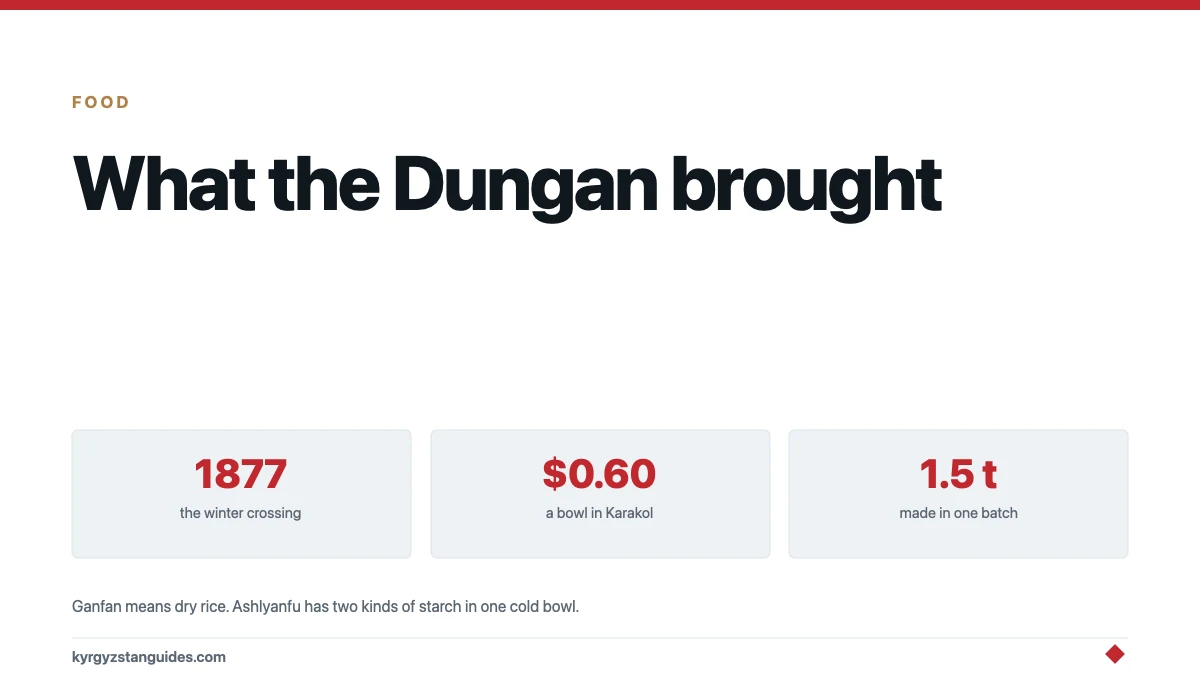
Ganfan means "dry rice". That is the whole dish in its name: steamed white rice with a separately cooked sauce ladled over it, rather than the soup version, suyfan. The sauce is a stir-fry of beef, lamb or chicken with onion, tomato, peppers, cabbage and carrot — close to the topping that goes on laghman, but over rice instead of noodles.
If you have eaten in Kyrgyzstan you have probably eaten Dungan food without being told so. Two dishes in particular, ganfan and ashlyanfu, came here with refugees who walked over the Tien Shan in the winter of 1877–78, and they have been on Kyrgyz menus ever since.
This is about those two dishes, the people who brought them, and where to eat them. Our post on the Dungan people covers the community itself, and the laghman guide handles the noodles.
Ashlyanfu, and why Karakol
Ashlyanfu is a cold dish with two starch components in the same bowl, which is what makes it odd and what makes it good.
There are hand-pulled starch noodles, and there is a separate jellied starch — a crystalline mung-bean or potato-starch jelly, cut into pieces. Both go into a dressing of vinegar and chilli oil. Karakol vendors add egg and chopped herbs, and the standard accompaniment is a fried potato pastry, a pirozhok, eaten alongside.
The name is a compound: ash, food, plus liang-fen, the Chinese name for a cold starch-jelly dish. The account I found says the dish began as plain starch jelly in vinegar and chilli and only became ashlyanfu once the noodles joined it. That etymology comes from a single travel-media account rather than a linguistic source, so treat it as likely rather than settled.
Karakol is the place because that is where the Dungan settled. Refugees from the failed Hui rebellion in northwest China came over the mountains in 1877–78 and took up land in villages immediately around the town — Yrdyk, Alexandrovka — and Karakol has been the demographic and culinary centre of the community ever since. The town's central bazaar has an ashlyanfu row with dozens of competing stalls.
The dish has become a civic identity. For Karakol's 150th anniversary on 10 July 2019, ten chefs made a 1.5-tonne batch of ashlyanfu and served it free to roughly 4,000 people — the country's second run at an oversized-national-dish record, after a 1.4-tonne beshbarmak in 2018 and a 117-metre chuchuk sausage in Bishkek. There is also a dedicated Ashlyan-fu festival in the town.
One thing I checked rather than assumed: ashlyanfu is not on any heritage list I could find, UNESCO or national. Kyrgyz food does appear on the UNESCO lists — the multinational flatbread element from 2016, and maksym from 2025 — but nothing Dungan. I searched specifically for it. Absence of a listing in my search is not absolute proof of no listing, but nobody should be telling you this dish is UNESCO-protected.
The walk that brought it here
The Dungan are Hui, Chinese Muslims, and they left after the Hui rebellion of 1862–1877 failed. The scale of what they were leaving is part of why they left in winter: roughly a million Dungans killed and more than 800 mosques burned, by the summary Global Voices gives of the historical record.
Three groups crossed, around 5,000 people in total, in an exceptionally hard winter:
| Group | Origin | Led by | Settled |
|---|---|---|---|
| ~1,000 people | Turpan, Xinjiang | "Ma Daren" | Osh |
| 1,130 on arrival | Didaozhou, Gansu | ahong Ma Yusuf | Yrdyk, 15 km from Karakol, spring 1878 |
| 3,314 on arrival | Shaanxi | Bai Yanhu | Karakunuz, now Masanchi — in modern Kazakhstan |
The arrival counts are recorded. The death toll is not, and I want to be careful here because the figure gets thrown around. One widely repeated account says two-thirds of the refugees died crossing; other tellings say fewer than half who set out survived. I could not find a primary academic source giving a single authoritative number. The honest statement is that roughly a third to a half of those who started the crossing survived it, and that the precision beyond that is not there.
How many Dungans are there now
Also disputed, and worth showing rather than averaging:
| Source | Figure |
|---|---|
| National Statistical Committee ethnic breakdown, start of 2021 | 1.14% of the population — roughly 74,000–77,000 |
| 2021 census figure circulating in aggregated results | ~76,573 |
| Global Voices, 2024 | ~60,000 in Kyrgyzstan (30,000 Kazakhstan, 10,000 Uzbekistan) |
| Joshua Project, a missions demographic database | ~83,000 |
Call it 60,000 to 83,000, clustering around 75,000. I could not open the primary census table directly — the statistics committee PDF would not extract as readable text — so nobody should take a precise figure from me here.
What is worth noting is the direction. Between the 2010 and 2022 censuses the Dungan population grew from 58,100 to 66,500 while the Uyghur population fell 35 per cent, from 48,500 to 31,600. Both communities are central to noodle cooking here and they are moving opposite ways.
What else Dungan kitchens make
Beyond ganfan and ashlyanfu, two dishes are documented:
Sanzy — a fried Dungan pastry, sold by the same Karakol vendors who sell ashlyanfu.
The eight bowls — a ceremonial dish, tripe soup served with eight different kinds of meatball, one type per bowl, with fried bread. This is feast cooking, not something you will find on a bazaar stall.
And the broader point: Dungan and Uyghur kitchens are where the vegetables are in Kyrgyz food. The pastoral Kyrgyz core of the national cuisine is meat, dough and dairy. If you want a plate with capsicum, tomato and cabbage on it, you are eating something a Chinese Muslim family brought here, which is also why our vegetarian guide keeps pointing at the same restaurants.
What it costs and where to eat it
At Karakol's bazaar, reporting from RFE/RL's Current Time put a serving of ashlyanfu at roughly $0.60 and the fried potato pastry at about $0.18, with named vendors including Elvira Alimova, who is from Yrdyk, and Malika Jumazova, who also sells sanzy. Those prices are from 2021 and will have moved, but the order of magnitude is right: this is street food, not a restaurant dish.
For something structured, Destination Karakol runs a Dungan Village family dinner in Yrdyk at 1,400 som per person, including a small Dungan museum and a hands-on ashlyanfu lesson, with an English-speaking guide an extra 800 som for the group.
In Bishkek, ganfan turns up on the menu at most Dungan and Uyghur cafés, usually next to the laghman.
The mosque, and a claim worth handling carefully
Karakol's Dungan mosque was built between 1907 and 1910. A architect from Beijing, Zhou-Sy, was invited in 1907 and worked with a team of around twenty — roofers, masons, woodcarvers — spending three years preparing materials before the building went up. Tien Shan fir, elm and local poplar, with walnut for the carved interior. Local masters did the foundations and stonework; the Chinese team did all the timber. Zhou-Sy drew the ornament onto the wood and his assistants cut it immediately.
It looks like a Buddhist temple, which is the thing everyone says and is true: curved eaves, carved columns, bright paint.
Now the claim. Everybody, including this site, writes that it was built without a single nail. I went looking for a heritage, restoration or engineering source confirming it and did not find one. Every source that states it is a tourism page repeating the same sentence. The claim is entirely plausible — traditional Chinese timber framing genuinely works by mortise and tenon — but "plausible and universally repeated" is not the same as "verified", and I would rather tell you that than keep passing it along as established fact.
FAQ
What is ganfan?
Steamed white rice topped with a separately cooked sauce of stir-fried meat, onion, tomato, peppers, cabbage and carrot. The name means "dry rice", as opposed to suyfan, the soup version. It uses much the same topping as laghman, served over rice instead of noodles.
What is ashlyanfu made of?
Two starch components in one cold bowl: hand-pulled starch noodles and a separate jellied mung-bean or potato starch cut into pieces, dressed with vinegar and chilli oil. Karakol versions add egg and chopped herbs, and it is normally eaten with a fried potato pastry on the side.
Why is Karakol famous for ashlyanfu?
Because Dungan refugees settled in the villages immediately around Karakol after crossing the Tien Shan in the winter of 1877–78, and the town has been the centre of the community ever since. Its central bazaar has a dedicated ashlyanfu row with dozens of competing stalls.
How many Dungans live in Kyrgyzstan?
Estimates range from about 60,000 to 83,000 depending on the source, clustering around 74,000–77,000 from the statistics committee's figure of 1.14 per cent of the population at the start of 2021. The community grew from 58,100 to 66,500 between the 2010 and 2022 censuses.
How much does ashlyanfu cost in Karakol?
About $0.60 a serving at the bazaar as reported in 2021, with a fried potato pastry around $0.18. A guided Dungan village dinner in Yrdyk with a cooking lesson runs 1,400 som per person, plus 800 som for the group if you want an English-speaking guide.
Is ashlyanfu a UNESCO heritage dish?
No listing turned up when I searched specifically for it, on either the UNESCO intangible heritage register or a Kyrgyz national list. Kyrgyz flatbread was inscribed in 2016 and maksym in 2025, but nothing Dungan, so treat any claim that ashlyanfu is UNESCO-protected with suspicion.
Was Karakol's Dungan mosque really built without nails?
It is said so everywhere, including previously on this site, but I could not find a heritage, restoration or engineering source that confirms it — only tourism pages repeating each other. The construction record itself is solid: built 1907–1910 by a Beijing architect named Zhou-Sy with about twenty craftsmen, from Tien Shan fir, elm and poplar with walnut carving.