Tokmok is the third-largest city in Kyrgyzstan’s north, yet almost no traveler stays the night — they come for the 11th-century Burana Tower 12 km south, and leave by dusk. That is the honest shape of a Tokmok visit: a low-slung industrial town about 60 km east of Bishkek that works best as the base for a half-day loop out to one of the country’s oldest standing monuments.
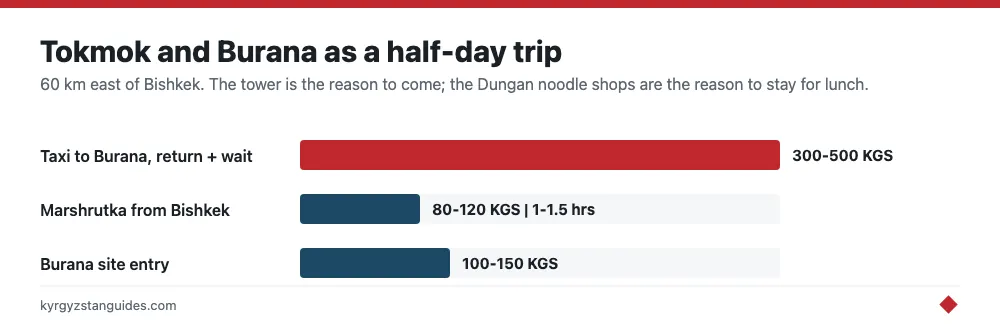
From Bishkek’s Eastern Bus Station, marshrutkas reach Tokmok in about 1 to 1.5 hours for 80–120 KGS, and from there a taxi covers the last stretch to Burana for 300–500 KGS round trip with a wait. If your time is tight, Burana is easily done as a Bishkek day trip without setting foot in the town center at all. But Tokmok itself rewards an hour: one of the country’s largest Dungan communities, the food that comes with it, and a Soviet-era street grid that tells its own story.
Why the town exists
Tokmok sits in the Chuy Valley on the Chu River, close to the medieval city of Balasagun — the Karakhanid capital whose only aboveground survivor is the Burana minaret. For centuries this was a Silk Road crossing where the road east toward the Boom Gorge and Issyk-Kul splits from the route north to Kazakhstan; the border is barely 20 km away. The modern town is a product of the Soviet 20th century, with a population of 73,433 at the 2022 census that includes a substantial community of Dungans, Chinese-speaking Muslims who arrived in the winter of 1877-78 after fleeing Qing China, alongside Russians, Uyghurs, and Kyrgyz. That mix shows up on the plate and in the architecture more than in any tourist brochure.
Burana Tower, the reason you came
The Burana Tower is a 25-meter brick minaret, originally closer to 45 meters before earthquakes took the top, dating to the 10th–11th centuries, all that clearly remains of Balasagun. Entry to the site runs about 100–150 KGS. You can climb the internal spiral staircase, which is steep, dark, and awkward enough that a phone torch and steady footing matter; the reward at the top is a 360-degree sweep over the Chuy plain to the wall of the Kyrgyz Ala-Too. At the base sits an open-air field of balbals (stone grave markers carved with faces, gathered from across the region) plus a small museum of Karakhanid coins and pottery. Allow an hour, more if you like ruins. Morning light is kinder for photos and the site is quietest before the Bishkek tour vans arrive around 11am.
Burana pairs naturally with other sights east of the capital, and if you are building a broader plan our things to do in Bishkek guide slots it into a day-trip circuit.
The Dungan town and its food
The genuine reason to enter Tokmok proper is its Dungan community — one of the largest in Kyrgyzstan, descended from Chinese-speaking Muslims who crossed the Tian Shan in the 1870s. That heritage is most alive on the plate: Tokmok’s ashlan-fu, laghman and hand-pulled noodle spots are considered some of the best in the Chuy Valley, and a bowl here costs 100–150 KGS. The town’s working mosques are modest, functional buildings serving the local community rather than sights in themselves — the famous pagoda-roofed Dungan Mosque built without nails is in Karakol, a six-hour drive east, not here. Come to Tokmok hungry rather than expecting monuments, and the stop makes sense.
Beyond that, the center is functional rather than charming: a bazaar, a Lenin statue that still stands, Soviet apartment blocks, and cheap canteens. The Dungan influence means the food is a highlight — look for hand-pulled ashlan-fu (cold spicy noodles) and lagman done the Dungan way, which locals will tell you is the real thing. If Central Asian noodle culture interests you, our Kyrgyz food guide explains where these dishes come from.
Getting there and moving on
Tokmok is a transport pivot. Marshrutkas and shared taxis run constantly between Bishkek’s Eastern Bus Station and Tokmok through the day; the ride is short and flat. Crucially, Tokmok is also where the highway forks: south and east through the Boom Gorge toward Balykchy and Issyk-Kul, or north to the Ak-Jol / Chon-Kapka crossing into Kazakhstan and on toward Almaty. Any Issyk-Kul-bound marshrutka out of Bishkek passes through or near Tokmok, so it doubles as a pickup point if you are already staying in the Chuy Valley. For the full picture of marshrutkas, shared taxis, and fare etiquette, see getting around Kyrgyzstan.
There is little reason to sleep here, Bishkek is an hour away with far more choice, but a couple of basic guesthouses and a Soviet-style hotel exist if you are crossing to Kazakhstan early and want to be near the border.
Our verdict
Tokmok isn't a destination; it is a doorway. Treat it as one and it delivers cleanly: catch an early marshrutka from Bishkek, taxi out to Burana for the tower and the balbal field, circle back into town for a Dungan lunch of ashlan-fu or laghman, and be home by mid-afternoon. If you are short on time, skip the town entirely and do Burana direct from Bishkek — you won't miss much. But if you have an extra hour and any curiosity about the Dungan story, a proper noodle lunch in town is worth the detour — and few visitors ever bother, which is exactly why it stays good.
A town that lost a quarter of itself and got it back
Tokmok's population line is the most interesting thing about it, and it is not in any guidebook. The census series runs: 58,655 in 1979, 72,927 in 1989, 59,409 in 1999, 53,231 in 2009, and 73,433 in 2022.
Read that again. The town lost roughly 18% of its people in the decade after the Soviet collapse, kept losing them into the 2000s until it was about 27% below its 1989 figure, and only got back to its 1989 size in the 2020s. Thirty-three years to return to where it started. The empty-feeling street grid and the oversized public buildings are not a design choice. They were built for a population that left and has only just come back.
At 74.3 thousand as of January 2023 in the National Statistical Committee's own yearbook, Tokmok is Kyrgyzstan's fifth-largest city, behind Bishkek, Osh, Jalal-Abad and Karakol.
The town has been founded, promoted and demoted more than most. It began as a Kokand khanate fortress around 1825-30; a Russian fortification went up on the ruins under Colonel Chernyaev's detachment on 13 May 1864. It received city status in 1867, lost it in 1878 when the district centre moved to Pishpek, which is now Bishkek, and got it back in 1927. Being overtaken by Bishkek is, in a real sense, the central fact of Tokmok's history.
Where the Dungans came from, and why they are here
The Dungan presence is not a vague historical drift. It is three specific groups of refugees who crossed in one appalling winter.
After the defeat of the Hui Muslim rebellions in northwest China between 1862 and 1878, roughly a thousand people from Turpan under Ma Daren reached Osh; 1,130 from Didaozhou in Gansu, led by the ahong A Yelaoren, reached Yardyk near Karakol in the spring of 1878; and the Shaanxi group under Bai Yanhu, who died in 1882, settled at Karakunuz. That village is now Masanchi, 8 km north of Tokmok across the Chu river, on the Kazakh side of what became an international border. Several hundred more Dungan families founded villages near Tokmok and in the Sokuluk valley through the 1880s.
At the 2009 census Tokmok was 46.8% Kyrgyz, 20.5% Russian, 16.5% Dungan and 8.6% Uzbek, with Tatars, Uyghurs, Kazakhs and Germans besides. Nationally the Dungan population reached 66,500 at the 2022 census, about 1% of the country, up from 58,100 a decade earlier. They are one of the few minorities that grew in absolute terms over a period when the Russian population fell from 419,600 to 282,800. That is why the food here is worth the detour: this is a community that stayed and expanded, not a remnant.
The glass town
The other thing Tokmok does is make glass. Interglass, the float-glass plant here, is described by the EBRD as the largest industrial glass producer in Central Asia, and the bank's involvement is the clearest measure of the scale: €5.5 million in 2004, €10 million in 2009 and a further €8 million in July 2011, the last of these for rebuilding and recommissioning the plant (the bank’s 2012 announcement describes a $10 million loan approved that July, which appears to be the same one). The refurbished furnace was relit in 2012.
You will not tour it and there is nothing to see as a visitor. But it explains the town: this is a working industrial place on the left bank of the Chu river, not a heritage site with a tower attached. Summers are hot, with a July maximum of 37 °C on the old records and a January minimum of −26 °C, so pick your month.
FAQ
Is Tokmok worth visiting?
For an hour, yes, mainly for Dungan food and as the base for Burana Tower 12 km south. It is a working industrial town, not a sight. Most travellers do Burana as a Bishkek day trip without stopping in the centre at all.
How big is Tokmok?
73,433 at the 2022 census, or 74.3 thousand as of January 2023 in the National Statistical Committee's yearbook. That makes it Kyrgyzstan's fifth-largest city, after Bishkek, Osh, Jalal-Abad and Karakol.
Who are the Dungans of Tokmok?
Chinese-speaking Muslims descended from refugees who fled the defeat of the Hui rebellions in northwest China in the winter of 1877-78. They made up 16.5% of Tokmok at the 2009 census, and 66,500 people nationally at the 2022 census.
What is there to eat in Tokmok?
Dungan food, which is the reason to stop. It is noticeably different from Kyrgyz cooking: more vegetables, more chilli and vinegar, hand-pulled noodles. Ask for the Dungan places rather than the canteens on the main road.
How do you get from Bishkek to Tokmok?
Marshrutkas from Bishkek's Eastern Bus Station take about 1 to 1.5 hours for 80-120 KGS. From Tokmok a taxi to Burana runs roughly 300-500 KGS return including waiting time. The straight waterway you cross on the way in is the Great Chuy Canal, dug by hand in 1941, and twenty minutes west of Tokmok, back toward Bishkek, the restored Buddhist temple at Krasnaya Rechka is another of the valley’s ancient sites and an easy stop on the return.
Is Tokmok the administrative centre of Chuy region?
Sources conflict on the formal designation, and in practice Bishkek functions as the regional seat. Treat any confident claim either way with caution.