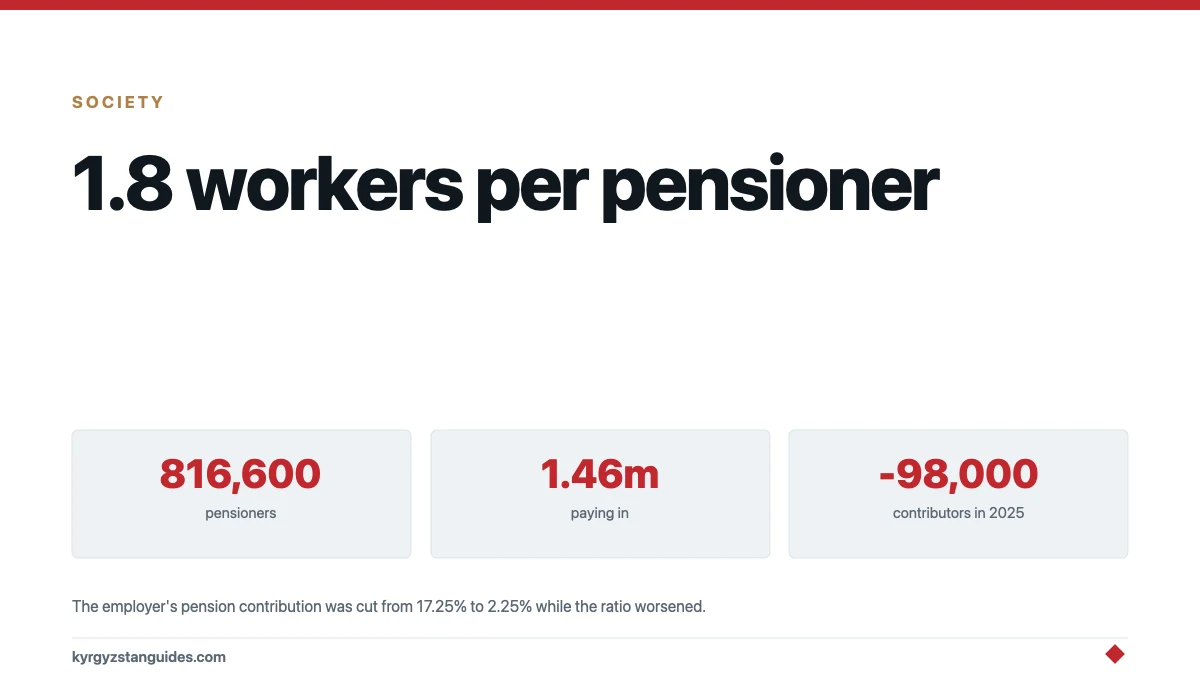
At the start of 2026 Kyrgyzstan had 816,600 pensioners and 1.464 million people paying social insurance contributions. That is 1.8 contributors per pensioner. The figure was put to parliament in September 2026 by MP Dastan Bekeshev, and the part that alarmed him was not the ratio itself but the direction: the number of people paying in fell by almost 98,000 during 2025 alone.
A pay-as-you-go pension system is arithmetic. Money comes in from people working now and goes straight out to people who have stopped. When the paying side shrinks while the receiving side grows, no amount of administrative reform fixes it.
This post is about how the Kyrgyz system actually works, what a pension is worth in cash, and the two facts that make the country's position unusual: a very young population that is nonetheless facing a pension squeeze, and roughly 880,000 citizens working abroad who mostly pay nothing into it.
What a pension is actually worth
From 1 October 2026 insurance pensions were indexed upward by 20 per cent, funded by 4.4 billion som and reaching more than 832,000 people. The increase was capped: at least 1,000 som and at most 10,000 som per person.
| After the October 2026 rise | Monthly amount |
|---|---|
| Average pension | 12,898 som (roughly $145) |
| Minimum old-age pension | 8,800 som |
| Base (flat) component of the insurance pension | 3,170 som, unchanged |
| Monthly social benefit, for people with no contribution record | 2,000–8,000 som by category, averaging 6,344.7 som |
The government justified the indexation with 2025 consumer price inflation of 108.2 per cent and average wage growth of 17.6 per cent, and the figures come from the Ministry of Labour and Social Protection and government-cited Social Fund data.
Two details matter more than the averages. First, disability and survivors' pensions are calculated on a different formula and can legitimately land below the 8,800-som minimum old-age pension, which surprises people who assume the minimum is a floor for everyone. Second, the 8,800 som minimum applies to people who meet both the age and the insured-record test.
For context on that 12,898 som average: in 2022 the average pension was 8,114 som, which the National Statistical Committee noted exceeded the poverty line of 7,178 som by 28.6 per cent. The pension in Kyrgyzstan is set to sit a little above subsistence, not comfortably above it.
Retirement ages, and the thing that is actually rising
Men retire at 63, women at 58. The Social Fund has said publicly it has no plans to change either.
What is changing is the contribution record you need. The minimum insured period is being raised in stages — six years from 2026, climbing toward twenty years by 2045. This is the quiet reform. Nobody has to defend raising the retirement age if the qualifying period does the same work. A person with a patchy record of formal employment, which describes a great many Kyrgyz working lives, may reach 58 or 63 and find they qualify for a social benefit rather than a pension.
Soviet service still counts. Wage certificates from any 60 consecutive months of work before 1 January 1996 can be used to establish the earnings-related part of the pension, which is how careers that straddle 1991 get valued at all. I found this described consistently in Kyrgyz explainers rather than in a primary legal text I could read directly, so treat the sixty-month mechanism as reliably reported rather than quoted from the statute.
The contribution cut nobody outside Kyrgyzstan noticed
Here is the part that changes how the dependency ratio should be read.
On 23 July 2024 the President signed a law cutting the total social insurance contribution rate from 27.25 per cent to 12.25 per cent, effective 1 August 2024. The cut fell almost entirely on employers. The Social Fund's own breakdown is:
| Who pays | Rate | Where it goes |
|---|---|---|
| Employer | 2.25% | Pension Fund 1%, Health Insurance Fund 1%, Employment Fund 0.25% |
| Employee | 10% | Pension Fund 8%, State Accumulative Pension Fund 2% |
The employer share went from roughly 17.25 per cent to 2.25 per cent. The employee now pays more than four times what the employer does into their own pension, which is unusual across the former Soviet space.
The reasoning was not fiscal recklessness. It was a bet on informality: employers were declaring low wages or no wages to dodge a 27 per cent charge, so cutting the charge to 12.25 per cent was meant to bring salaries out of the shadows and widen the base. Russian coverage of the change ran under the headline that wages would come out of hiding.
Whether the bet paid off is the open question, and the 98,000 lost contributors in 2025 is not an encouraging early answer. The reduction does not apply to budget-funded organisations, large mining licence holders, electricity, heat and gas suppliers, or alcohol and tobacco producers.
The 2 per cent accumulative component has existed since 1 January 2010. It is invested by the Social Fund within legally specified instruments, so it is a state-run funded tier rather than a private pension market.
A young country with an old-age problem
Kyrgyzstan is demographically young. In 2025 around 6 per cent of the population — over 440,000 people — was 65 or older, and the median age was 25.4 years. The UN classes the country as on the threshold of ageing rather than ageing, and projects it crosses that line around 2030. By 2050 the 65-plus share is projected at 10.1 per cent and the median age at 30.5.
So why the squeeze now? Because the pension problem here is not driven by longevity. It is driven by who is in the country and who is paying.
Births are already falling: 140,500 in 2025 against a 2019 peak of 173,500. And the gender split among pensioners is stark. At the start of 2023, men aged 63 and over numbered just over 197,000 — 5.7 per cent of the male population — while women aged 58 and over numbered over 430,000, or 12.1 per cent of the female population. Roughly 2.2 women draw a pension for every man. That gap comes from the five-year difference in retirement age stacked on top of a life-expectancy gap that was then 68.0 years for men and 76.3 for women.
The 880,000 who are not paying in
Around 880,000 Kyrgyz citizens are officially abroad, the great majority working in Russia. Most of them are prime contribution-paying age, and most contribute nothing to the Social Fund.
Two mechanisms partly address this.
The first is the EAEU pension agreement, signed 20 December 2019 and in force from 1 January 2021 across Russia, Kazakhstan, Belarus, Armenia and Kyrgyzstan. It does three things: it requires each member state to grant pension rights to citizens of the others on the same terms as its own nationals, it allows insured years earned in different member states to be added together to establish eligibility, and it sets up a way to export a pension earned in one state to a pensioner living in another. It is in real use — Kyrgyzstan's Social Fund has assigned pensions to EAEU citizens under it. The catch is that it only helps migrants in formal employment, and a large share of Kyrgyz labour in Russia is not.
The second is newer and aimed squarely at that gap. Since September 2026 migrants can take out a voluntary pension policy remotely, through the Tunduk app or the taxpayer cabinet, choosing a contribution tier of 10, 8 or 2 per cent of the previous year's national average wage and paying by card, with the data passed automatically to the Social Fund. No trip home required.
It is voluntary, which is the whole difficulty. A 28-year-old sending money to a family in Naryn is being asked to fund a pension forty years away instead of sending more this month.
What I could not establish
Being straight about the gaps: I could not find official data on elderly poverty rates in Kyrgyzstan, on whether pensioners predominantly live with family or alone, or on the rural-versus-urban split of pensioners. These would be the most useful numbers for understanding what a 12,898-som pension actually means in a household, and as far as I can tell they are not published. Nor is there any published breakdown of how many of the 880,000 citizens abroad contribute versus how many do not.
Why a traveller might care
Because it explains a household you will probably sit in. In a village guesthouse, the grandmother's pension is often the only predictable monthly money in the building — smaller than what the son in Moscow sends, but arriving on the same date every month regardless of whether construction work in Russia was available that month. Remittances are larger and shakier. The pension is small and certain. Both are holding the same roof up.
FAQ
What is the retirement age in Kyrgyzstan?
63 for men and 58 for women. The Social Fund has said it has no plans to change either age. What is rising instead is the minimum insured contribution period, which went to six years from 2026 and is legislated to climb toward twenty years by 2045.
How much is the average pension in Kyrgyzstan?
After the indexation of 1 October 2026, the average insurance pension is 12,898 som a month, roughly $145, and the minimum old-age pension is 8,800 som. Disability and survivors' pensions use a different formula and can be lower than that minimum.
How many pensioners are there in Kyrgyzstan?
816,600 at the start of 2026, against 1.464 million people paying social insurance contributions — about 1.8 contributors per pensioner. The number of contributors fell by almost 98,000 during 2025.
What do employers and employees pay into the Kyrgyz pension system?
Since 1 August 2024 the total rate is 12.25 per cent: the employer pays 2.25 per cent and the employee 10 per cent, of which 8 points go to the Pension Fund and 2 points to the State Accumulative Pension Fund. The total was cut from 27.25 per cent, with almost the whole reduction coming out of the employer's share.
Do Kyrgyz migrants working in Russia get a pension?
Only if their employment is formal. The EAEU pension agreement, in force since 1 January 2021, lets insured years from Russia, Kazakhstan, Belarus and Armenia be added to Kyrgyz years and lets a pension be paid across borders. Since September 2026 migrants can also buy a voluntary Kyrgyz pension policy remotely through the Tunduk app. Informal work abroad builds no entitlement in either country.
Does Soviet-era work count toward a Kyrgyz pension?
Yes. Wage certificates covering any 60 consecutive months of employment before 1 January 1996 can be used to calculate the earnings-related component, so pre-independence service is not lost. This is consistently described in Kyrgyz explainers rather than in a primary legal text I was able to read directly.
What happens to people with no work record at all?
They receive a monthly social benefit rather than a pension. It ranges from 2,000 to 8,000 som depending on category, averaged 6,344.7 som, and had 108,400 recipients as of 1 November 2025. Categories include elderly people without a qualifying record, children with disabilities and people disabled since childhood.