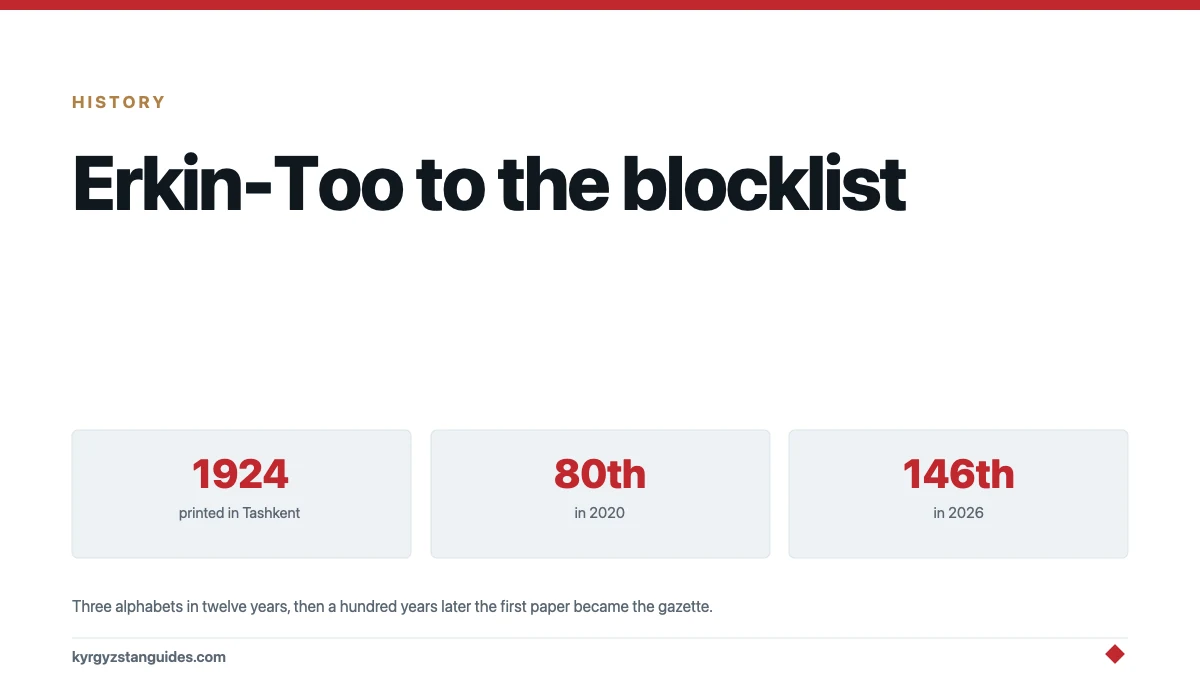
Kyrgyzstan ranked 80th in the world for press freedom in 2020. In 2026 it ranks 146th out of 180. That is a fall of about 66 places in six years, and it takes the country from being the regional outlier — the one Central Asian state with a genuinely contested media space — into Reporters Without Borders' "very serious" category alongside its neighbours.
This post is the long view: where the Kyrgyz press came from, what the alphabet changes did to it, and what has happened since 2023, with dates and sources rather than adjectives. Where a case is ongoing or its outcome disputed, I say so.
The first newspaper, printed in another country
Erkin-Too, "Free Mountains", was the first Kyrgyz-language newspaper. It first appeared on 7 November 1924 — and it was printed in Tashkent, because Kyrgyzstan had no printing infrastructure of its own. Kasym Tynystanov, who built the Kyrgyz alphabet, was among its founders, and the paper's appearance coincided with the 1924 standardisation of written Kyrgyz.
Its name changed with the politics: Kyzyl Kyrgyzstan, "Red Kyrgyzstan", from August 1927; Sovettik Kyrgyzstan, "Soviet Kyrgyzstan", from 1956; Kyrgyz Tuusu in 1991. The Erkin-Too name was later revived, and in June 2025 it was formally redesignated the State Official Newspaper of the Kyrgyz Republic. A century on, the first Kyrgyz newspaper is the government's gazette.
Russian-language press in the region came earlier. Turkestanskie Vedomosti, founded in Tashkent in 1870, was the first Russian-language newspaper in Russian Turkestan and ran until 1917. A regional counterpart, Semirechenskie Oblastnye Vedomosti, launched the same year in the Semirechye administrative centre, covering the oblast that contained Pishpek. I could not verify from a primary archive exactly how either covered Pishpek specifically.
Three alphabets in twelve years
This is the part people skip, and it matters more than it sounds.
A modified Arabic-based Kyrgyz alphabet was standardised around 1923–24. A Latin alphabet, developed under Tynystanov as part of the wider Soviet Uniform Turkic Alphabet project, was adopted in 1928. Cyrillic replaced it in 1940.
Each change reset publishing completely. Type had to be recut, primers reprinted, newspapers retypeset, and every literate adult partially re-taught. It also functioned as a filter: what had been printed in the previous script became inaccessible to the next generation of readers unless somebody chose to reissue it. Combine that with the 1937–38 purges, which killed Tynystanov himself, and the written record of the first Kyrgyz decade is thinner than the volume of publishing would suggest.
Soviet titles, and what survived
Sovettik Kyrgyzstan, later Kyrgyz Tuusu, was the main Kyrgyz-language party paper. Vecherniy Bishkek, founded as Vecherniy Frunze on 1 January 1974 as the newspaper of the Frunze city Communist Party committee, was renamed with the city in 1991, is now privately owned and is still publishing.
After 1991 Kyrgyzstan built the most open media landscape in Central Asia. By the start of 2020 it had roughly 1,800 registered media entities, up about 18 per cent over five years, including some 126 independent broadcasters, alongside print titles Kyrgyz Tuusu, Slovo Kyrgyzstana, Erkin-Too, Vecherniy Bishkek and Super-Info. The leading independent news outlets of the modern period are Kloop, Temirov Live, 24.kg, Kaktus.media and AKIpress — several of which appear again in the next section for reasons that are not about their journalism.
What has happened since 2023
Set out plainly, with dates.
Radio Azattyk, RFE/RL's Kyrgyz service, was blocked in October 2022 — site blocked, bank account frozen, programmes pulled from local affiliates — apparently over coverage of the September 2022 Kyrgyz-Tajik border clashes. A Bishkek court ordered its operations terminated on 27 April 2023. Access was restored after a 12 July 2023 court decision approving a settlement between the culture ministry and RFE/RL; the site was unblocked and the account unfrozen.
Kloop. A liquidation lawsuit began in August 2023 and the website was blocked that September. On 9 February 2024 a Bishkek district court ordered the Kloop Media Public Foundation liquidated, on the grounds that its charter did not list journalism as an activity. The Supreme Court upheld the liquidation on 16 July 2024 in a closed hearing, a final and unappealable decision. In October 2025 a court declared Kloop materials "extremist". In September 2025 two Kloop camera operators, Joomart Duulatov and Aleksandr Aleksandrov, were sentenced to five years on charges of calling for mass unrest, tied to arrests in January 2024.
Temirov Live. Eleven current and former staff of the outlet and its sister project were arrested in raids in January 2024, indicted for indirectly calling for mass unrest by discrediting the authorities. The October 2024 verdict sentenced director Makhabat Tajibek kyzy to six years and presenter Azamat Ishenbekov to five, gave two others three-year probation, and acquitted seven. The Supreme Court upheld those sentences on 25 February 2025.
Then it moved the other way. On 10 March 2026 the Supreme Court overturned Tajibek kyzy's six-year sentence and ordered a retrial, following sustained international pressure including a November 2025 statement from the UN Working Group on Arbitrary Detention. She had been the last Temirov Live journalist still imprisoned. She was released under a travel ban with hearings set for late August 2026. That case is ongoing and I am not going to predict its end.
The laws
2021: a "false information" law allowing authorities to block sites extrajudicially.
2024: a further false-information law signed by President Japarov, with fines around 100,000 som (roughly $1,175) for individuals and 200,000 som for legal entities. The Venice Commission found the draft had significant deficiencies risking self-censorship; CPJ urged a veto, which was not given. A foreign-agent law modelled on the Russian one followed the same year.
August 2025: a sweeping new Mass Media Law took force. All media including online outlets must register. Foreign ownership is capped at 35 per cent. Three warnings in one year triggers liquidation proceedings for content deemed to incite constitutional change or ethnic discord.
10 April 2026: implementing regulations adopted — mandatory registration and re-registration on any ownership or name change, 30-day notification of changes to address, phone, website, editor or passport details, and a publicly accessible register. A separate blogger-registration law targeting large-following accounts was reported as being drafted as of mid-2026; I could not establish that it has been enacted.
Two further 2025–26 items: the journalist and activist Kanyshay Mamyrkulova was convicted of inciting mass unrest over Facebook posts criticising Kyrgyz-Tajik border negotiations, receiving a four-year suspended sentence and a social-media publishing ban; and Human Rights Watch researcher Steve Swerdlow was denied entry to Kyrgyzstan in May 2026 without explanation.
Who owns the broadcasters
KTRK, the state broadcaster, runs six television and three radio channels with over 1,000 employees. Around $7.6 million is allocated from the state budget to public broadcasting, roughly three-quarters of it to KTRK. One analyst describes OTRK and Ala-Too 24 as functioning as a propaganda and agitation channel for the three branches of government.
Among private channels, NTS is widely reported to be owned by Omurbek Babanov, a former prime minister and opposition politician — one of the few significant privately held top channels, and an illustration of a pattern that runs through the sector: media ownership and political position are not separate things here.
What this means if you are visiting
Practically, very little day to day. The internet is broadly open, our post on media and internet access covers the current picture, and nobody is going to ask what you read.
What it changes is how you read about Kyrgyzstan. Several of the outlets that produced the best investigative reporting on this country in the last decade have been liquidated, declared extremist, or had staff imprisoned. When you cannot find recent independent reporting on a Kyrgyz subject, that is sometimes because it was not written, and sometimes because the organisation that would have written it no longer exists.
On this site, the practical consequence is that I lean on institutional sources, court records and the surviving outlets, and say when something could not be verified. That is a methodological choice with a political cause.
FAQ
What was the first Kyrgyz newspaper?
Erkin-Too, "Free Mountains", first published on 7 November 1924 — printed in Tashkent, because Kyrgyzstan had no printing infrastructure of its own. Kasym Tynystanov was among its founders. It became Kyzyl Kyrgyzstan in 1927, Sovettik Kyrgyzstan in 1956 and Kyrgyz Tuusu in 1991, and the revived Erkin-Too was made the state official newspaper in June 2025.
How did the alphabet changes affect Kyrgyz publishing?
Three scripts in twelve years — Arabic-based around 1923–24, Latin adopted in 1928, Cyrillic from 1940 — meant type had to be recut, primers reprinted and newspapers retypeset each time, while previously printed material became inaccessible to the next generation of readers unless deliberately reissued.
What is Kyrgyzstan's press freedom ranking?
146th of 180 countries in the 2026 Reporters Without Borders index, down from 144th in 2025 and 80th in 2020 — a fall of roughly 66 places in six years, moving Kyrgyzstan into the "very serious" category.
What happened to Kloop?
A Bishkek court ordered the Kloop Media Public Foundation liquidated on 9 February 2024 on the grounds that its charter did not list journalism as an activity, and the Supreme Court upheld this on 16 July 2024 in a closed, unappealable decision. Its materials were declared extremist in October 2025, and two camera operators were sentenced to five years in September 2025.
Is Radio Azattyk available in Kyrgyzstan?
Yes, since 2023. RFE/RL's Kyrgyz service was blocked in October 2022 and ordered shut on 27 April 2023, but a court approved a settlement with the culture ministry on 12 July 2023, after which internet providers restored access and its bank account was unfrozen.
What does Kyrgyzstan's 2025 media law require?
All media, including online outlets, must register with the authorities; foreign ownership is capped at 35 per cent; and three warnings within one year can trigger liquidation for content deemed to incite constitutional change or ethnic discord. Implementing regulations adopted on 10 April 2026 added re-registration duties, 30-day notification of changes and a public register.
Who owns the media in Kyrgyzstan?
The state broadcaster KTRK runs six TV and three radio channels with over 1,000 staff, funded by roughly three-quarters of the $7.6 million state public-broadcasting allocation. Among private channels, NTS is widely reported to belong to Omurbek Babanov, a former prime minister — media ownership and political position overlap substantially.