Kyrgyzstan spent thirty years as Central Asia's outlier — the one country in the region with a genuinely combative independent press. It's still the highest-ranked in the region on press freedom. It has also fallen further, faster, than almost anywhere on earth.
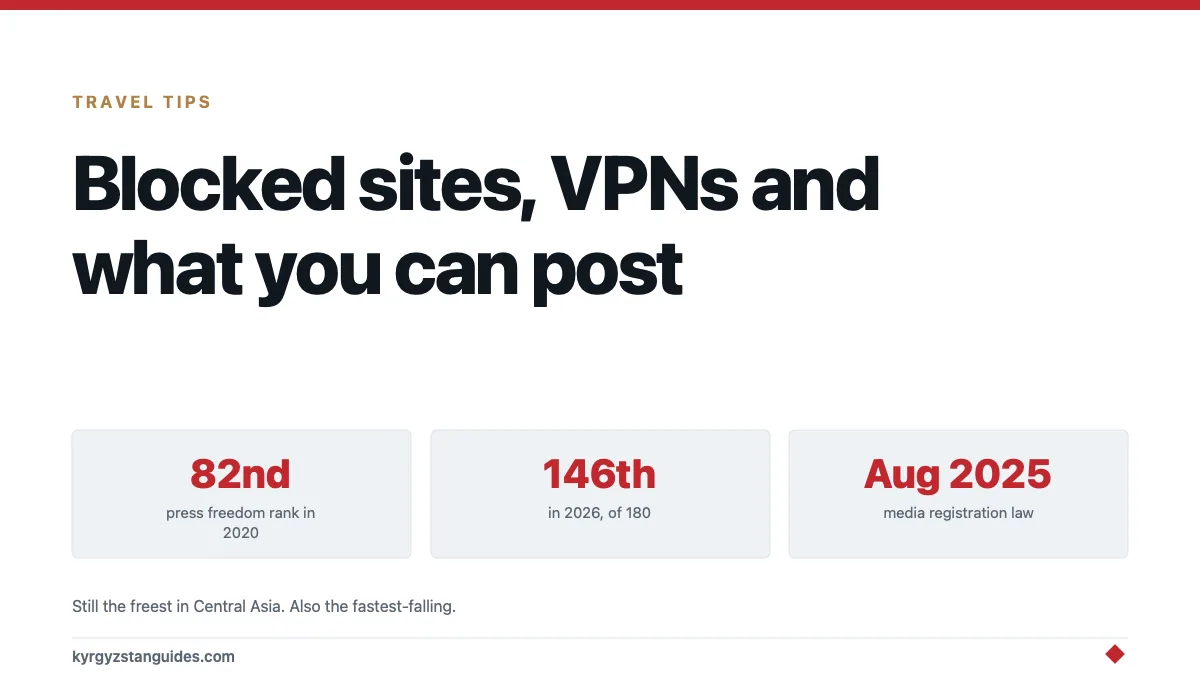
In 2020 Kyrgyzstan ranked 82nd of 180 countries in the RSF World Press Freedom Index. In 2026 it ranked 146th.
Our post on the history of the Kyrgyz press sets out how it got here, from 1924 onward. That is a drop of 64 places in six years, and it has practical consequences for a visitor: websites that do not load, a media law that affects who can publish, and a set of things it is unwise to post while you're here.
The numbers
| Year | RSF rank |
|---|---|
| 2020 | 82 of 180 |
| 2025 | 144 of 180 (down 24 in one year) |
| 2026 | 146 of 180 |
Even at 146, Kyrgyzstan is the highest-ranked country in Central Asia. Which tells you as much about the region as about Kyrgyzstan. RSF's country profile tracks the detail.
What has actually happened
A sequence of specific events rather than a general drift.
Kloop, one of the country's best-known investigative outlets, has been subject to blocking and legal action, and in 2025 it and its founder were designated "extremist" along with the YouTube channel Temirov Live and a related channel.
Bolot Temirov, the investigative journalist behind that channel, was expelled from the country in 2022. In January 2024, eleven journalists linked to the channel were arrested.
April TV was ordered liquidated by a Bishkek court in July 2025, in a case widely understood as a response to its reporting.
Kanyshay Mamyrkulova, a journalist and activist, was detained in March 2025 over Facebook posts criticising the negotiations behind the Kyrgyz–Tajik border agreement, and later received a four-year suspended sentence and a ban on posting to social media.
A media law in force from August 2025 requires government registration for all media outlets, including online ones.
A "false information" law signed by President Japarov allows content to be taken down.
The Royal Society for Asian Affairs has written on the shrinking space for media in the country, and Fergana reported the 2025 fall in the index.
What this means practically for you
Most visitors will notice very little. But a few things are worth knowing.
Some sites won't load. Blocking is applied to specific domains, principally independent Kyrgyz outlets. General international news, social media and ordinary services work normally.
A VPN is worth having. Not because you need to evade anything, but because it solves the blocked-domain problem and because public wifi here, as anywhere, is not secure. Our internet and wifi guide covers connectivity generally.
Be thoughtful about what you post while you are here. Not paranoid. But the Mamyrkulova case involved Facebook posts about a border negotiation, and a foreign visitor posting sharp political commentary from inside the country is taking an unnecessary risk for no benefit.
Do not photograph security infrastructure. Border posts, checkpoints, military installations, and the perimeter of sites like Kumtor. This is standard advice for the region and it is enforced.
Be careful who you put at risk. If somebody talks to you frankly about politics, do not publish their name. This matters much more than anything that could happen to you, because you leave and they don't.
Journalists should think about visas. If you are working here as a reporter, the registration requirements and the general environment are worth researching properly before arriving on a tourist visa.
Why it is still the regional outlier
Worth saying, because the numbers alone read worse than the experience.
Kyrgyzstan still has independent outlets publishing, still has protests that happen without being crushed, still has a public that argues loudly about politics in ordinary conversation. Its neighbours mostly do not. Turkmenistan sits near the very bottom of the same index.
The country removed three presidents by street protest (2005, 2010 and 2020) which isn't a thing that happens in a closed political system.
What has changed is the direction. The independent press that made Kyrgyzstan unusual is the thing currently under pressure, and the tools being used, extremism designations, registration requirements, false-information laws — are the standard regional toolkit rather than anything improvised.
The broader context is not local. RSF's 2026 index found global press freedom at a 25-year low, with economic pressure on newsrooms as significant a driver as political pressure. Kyrgyzstan's fall is steeper than most, but it's not happening against a stable background.
It's also worth being precise about what this does and does not mean for a visitor. A country can have a deteriorating press environment and remain entirely safe, welcoming and easy to travel in. Kyrgyzstan is both of those things simultaneously, and conflating them would be a mistake in either direction.
The practical internet picture
Separate from the politics, because most of what affects you day to day is infrastructure rather than policy.
Mobile data is cheap and good in populated areas. A local SIM costs very little and 4G coverage along the main valleys and in towns is better than visitors expect. Our SIM card guide covers the operators.
Coverage stops at the mountains. Reliably absent on treks, at most yurt camps, and in side valleys. This is why a satellite messenger matters here more than in Europe.
Guesthouse wifi is variable. Working in Bishkek and Karakol, intermittent elsewhere, often nonexistent on a jailoo.
Download offline. Maps, translation, tickets and documents. Assume you'll be without connection for days at a time, because you'll be.
Cash still beats connectivity. Card and app payments depend on a network that isn't always there, which is the practical point made in our guide to paying in Kyrgyzstan.
How to follow the country properly
If you want to read about Kyrgyzstan before or after a trip:
Regional outlets in English — Eurasianet, The Diplomat, Times of Central Asia, RFE/RL's Kyrgyz service. All accessible from outside.
Kyrgyz outlets — 24.kg, Kloop, AKIpress. Varying accessibility inside the country.
For history rather than news, our history overview and the pieces on 1916 and 2010 give the background that most current reporting assumes you already have.
Which outlets still exist to read is itself a recent story. Reading regional coverage before you come is the single best preparation for understanding conversations you'll have here, and it's more useful than any packing list.
FAQ
Is the internet censored in Kyrgyzstan?
Selectively. Specific domains, principally independent Kyrgyz news outlets, have been blocked. General international sites and services work normally.
Do I need a VPN in Kyrgyzstan?
Not to function, but it's worth having. It resolves blocked domains and secures public wifi connections.
What is Kyrgyzstan's press freedom ranking?
146th of 180 in RSF's 2026 World Press Freedom Index, down from 82nd in 2020. Still the highest-ranked country in Central Asia.
Is it safe to discuss politics in Kyrgyzstan?
Yes, in conversation, people discuss politics openly and often. Be careful about publishing, naming people, or posting political commentary on social media while in the country.
Can I photograph anything I like?
No. Avoid border posts, checkpoints, military and security installations, and industrial sites with perimeters. Ordinary street and landscape photography is fine.
Which news sources cover Kyrgyzstan in English?
Eurasianet, The Diplomat, Times of Central Asia and RFE/RL for regional coverage; 24.kg, Kloop and AKIpress for domestic reporting.