Drive up the Barskoon valley from the south shore of Issyk-Kul, past the waterfalls and the Gagarin memorial, and keep going. The road climbs and climbs. Somewhere above 4,000 metres it reaches an open pit that has produced more gold than anything else in Central Asia, sits on top of two glaciers, and has at various points supplied around a tenth of Kyrgyzstan's entire economy.
You can't visit Kumtor. It's a working mine with a controlled access road. But you drive most of the way there on one of the more popular day trips from the south shore, and almost nothing written for travellers explains what the trucks are doing on that road.
The scale of the thing
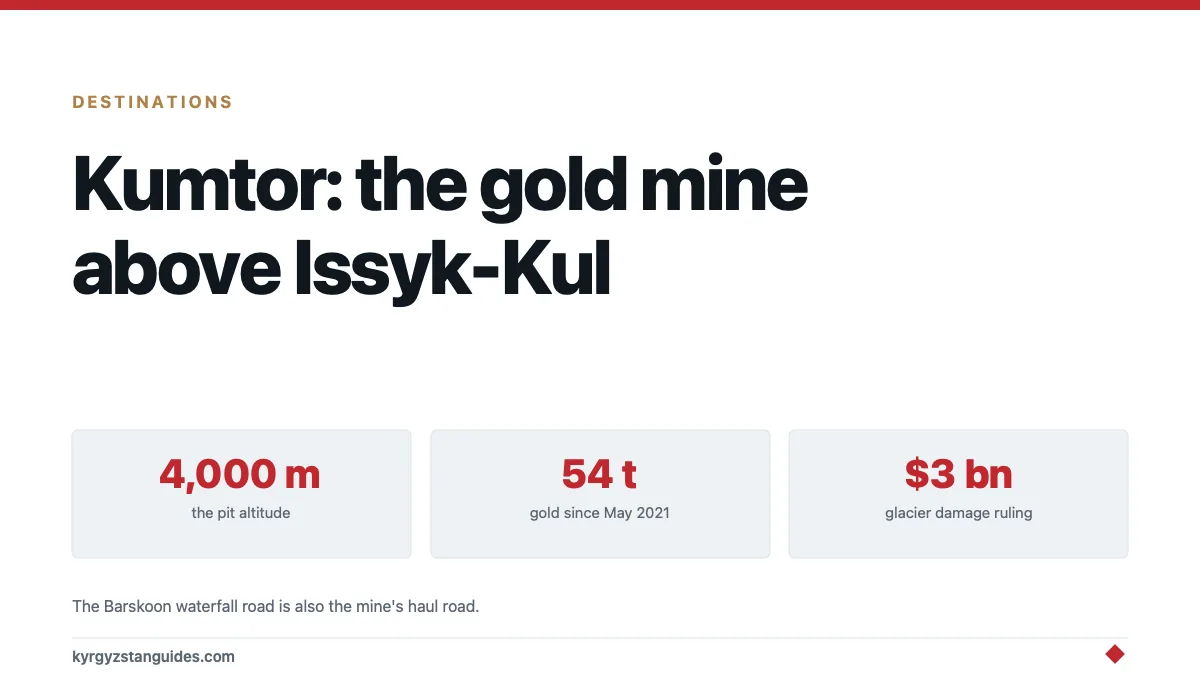
Kumtor is one of the highest-altitude gold mines operating anywhere in the world. The pit sits at roughly 4,000 m in the Tien Shan, which means permafrost, thin air, and a workforce that rotates in shifts because nobody lives up there permanently.
Since the Kyrgyz state took over operations in May 2021, the mine has produced 54 tonnes of gold generating around $3.5 billion in revenue, of which roughly $891 million went to the state budget in taxes and other contributions. For a country of about seven million people, that isn't a line item. It's a pillar.
This is the fact that makes every argument about Kumtor difficult. The environmental case against it's strong. So is the case that the national budget can't easily do without it.
What happened to the glaciers
The pit is surrounded by ice, and the waste rock has to go somewhere.
For years, waste rock was dumped onto the Davydov and Lysyi glaciers, which degraded them. In 2017 the government amended the water code in a way that, in practical effect, legalised mining operations on those two glaciers.
After the 2021 takeover, a Kyrgyz court ruled that the operation had committed environmental violations through exactly this dumping, causing the glaciers' gradual erosion, and assessed the cost to the state at $3 billion.
Read those two facts next to each other. The same activity was legalised in 2017 and litigated as a violation a few years later. The physical damage to the ice didn't change; the politics around it did.
Why glaciers specifically matter here's covered in our guide to Kyrgyzstan's glaciers: they're the country's water storage. Rivers that feed farmland across the Fergana valley and beyond begin as melt from this range. Removing ice is not an aesthetic loss.
The current response is a shift to underground mining, formally launched in 2025 and reported by The Times of Central Asia. The stated logic is that going underground removes the need to strip and dump enormous volumes of waste rock, protecting what remains of the surrounding ice.
Whether that undoes decades of surface mining is a different question from whether it stops adding to the problem. It stops adding to the problem.
The Barskoon spill
On 20 May 1998, a truck carrying sodium cyanide to the mine went off the road above the village of Barskoon and into the river.
Roughly 1.7 to 1.8 tonnes of sodium cyanide entered the water. The river runs down to Issyk-Kul, and Barskoon's residents, around 6,500 people. Used it for drinking and irrigation. The company didn't notify the village for approximately five hours.
Close to 600 people were treated for poisoning. RFE/RL reported two decades later that compensation for victims remained minimal and contested.
This is the context for a fact travellers do notice: the trucks. If you go up the Barskoon valley for the waterfalls, you'll share the road with heavy mine traffic, and you will see why local feeling about that road isn't neutral.
The nationalisation
The mine was developed and operated by the Canadian company Centerra Gold. On 14 May 2021, President Sadyr Japarov signed legislation allowing temporary state control, eight days after parliament approved it, and the operation passed to the Kyrgyz government.
Depending on who is describing it, this was either the recovery of a national asset that had been signed away on bad terms in the 1990s, or an expropriation that will make foreign investors think twice about Kyrgyzstan for a generation. Both readings have evidence behind them.
Al Jazeera's reporting at the time framed it primarily as an environmental dispute, which is how the Kyrgyz side presented it: the court findings on glacier damage were the legal instrument. Centerra's position was that the process was political and the environmental case a pretext.
What is not disputed: revenue to the state rose substantially afterwards.
It is also worth noting how long this had been coming. Kumtor was a point of political conflict for most of two decades before 2021. Parliamentary commissions, renegotiated agreements, protests that blocked the access road, and repeated attempts to revisit the original 1990s terms. The nationalisation wasn't a sudden decision. It was the end of an argument that had been running since the mine opened.
Should this change how you travel?
Not dramatically. But a few things follow from it.
The Barskoon road is an industrial road. It's also beautiful, and the waterfalls are worth the trip. Just understand that you are on a mine haul route, drive accordingly, and don't expect solitude.
Don't photograph the mine or its checkpoints. This should be obvious and regularly isn't. It's a strategic national asset with security.
The tap water question. Issyk-Kul's water quality is monitored and the 1998 event is a historical one, but our standing advice on drinking water in Kyrgyzstan applies here as everywhere: filter or buy.
Take local opinion seriously. If you end up in conversation about Kumtor in a village on the south shore, you're not discussing an abstraction. People there remember 1998.
Why it belongs in a travel guide
Because Kyrgyzstan sells itself on wilderness, and Kumtor is the clearest case of the trade-off that sits underneath that image.
The country has spectacular mountains and very little else to build an economy on. Tourism is small. Remittances are large. Gold is the thing that actually pays. Every argument about protecting the glaciers and high pastures runs into the question of what replaces the revenue, and nobody has a convincing answer.
Knowing that does not mean you have to take a side. It means that when you stand at the Barskoon waterfalls watching ore trucks grind past, you understand what you're looking at.
The mine’s relationship with the two glaciers in its footprint is written into national law. Article 57 of the Water Code protects glaciers — except Davydov and Lysy, named in the statute. Our page on the glacier law sets out the exemption and its history.
FAQ
Can you visit the Kumtor gold mine?
No. It's a working mine with a restricted access road at around 4,000 m. The public road up the Barskoon valley stops well short of it.
Where is the Kumtor mine?
In the Tien Shan mountains of Issyk-Kul region, reached via the Barskoon valley from the lake's southern shore. The pit sits at roughly 4,000 metres.
What happened to the Davydov and Lysyi glaciers?
Mine waste rock was dumped onto them over many years, causing degradation. A Kyrgyz court later found this constituted an environmental violation and assessed $3 billion in damage to the state.
What was the 1998 Barskoon cyanide spill?
A truck carrying sodium cyanide to Kumtor crashed into the Barskoon river on 20 May 1998, releasing roughly 1.7–1.8 tonnes. Villagers weren't warned for about five hours and close to 600 people were treated for poisoning.
Who owns Kumtor now?
The Kyrgyz state. Legislation permitting state control was signed in May 2021, transferring the operation from Canadian company Centerra Gold.
Is the Barskoon valley safe to visit?
Yes, and it's a popular trip for the waterfalls. It's a shared road with mine traffic, so drive cautiously and don't photograph mine infrastructure or checkpoints.