Kyrgyzstan is one of the most glaciated countries on earth and its glaciers are shrinking fast. So it is reasonable to assume there is a law protecting them. There is a provision, it is real, and it contains an exemption that names two specific glaciers.
Those two glaciers are inside a gold mine.
There is no glacier law, there is an article
First, a correction to how this is usually described. Kyrgyzstan has no standalone law on glaciers. A search of the Ministry of Justice legal database returns thirty-seven acts mentioning glaciers, and essentially all of them are about naming a glacier or a peak.
Protection lives inside the Water Code. The current one is No. 128 of 27 June 2025, published on 1 July 2025 and in force six months later, from around 1 January 2026. It repealed the 2005 code.
Glaciers have clear legal standing in it. Article 2 defines a water object to include rivers, streams, springs, lakes, ponds, marshes and glaciers and snowfields. So a glacier is legally water, not landscape.
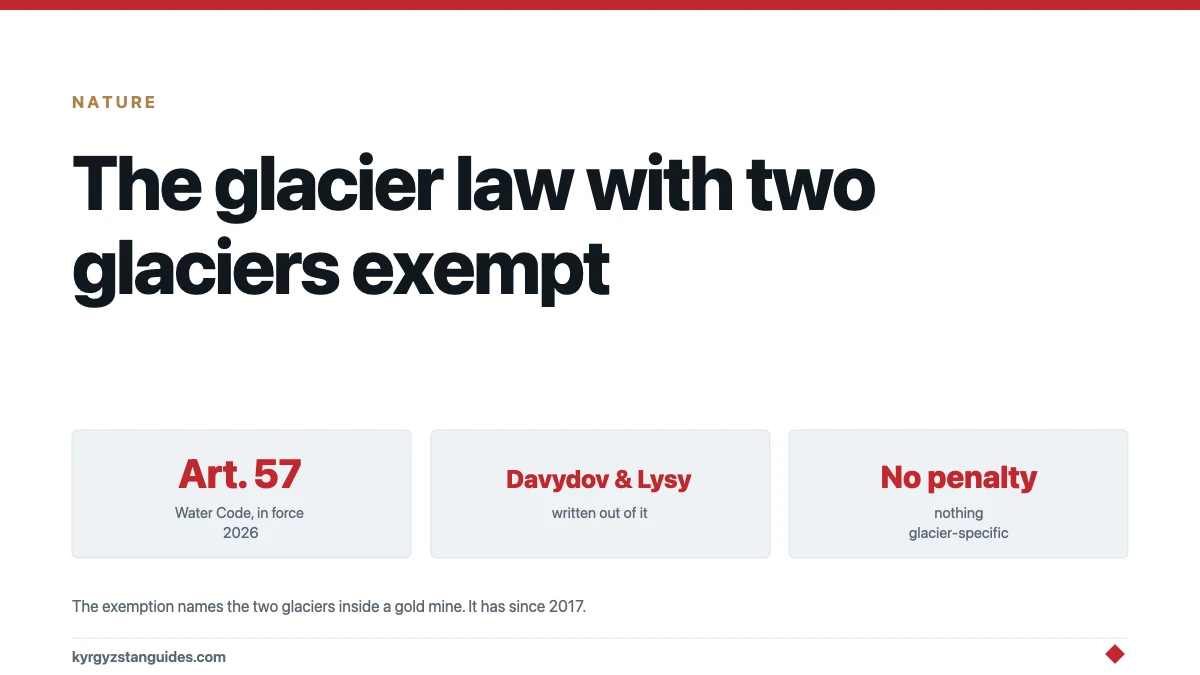
Article 57, titled Protection of glaciers, prohibits three things: activities using coal, ash, oils or other substances that accelerate glacier melt; activities capable of affecting the condition of glaciers or the quality of the water they hold; and activities connected with ice production.
Except the Davydov and Lysy glaciers
The prohibition ends with a carve-out written into the statute: the bans apply except for activities on the Davydov and Lysy glaciers. A second paragraph clarifies that the exception does not retrospectively cover prior impacts on those two.
Davydov and Lysy are the glaciers in the footprint of the Kumtor mine. Ice has to be stripped to reach the ore beneath, and waste rock was placed on the ice. The exemption is not an oversight or a drafting accident; it is the operating condition of the country's largest single taxpayer, written into environmental law by name.
It is also not new. The identical wording, with the same two glaciers named, appeared in Article 62 of the 2005 Water Code, inserted by Law No. 193 of 23 November 2017. The 2025 code carried it across unchanged. Nine years on, through a change of government and a change of mine ownership, the two named glaciers are still outside the protection.
The carve-out reaches further than Article 57. Article 62 of the new code governs runoff formation zones, banning tailings dumps, landfills, cemeteries and carcass pits there, and banning the pollution of ice, glaciers and snowfields with industrial and household waste, oil products and toxic chemicals — except in the cases provided for in Article 57. The exemption propagates.
And there is no penalty
This is the part that decides whether a prohibition means anything. The Code on Violations, No. 128 of 28 October 2021, contains no glacier-specific offence at all.
What applies instead are two general water provisions: Article 236, on violating requirements for protecting waters from pollution and littering, at 100 calculation indices for an individual and 280 for a legal entity; and Article 246, on violating water conservation rules, at 55 and 170. I am not going to convert those into som, because I could not verify the current value of a calculation index.
So: a prohibition with a named exemption, enforced through generic water-pollution fines set in index units.
Why this matters more here than almost anywhere
Glacier law is an abstraction in most countries. In Kyrgyzstan it is water policy, because the glaciers are the reservoir.
The country’s rivers are fed by seasonal snowmelt and by ice melt, and the ice is the part that releases water late in summer, after the snow has gone. That is precisely when downstream irrigation needs it, which is why water politics with Uzbekistan and Kazakhstan turns on summer releases. A shrinking glacier is a reservoir that empties earlier each year.
It also cuts the other way in the short term. Accelerated melt means more water now and less later, which masks the problem in the statistics and makes the eventual shortfall arrive as a step rather than a slope.
Against that, the legal position is a single article with a named exemption and no dedicated penalty. The explanatory note to the 2026 draft saying current legislation lacks a full mechanism is not an activist claim. It is the state’s own assessment of its own law.
What is moving now
Two things, both from 2026, and it is worth being clear that neither adds a prohibition.
Presidential Decree No. 313 of 4 September 2026 backs the creation of a Fund for the protection and preservation of the glaciers of Kyrgyzstan and Issyk-Kul. It gave the Cabinet until 1 October 2026 to define the fund's legal form, governance, project selection, financing, transparency and audit, with money to come from international financial organisations, climate funds, grants, voluntary contributions and investment. Coordination is split between the water, ecology and emergencies ministries. It is a funding and administrative instrument. It creates no new ban.
Separately, the Ministry of Emergency Situations has put out for public consultation amendments to the law on hydrometeorological activity that would create a unified state register of glacier data — location schemes, morphometric parameters, records of glaciation change — with mandated coordination of research, long-term monitoring and forecasting.
The explanatory note attached to that draft is the most candid official statement on the subject I found. It says current legislation lacks a full mechanism for comprehensive protection of glaciers from pollution and shrinkage, and it names the risk areas: mining zones, areas of intense tourism, and transport corridors. The second of those is worth sitting with if you are planning to walk on one.
For what is physically happening to the ice, see our guide to Kyrgyzstan’s glaciers and the separate case of rock glaciers, which the law does not distinguish.
FAQ
Does Kyrgyzstan have a law protecting glaciers?
Not a standalone one. Protection sits in Article 57 of the Water Code No. 128 of 27 June 2025, in force from around 1 January 2026, which bans activities that accelerate melt, affect glacier condition or water quality, or involve ice production.
Which glaciers are exempt from Kyrgyz glacier protection?
Davydov and Lysy, named in the statute itself. They are the glaciers within the Kumtor gold mine footprint. The same exemption was introduced in 2017 and carried unchanged into the 2025 Water Code.
What is the penalty for damaging a glacier in Kyrgyzstan?
There is no glacier-specific offence. Two general provisions apply: Article 236 of the Code on Violations at 100 calculation indices for an individual and 280 for a legal entity, and Article 246 at 55 and 170.
Are glaciers legally protected as water in Kyrgyzstan?
Yes. Article 2 of the Water Code defines a water object to include glaciers and snowfields alongside rivers, lakes and springs, so a glacier is legally a body of water rather than landscape.
What is the Kyrgyz glacier fund?
A fund for protecting the glaciers and the Issyk-Kul ecosystem, backed by Presidential Decree No. 313 of 4 September 2026, with the Cabinet directed to define its structure and financing. It is an administrative and funding instrument and creates no new prohibition.
Is tourism a recognised threat to Kyrgyz glaciers?
Officially, yes. The explanatory note to a 2026 draft amendment names mining zones, areas of intense tourism and transport corridors as the risk areas, and states that current legislation lacks a full protection mechanism.