For three decades, most of the Soviet Union's rare earth elements came out of one open pit in Kyrgyzstan's Kemin district. The figure that anchors every account — that Kutessay II supplied 80 per cent of the USSR's rare earths until 1992 — appears in the factual background of an international arbitration award, which attributes it rather than proves it; no independent production ledger has ever surfaced. With Soviet strategic minerals, that is usually as good as the record gets.
What makes Kutessay worth a full telling is not just the Soviet chapter. It is what happened when a Canadian company tried to restart it — a legal saga that produced two arbitration awards about the same mine, eight times apart in value, and a lesson in reading headlines about court victories.
The Soviet operation
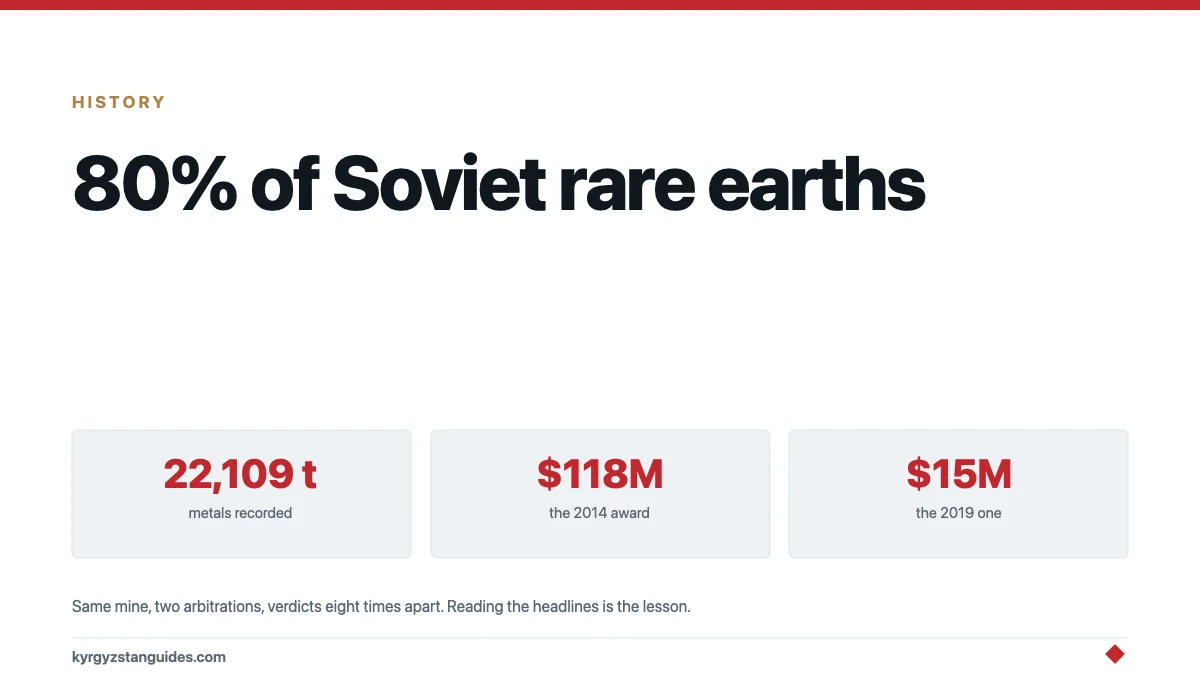
Discovered in 1953 and brought into operation in 1958 — with the USGS internally inconsistent on whether mining dates from 1958 or 1960 — Kutessay II worked as an open pit from 1960, feeding ore to a plant at Aktyuz and onward to the Kyrgyz Chemical and Metallurgical Plant with its rail terminal at Kashka. The USGS yearbook record totals the output: 22,109 tonnes of rare-earth metals from 5.45 million tonnes of ore, with processing spanning fourteen rare-earth elements.
Fourteen elements matters. Rare earths are not rare so much as miserable to separate, and heavy rare earths — the ones in magnets and defence applications — are the misery squared. The claim later made for Kutessay in investor materials was that it was the only hard-rock heavy-rare-earth operation ever put into production outside China. Treat that as a company's framing of its own asset; what is certain is that very few places on Earth have ever done this work at all, and this hillside in Kemin is one of them.
Then 1992: the customer evaporated. The pit sat idle for about fifteen years.
The Canadian chapter, and the two awards
In 2009, Toronto-listed Stans Energy took a twenty-year licence and bought the Kashka processing plant and rail terminal for US$5.5 million. By 2012–13 the state had ordered work stopped; in 2013 the General Prosecutor sued to void the licence.
What followed is the part everyone garbles, so here it is as the documents have it:
| Forum | Date | Result |
|---|---|---|
| Moscow Chamber of Commerce arbitration | April 2014 | Award exceeding US$118 million against Kyrgyzstan |
| Permanent Court of Arbitration, case 2015-32 | 20 August 2019 | Liability found, but damages of US$15,027,081.89 |
The $118 million figure is the one that travelled — and it was the award of a forum the Kyrgyz side dismissed as a "pocket arbitration," in proceedings Kyrgyzstan contested root and branch. The PCA's 2019 award, the weighty one, agreed Kyrgyzstan was liable — and then valued the loss at an eighth of the claim's US$128.23 million, with the state bearing two-thirds of costs. Same mine, same dispute, and the answer to "what was Kutessay worth?" moved by a factor of eight depending on who was asked.
For Kyrgyzstan the saga became Exhibit A in its difficult history with foreign miners, alongside the Kumtor fight; for investors it became a cautionary line item. The licence went back out to tender in 2017.
What is actually in the ground
The honest answer: substantial, dated, and in need of re-proving. The one figure traceable to a published survey is a 1996 state estimate of 20.2 million tonnes of remaining resources at 0.22–0.30 per cent grade — Soviet-classified numbers in a Western reporting world, which investors discount on sight. A commonly cited 51,500-tonne oxide reserve could not be traced to any yearbook I could read, so it is not in this post.
Grade is the catch. A fraction of a per cent of mixed oxides, heavy on processing, light on glamour: Kutessay was viable as a strategic asset inside a command economy and has to argue for itself all over again as a commercial one. The government now talks of rare-earth development by 2035, with twenty deposits named and no major financing attached — and global rare-earth politics, where China's dominance keeps Western buyers hunting alternatives, is the only reason the conversation continues at all.
How to read a Soviet reserve number
A paragraph of translation, because the 1996 estimate above is written in a dead dialect.
Soviet geology classed reserves as A, B, C1 and C2 — grades of drilling density and confidence — under rules that answered a planner's question: how much is there? Western codes like JORC or NI 43-101 answer an investor's question instead: how much can be mined at a profit, shown by a study someone signs? A Soviet C1/C2 tonnage carries no costs, no metallurgy, no economics — so when a prospectus says a deposit “requires confirmation to international standards,” it means the number may survive re-drilling or may halve, and nobody lends against it until someone pays to find out.
That is Kutessay's actual position. The rocks did not move; the bookkeeping standard did. Between a 1996 state estimate and a bankable reserve stands several years of drilling and a feasibility study — the exact investment the licence fight of 2012–14 interrupted, and that no one has completed since. Any headline about Kyrgyzstan's rare-earth riches that skips this translation is quoting the planner's dialect to the investor's audience.
Standing at the edge of it
Kemin district is the top-right corner of the Chui valley, better known to travellers as the gateway to Chong-Kemin's valley walks. The Aktyuz ore field sits in the hills above — tailings, the old plant, the villages the industry built — with nothing marked for visitors and radiological housekeeping best left unexplored on foot. As with most of Kyrgyzstan's Soviet mineral map, the realistic engagement is knowing what the place was as you pass: the unremarkable-looking side valley that once fed most of an empire's magnet metals.
What I could not establish
Independent corroboration of the 80 per cent figure beyond the arbitration record's background. The 51,500-tonne reserve claim, as above. Whether the 2017 re-tender produced an active licensee doing anything measurable — reporting names ambitions, not work. And any account of what the Soviet operation left radiologically: thorium travels with these ores everywhere else, and the public record for Aktyuz is conspicuously quiet on it.
FAQ
What was mined at Kutessay II?
Rare earth elements — fourteen of them, by the USGS account — from an open pit in Kyrgyzstan's Kemin district, discovered in 1953 and operating from 1958. Total recorded output was 22,109 tonnes of rare-earth metals from 5.45 million tonnes of ore, and an arbitration award's background states it supplied 80 per cent of the USSR's rare earths until 1992.
Did Kyrgyzstan really lose a $118 million case over the mine?
It lost two cases with two very different price tags. A Moscow Chamber of Commerce arbitration awarded over US$118 million in April 2014 — a forum Kyrgyzstan dismissed as a "pocket arbitration." The Permanent Court of Arbitration's 2019 award found liability but set damages at US$15.03 million, roughly an eighth of the US$128.23 million claimed.
Why did the Soviet Union mine rare earths in Kyrgyzstan?
Because the deposit could feed a fourteen-element separation chain inside a closed economy that did not count costs the commercial way. Heavy rare earths especially have been processed in very few places ever; Kutessay's claim to be the only hard-rock heavy-rare-earth producer outside China comes from investor materials, but the shortlist is genuinely that short.
How much is left at Kutessay?
The traceable figure is a 1996 state estimate of 20.2 million tonnes of resources at 0.22-0.30 per cent grade — dated, Soviet-classified numbers that modern investors discount. A widely repeated 51,500-tonne oxide reserve could not be traced to a readable source.
Is the mine working today?
No meaningful production is recorded. The licence was re-tendered in 2017 after the Stans Energy dispute, and the government's stated ambition is rare-earth development by 2035 across some twenty deposits — ambitions without announced major financing.
Where is Kutessay II?
In the Aktyuz ore field of Kemin district, in the hills at the eastern end of the Chui valley — the same corner travellers pass entering the Chong-Kemin valley. Nothing at the site is arranged for visitors.
Why do rare earths matter?
They sit in magnets, motors, turbines, and defence systems, and their separation is dominated by China. That geopolitical concentration is why a mothballed Kyrgyz pit from 1958 still appears in strategy documents: the list of places that have ever done this work is short enough to keep every entry interesting.