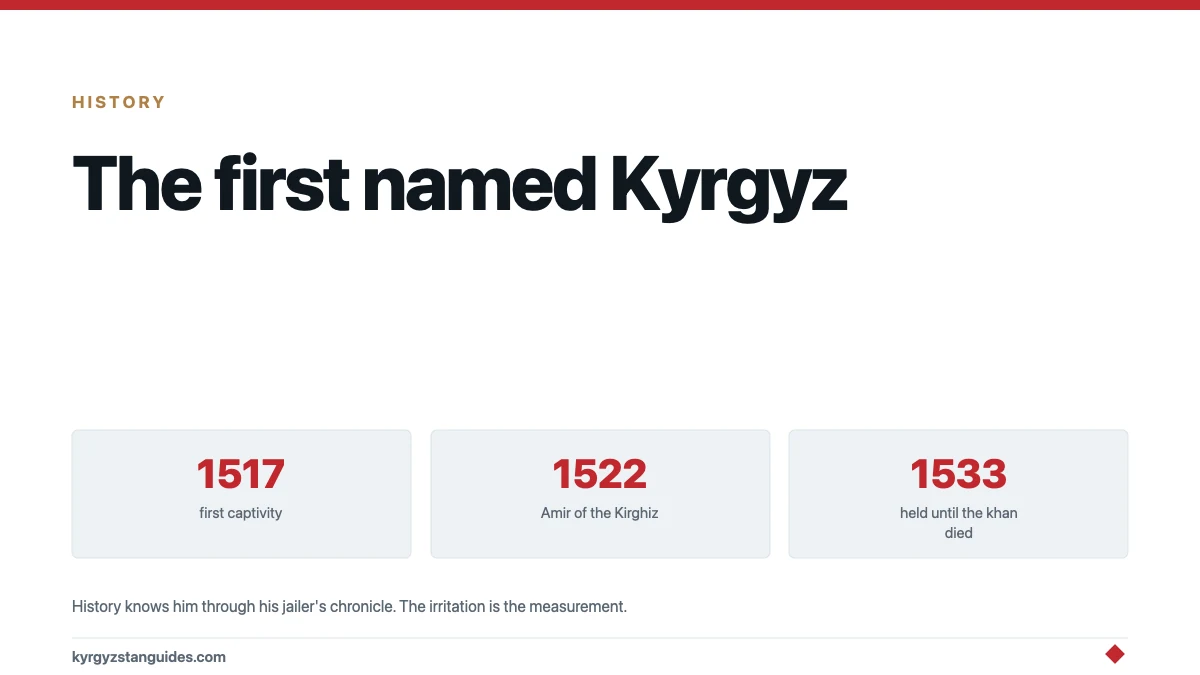
The first individual Kyrgyz leader to enter the written record appears in a Persian chronicle finished in 1546 — as a prisoner. The Tarikh-i-Rashidi, written in Kashmir by the Moghul grandee Mirza Haidar Dughlat, names "Muhammad Kirghiz": raider of Turkestan and Ferghana, twice-captured captive of Sultan Said Khan, and eventually the khan's own appointed "Amir of the Kirghiz".
Everything before him, in Kyrgyz terms, is epic, archaeology and other people's ethnography. Muhammad Kirghiz is where a named person with dated actions begins — and the chronicle that preserves him was written by his enemies' side, which makes reading it a lesson in squeezing truth from hostile sources. The full English translation sits free on archive.org, and this post works from that text.
The world he operated in
Early 1500s Central Asia: the Moghul khans — Chinggisid rulers of Moghulistan, cousins to the Mughals of India (our author Mirza Haidar was Babur's cousin) — claimed the Tian Shan pastures where Kyrgyz tribes actually lived and fought. The khans' problem, endlessly rehearsed in the chronicle, is that claiming nomads and governing them are different sports.
And one line of Mirza Haidar's sets the cultural stakes better than a chapter could. Surveying the steppe peoples, he notes that all the Moghuls have become Muslims, "but the Kirghiz are still infidels." Written in the 1540s, that is the era's sharpest outsider testimony on Kyrgyz religious identity — Islam had not yet taken among the Tian Shan tribes, centuries after it had taken their neighbours. Set that beside the modern landscape of 4,000 mosques and the distance travelled is the point.
What the chronicle actually says he did
Assembling the scattered passages:
The rise. Muhammad Kirghiz leads raids against Turkestan and Ferghana — the settled lands — profitably enough to become the Kyrgyz problem the khans must answer.
The first captivity. Seized in 923 AH (1517) after he freed a captured sultan on his own authority — the act of a man behaving as a sovereign — he is held, by the main narrative's account, for five years. (The book's own preface says fifteen; the dated chapters say five; this post follows the dates and flags the contradiction, which is the chronicle's, not ours.)
The release and the title. In 928 AH — 1522 — Sultan Said Khan campaigns into Moghulistan to subdue the Kyrgyz, sends his son Rashid as figurehead, and tries statecraft: Muhammad Kirghiz is freed and made Amir of the Kirghiz, the khan's governor over his own people. Poacher, gamekeeper.
The second captivity. It does not hold. Within years he is seized again — brought bound to Kashgar — and this time there is no release; the chronicle has him held until the khan's death in 1533.
A career of two imprisonments bracketing one co-option: the Moghul state could capture the man repeatedly but never the allegiance, and within a generation of the chronicle's writing, Moghul authority over the Tian Shan was effectively finished — the Kyrgyz tribes' absorption of those pastures is the quiet sequel the author did not live to resent.
Reading a history written by the jailer
A note on method, because every fact above arrives through enemy handwriting.
Historians extract from hostile chronicles by sorting what the author had no reason to invent from what he had every reason to shade. Dates, places, troop movements, the brute fact of a campaign or a captivity — a court historian writing for men who were there gets these roughly right, because his audience could check. Motives, character, piety — there the pen serves the payroll. So we can trust that Muhammad Kirghiz raided, was taken in 1517, was titled in 1522, was taken again; we should shrug at every adjective attached to him.
The same sieve applies to the famous “infidels” line. What Mirza Haidar records is that Kyrgyz practice did not register as Islam to a 16th-century Muslim jurist's eye — testimony about the boundary he drew, not an ethnography of what the tribes actually believed, which the chronicle never bothers to describe. The one thing a hostile source documents beyond argument is its own irritation; the size of that irritation is our best measure of the man.
The Tagai Biy question
Kyrgyz tradition knows a founding ancestor called Tagai Biy, from whom the right wing of the Kyrgyz genealogical system descends, and a widespread identification holds that Muhammad Kirghiz and Tagai Biy are the same man — a memorial plaque in the Barskoon gorge even dates him 1469–1533, borrowing the chronicle's death-adjacent date.
Handle with tongs. The Tarikh never uses the name (its own "Taghai" is a different, Moghul, grandee), the identification lives in later tradition and popular history, and scholarship entertains rivals — one academic treatment weighs a different folk hero entirely. The honest formula: tradition identifies them; the sources do not confirm it. What is documented is the chronicle's man; what is beloved is the genealogy's; the bridge between them is faith in oral memory, declared as such.
Why this matters more than a footnote
Because of what it does to the standard timeline. Popular histories bring the Kyrgyz to the Tian Shan from the Yenisei and then skip to Russian contact; the chronicle shows something more interesting — the Kyrgyz already the dominant military fact of these mountains by the early 1500s, troublesome enough to imprison, numerous enough to need governing, distinct enough to be the chronicle's named infidel exception. Whatever the migration story, by Muhammad Kirghiz's lifetime the Tian Shan was already functionally Kyrgyz, with the lake country he contested being the same Issyk-Kul shores the chronicle describes with an island where a khan hid his family.
For the longer argument about origins — Yenisei, migrations, and what the epic tradition preserves against what documents show — our history overview holds the thread. Muhammad Kirghiz is that argument's anchor at the documentary end: the moment Kyrgyz history stops being inferred and starts being, in the narrowest sense, written.
What I could not establish
The identification with Tagai Biy, as above — presented here as tradition, not finding. The five-versus-fifteen-year contradiction inside the chronicle itself, which no accessible scholarship resolves. His birth year — the plaque's 1469 has no traceable documentary basis. And anything of the man's own voice: the record is entirely his captors', and a history written by the jailer should be read with the cell door in view.
FAQ
Who was Muhammad Kirghiz?
The first named Kyrgyz leader in the written record, appearing in the Tarikh-i-Rashidi, a Persian chronicle completed in the 1540s. It describes his raids on Turkestan and Ferghana, two captivities under Sultan Said Khan, and his appointment as the khan's "Amir of the Kirghiz" after the 1522 campaign.
How long was he imprisoned?
The chronicle contradicts itself: its preface says fifteen years, while the dated narrative gives five years for the first captivity (from 1517) and an indefinite second captivity in Kashgar lasting until the khan's death in 1533. This post follows the dated narrative and flags the inconsistency.
Is Muhammad Kirghiz the same person as Tagai Biy?
Kyrgyz tradition widely identifies them, and a plaque in Barskoon gorge dates him 1469-1533 on that basis — but the chronicle never uses the name, and scholars debate the identification, with at least one rival candidate. Honest usage: tradition says yes; the sources neither confirm nor deny.
What does the chronicle say about Kyrgyz religion?
Its author states that all the Moghuls had become Muslims "but the Kirghiz are still infidels" — the sharpest contemporary testimony that Islam had not yet taken hold among the Tian Shan Kyrgyz in the early 1500s, centuries after their neighbours' conversion.
What is the Tarikh-i-Rashidi?
A history of Moghulistan written in Kashmir in the 1540s by Mirza Haidar Dughlat, a Moghul commander and cousin of Babur. Its English translation by Elias and Ross is in the public domain and freely readable on archive.org — the primary source behind every quotation in this post.
Why does one prisoner matter to Kyrgyz history?
Because he marks the shift from inferred history to documented history: a named individual with dated actions. And because the chronicle's irritation itself testifies that the Kyrgyz were already the dominant force of the Tian Shan by the early 16th century — the dates matter less than the dominance they record.
Can you visit anything connected to him?
The Barskoon gorge on Issyk-Kul's south shore has the memorial plaque to Tagai Biy bearing the traditional identification and dates. Treat it as a monument to the tradition — which is itself part of the story — rather than to a documented biography.