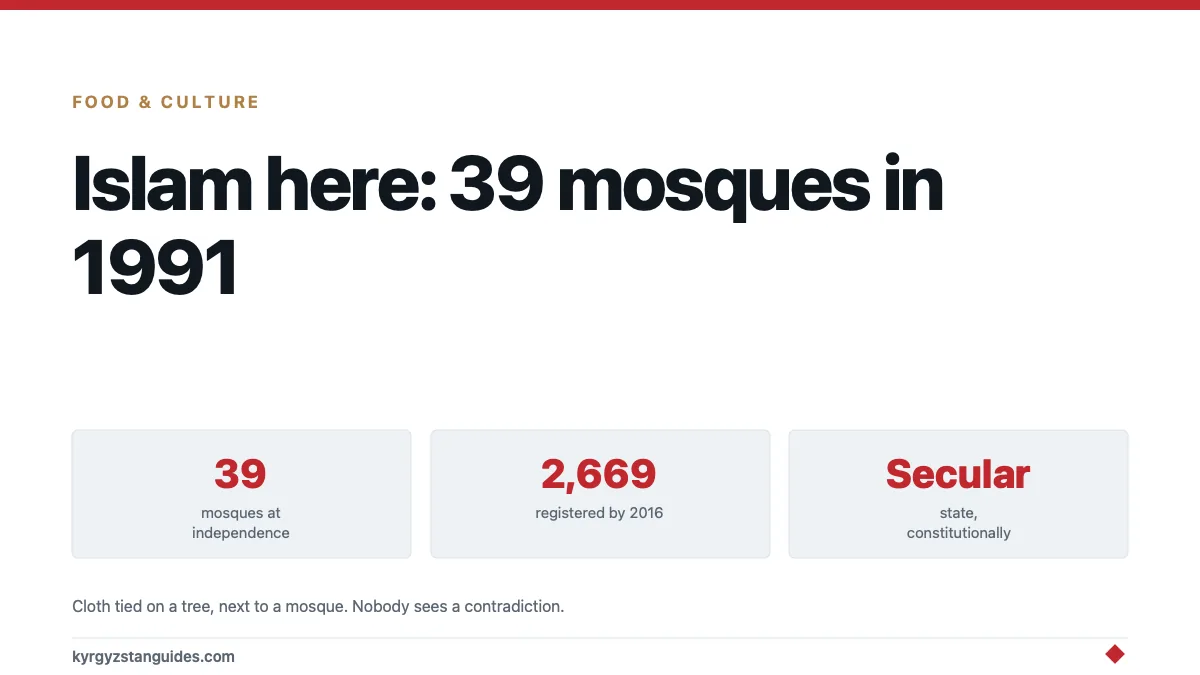
In 1991 there were 39 mosques in Kyrgyzstan.
By the country's fifth anniversary of independence there were more than 1,000. By 2016 there were 2,669 officially registered. The number has grown more than seventyfold in roughly three decades.
At the same time, Kyrgyzstan is a constitutionally secular state, alcohol is sold openly, headscarves are a minority choice in Bishkek, and a great many Kyrgyz people will describe themselves as Muslim while holding beliefs that predate Islam by a very long way.
All of this is simultaneously true, and untangling it explains a lot of what a visitor sees.
How Islam arrived
Not all at once, and not evenly.
The south first. Islam reached the Fergana valley and the settled towns of what is now southern Kyrgyzstan from the eighth century onward, through the same routes that carried trade. Sulaiman-Too in Osh shows the process directly: a pre-Islamic sacred mountain absorbed into Islamic practice rather than replaced by it.
The north much later. Kyrgyz herders in the northern mountains were nomadic, dispersed and hard to reach, and Islam spread among them substantially later — in many areas only from the seventeenth and eighteenth centuries, largely through Sufi orders and through contact with settled populations.
That difference is still visible. Southern Kyrgyzstan is more observant than the north, and it's one of several axes on which the two halves of the country differ.
Then seventy years of state atheism. The Soviet period closed mosques, suppressed religious education and produced generations for whom Islam was an ethnic marker rather than a practice. Surveys of religion in Kyrgyzstan treat that inheritance as the starting point for everything that followed.
What happened after 1991
Everything that had been suppressed became possible at once, with no institutional framework and no money.
The government took a liberal approach. Mosques and religious schools multiplied. And because domestic funding for religious infrastructure did not exist, the money came from abroad, from Saudi Arabia, Turkey and the Indian subcontinent, along with the theological positions attached to it.
That is the origin of a tension that runs through the subject here. The Islam being revived was not always the Islam that had been suppressed. Central Asian practice had its own character, Sufi-influenced, shrine-oriented, comfortable with pre-Islamic custom, and some of what arrived after 1991 was explicitly hostile to exactly that.
The detailed treatment is in the Silk Road Studies paper on religion and the secular state in Kyrgyzstan, which is the best single English-language account.
The layered reality
What you will actually encounter is several things at once.
Islamic practice. Friday prayers, Ramadan observed widely, Islamic funeral rites almost universally, halal norms around food in most households.
Pre-Islamic custom, unbothered. Tying cloth at sacred springs and trees. Sliding down the rocks at Sulaiman-Too for fertility. The müçöl red-cloth protection at threshold years. Consulting a tabyp, as covered in our traditional medicine guide. Burning juniper to cleanse a space.
Soviet secularism. Civil marriage, mixed-gender workplaces, alcohol at celebrations, a state that keeps religion out of government.
Ancestor reverence, which sits somewhere between all three and is arguably the most important of the four. The dead matter enormously here — the funeral customs, the memorial feasts, the seven generations of ancestors people are expected to know.
Kyrgyz people hold these together without visible strain. A family will slaughter a sheep according to Islamic practice for a feast marking a pre-Islamic calendar event, held in a Soviet-built culture house, and see nothing to reconcile.
Politics
Worth knowing because it is a live subject.
As society has become more observant, Islam has become a source of political legitimacy and a way to mobilise voters. Religious organisations are formally barred from interfering in government, and the practical picture is more complicated. Analysis of the politicisation of Islam around recent elections documents how this has developed.
The state's position is a balancing act: secular in law, increasingly accommodating in practice, and actively concerned about foreign-funded movements it considers extremist. That concern is the reason for religious registration requirements and for periodic restrictions.
The other faiths
Kyrgyzstan is Muslim-majority, not exclusively Muslim, and the minorities aren't incidental.
Russian Orthodoxy arrived with tsarist settlement, and the parishes that opened in the 1870s served garrisons before they served converts. The wooden Holy Trinity church in Karakol is the best-known building.
The Dungan, Chinese-speaking Muslims who crossed the Tien Shan in 1877, practise Islam with a distinct Chinese character, the Karakol mosque is built like a Chinese temple and was assembled without nails.
Nestorian Christianity was here first, for centuries, and is gone. The Syriac-inscribed gravestones of the Chuy valley are all that remains of congregations that existed here before Islam reached the northern mountains.
Small Protestant, Baptist and Jewish communities exist, along with Buddhists among the Korean population.
That list is a compressed version of the country's history: who arrived, who was moved here, who was already here and didn't survive. The deportations of 1944 added several of these communities in a single year.
What a visitor should do
Straightforward, and mostly it's the same as anywhere.
Dress modestly at religious sites. Covered shoulders and knees. Women cover their heads to enter a mosque. Our what to wear guide covers the general picture, which is more relaxed than most visitors expect.
Mosques are generally welcoming. Ask before entering. Remove shoes. Avoid prayer times unless invited.
Ramadan is observed but not enforced. Restaurants stay open, and nobody will expect you to fast. Eating conspicuously in front of someone fasting is still poor manners.
Alcohol is normal and also not. It's sold everywhere and drunk at celebrations, and plenty of observant families do not touch it. Follow your host.
Do not photograph people praying. As at Sulaiman-Too.
Do not treat the pre-Islamic practices as quaint. The cloth tied on a tree is somebody's request for a sick child to recover.
Avoid comparative theology. Nobody here needs a visitor's view on which version of Islam is correct, and that argument is genuinely sensitive.
FAQ
Is Kyrgyzstan a Muslim country?
It's Muslim-majority and constitutionally secular. Most Kyrgyz identify as Sunni Muslim, with observance varying widely between the more religious south and the more secular north.
How many mosques are there in Kyrgyzstan?
There were 39 in 1991. By 2016 there were 2,669 officially registered, an increase of more than seventyfold since independence.
When did Islam arrive in Kyrgyzstan?
From the eighth century in the settled south, and considerably later among northern nomadic Kyrgyz. In many areas only from the seventeenth and eighteenth centuries.
Do Kyrgyz people practise pre-Islamic traditions?
Yes, widely and without conflict. Tying cloth at sacred springs and trees, protective customs at müçöl years, consulting traditional healers and burning juniper all continue alongside Islamic practice.
What should I wear as a visitor?
Ordinary modest clothing is fine in daily life. At mosques and sacred sites, cover shoulders and knees, and women should cover their heads to enter a mosque.
Is alcohol available in Kyrgyzstan?
Yes, openly and widely. Many observant families abstain, so take your cue from your hosts rather than assuming either way.