Somewhere on your trip you will pass a tree hung with strips of cloth, or a spring with a low wall around it and a few coins on a stone. It will not be signposted, there will be no ticket office, and it will not appear in any guidebook. You have found a mazar, and you are standing in the middle of a live religious practice that almost nothing written in English for travellers explains.
A mazar is a sacred site visited for pilgrimage, zyyarat. In Kyrgyzstan that covers both natural objects — springs, trees, stones, caves, whole mountains — and built ones such as mausoleums, graves and old structures. Many are both at once. This is not a folk curiosity at the edges of the country. It is one of the most widespread religious practices in it.
How many there are, which nobody expects
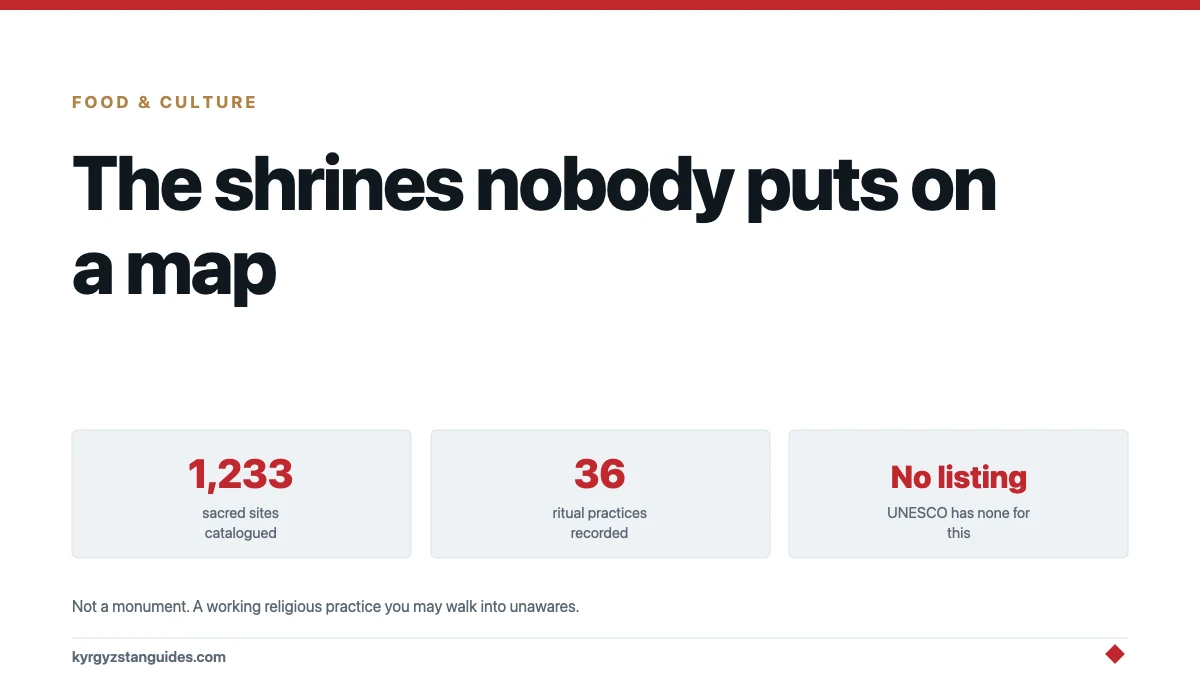
The usual assumption is a scattering of local shrines. The actual count is not that. A UNESCO International Assistance project with the Bishkek research centre Aigine, approved in November 2018, identified 1,233 sacred sites and 36 ritual practices across Kyrgyzstan, and produced a national manual on safeguarding them.
The regional breakdowns give a sense of the density. More than 400 sacred sites were identified in the southern provinces alone over about three years of fieldwork, an effort disrupted by the 2010 violence in Osh. Inside the Ysyk-Köl Biosphere Reserve there are around 130 documented sites. Aigine's own inventory work ran from 2005 to 2008, with the Talas volume published in 2007 and the Ysyk-Köl fieldwork appearing in 2009.
You will also see a figure of 1,075 sites repeated online. Its cited source is now a dead link. Use 1,233.
Islam or something older? The question is wrong
Every popular account reaches for the same formula: a blend of pre-Islamic shamanism and Islam. That framing comes from a long scholarly tradition running back to Valikhanov in the nineteenth century, and the researchers who have actually done the fieldwork are notably cooler about it.
Aigine's work cites the anthropologist Nathan Light's correction directly: throughout the twentieth century both Soviet scholars and clerical officials tried to separate Islamic from native practice, while the people actually doing it were generally unconcerned with the distinction. Aigine's own frame is two overlapping systems rather than two opposed ones — kyrgyzchylyk, traditional knowledge and practice, and musulmanchylyk, folk Islam.
And the field result is unambiguous on the basic question: the great majority of Kyrgyz pilgrims consider themselves Muslims. The live argument is not whether Kyrgyz are Muslim. It is which Islam — whether worship at sacred sites is permitted at all, whether ritual should be confined to Qur'anic practice, and whether the old healing practices are heresy.
That argument is real and it has institutional weight behind it. A 2007 Aigine survey in Talas interviewed 103 moldos, mullahs aged between 20 and 84; 90.5% said Islam should be state-supported and 84.5% said the Islam practised in Kyrgyzstan is the correct kind. The study was framed, pointedly, as moldos being both guardians and destroyers of tradition. Reformist Muslims criticise the whole ziyarat tradition as un-Islamic.
What I could not find, and looked for, is any formal Muftiyat ruling banning mazar pilgrimage. The documented opposition is scholarly and individual, not a located edict.
Sites you may actually encounter
On Issyk-Köl's south shore, Manjyly-Ata is the big one: a complex of springs, trees and old mausoleums, visited above all by people asking for children. It is developed enough to have ritual washing places and bins. Cholpon-Ata is associated with requests for wealth and livestock. Near Barskoon there are Enesaiy-Ata and Er-Tabyldy-Tash. The lake itself is treated as a sacred object.
In the south, Sulaiman-Too in Osh is described in the literature as the most famous sacred site in the country, tied to the prophet Sulaiman. It is the one place here where the practice intersects with World Heritage: UNESCO inscribed it in 2009 under criteria (iii) and (vi), recording 101 indexed petroglyph sites and 17 places of worship still in use, and calling it the most complete example of a sacred mountain in Central Asia. Beyond it: the Chil-Ustun cave and Dul-dul-At near Aravan, Kyrk-Chilten at Zardaly in Batken, the contested Zulpukor shrine, and the Ata-cycle sites Imam-Ata, Baba-Ata, Padysha-Ata and Arslanbap-Ata.
How to behave if you find yourself at one
There is no official visitor code. A national manual was produced under the UNESCO project but I could not locate its text, so what follows comes from what informants and site descriptions actually say, not from a rulebook.
Do not break branches, mow grass or cut reeds. This is the most consistently stated rule and it is not about tidiness — the vegetation is part of what is sacred. Come with sincere intent or do not come; misbehaviour at a site is locally understood to bring harm to the person who commits it. Very small children are generally not brought unless they are ill, and children who do come should be clean.
Many mazars have a guardian, a shaiyk, who receives visitors. If someone approaches you, they are not a tout. Greet them properly, as our guide to Kyrgyz etiquette sets out, and follow what they tell you.
Photography deserves its own sentence: ask. You are at a site where people come to ask for children, or for a sick relative to recover. Treat it the way you would a church during a service.
Nobody is protecting them
This is the part that gives the subject some urgency. Sacred sites in Kyrgyzstan are governed by community guardianship and informal rules, not by formal state management, and they are largely unrecognised by the state. Developing legal protection for them is an explicit priority of the researchers who catalogued them, which tells you it does not currently exist.
And despite the UNESCO project, there is no inscribed UNESCO heritage element covering mazar pilgrimage. Kyrgyzstan has fifteen or so inscriptions — akyns, Manas, aitysh, flatbread, kok boru, ak-kalpak, maksym, yurt-making and the rest — and this, one of its most widespread living practices, is not among them. It exists on the list only as a funded assistance project.
It is worth being clear what the researchers mean by a sacred site, because the definition is broader than a Western reader expects. The academic formulation used in the literature is areas of land and bodies of water, as well as constructions and items, which are spiritually or religiously meaningful for local people. Not consecrated by an authority. Meaningful to the people who go there. That is why an inventory can run to four figures.
The institutional background to the argument is worth a line too. The Muftiyat supervises the country’s moldos through a structure of nine Kazyyats, two urban and seven regional, at the time of the research. So the scholarly criticism of mazar pilgrimage is not floating free of institutions; it runs through the body that trains and oversees local clergy.
So: 1,233 documented sites, no legal protection, no heritage listing, and a theological argument running through the middle of it. That is a more interesting thing to walk past than a cloth-hung tree.
FAQ
What is a mazar in Kyrgyzstan?
A sacred site visited for pilgrimage, called zyyarat. It can be a natural object — a spring, tree, stone, cave or mountain — or a built one such as a mausoleum or grave, and often both together.
How many sacred sites does Kyrgyzstan have?
A UNESCO-supported project identified 1,233 sacred sites and 36 ritual practices. Over 400 were documented in the southern provinces alone, and around 130 inside the Ysyk-Köl Biosphere Reserve. A commonly repeated figure of 1,075 comes from a source that is now a dead link.
Is visiting mazars an Islamic practice?
The great majority of pilgrims consider themselves Muslims. Whether the practice itself is permissible is genuinely contested within Kyrgyz Islam, with reformist Muslims criticising the whole ziyarat tradition. No formal Muftiyat ruling banning it could be found.
Can tourists visit a mazar?
Generally yes, and you may well walk into one unawares. Do not break branches, cut grass or pick anything; ask before photographing; and if a guardian, a shaiyk, receives you, follow what they say. There is no ticket and no official visitor code.
Is Sulaiman-Too a mazar?
Yes, and the most famous one in the country. It is also a UNESCO World Heritage Site, inscribed in 2009, with 101 indexed petroglyph sites and 17 places of worship still in use.
Are Kyrgyz sacred sites legally protected?
Largely not. They are managed by community guardianship and informal rules rather than the state, and researchers who catalogued them list legal protection as an unmet priority. There is also no UNESCO intangible heritage listing for mazar pilgrimage.