Most etiquette guides for Central Asia are a list of prohibitions that make the place sound more difficult than it's.
Kyrgyzstan isn't a difficult country to behave correctly in. It is relaxed, forgiving of foreigners, and considerably less formal than its neighbours. But there's a small set of conventions that are genuinely used every day, and knowing six of them changes how you're received.
The greeting
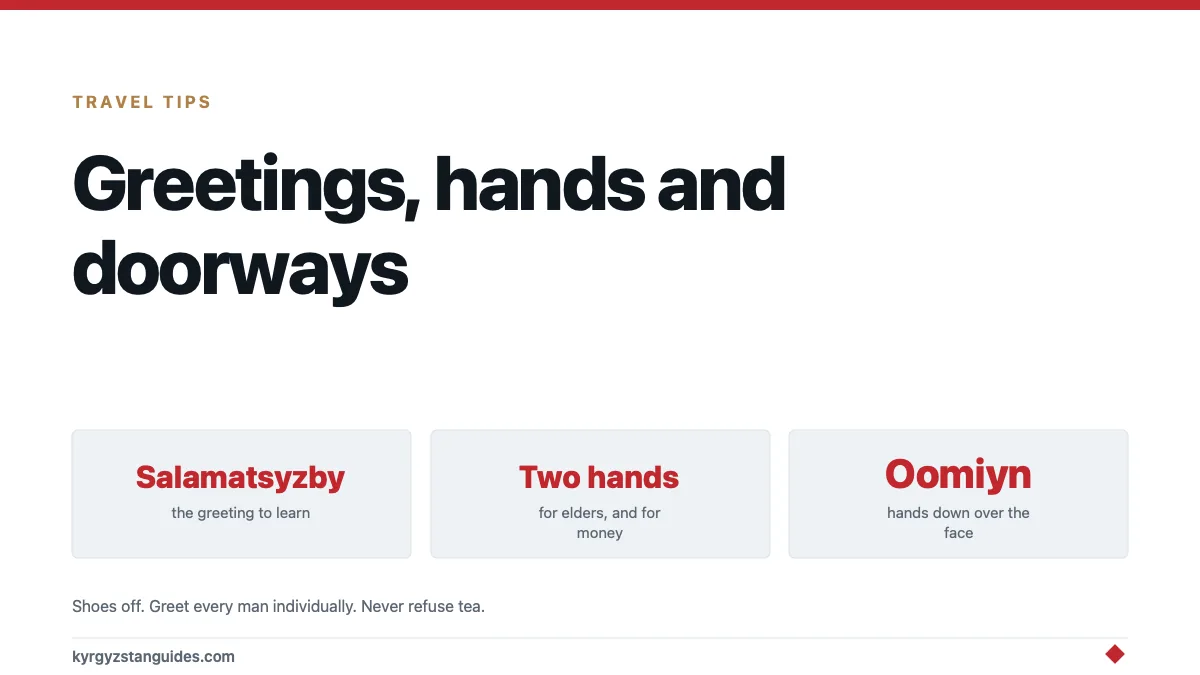
Salamatsyzby is the standard Kyrgyz greeting: formal, polite, usable with anyone. Salam is the casual version between people who know each other.
Assalamu alaykum is used between men, particularly older men and in religious contexts, answered with wa alaykum assalam. It arrived with Islam and sits alongside the Kyrgyz forms rather than replacing them.
Zdravstvuyte in Russian works everywhere and is what you'll hear in Bishkek constantly. Linguistic work on the concept of konok in Kyrgyz shows how much of the language's social vocabulary is built around receiving people.
Our phrases guide has the wider vocabulary, but if you learn one thing, learn salamatsyzby — and note the pattern covered in our piece on the language question: opening in Kyrgyz and switching to Russian lands better than the reverse.
Hands
This is the part most visitors get wrong and it's the most noticed.
Men shake hands with men. Firmly, with eye contact, and frequently with the left hand touching the other person's forearm or covering the handshake as a mark of warmth.
Shake with everyone in the room. On arriving at a gathering, a man goes round and greets each man individually. Skipping someone is a visible slight.
Two hands for respect. Receiving something from an elder, handing over money, giving a gift, accepting a bowl. Use both hands, or the right hand with the left touching the right forearm.
Do not offer a hand to a woman unless she offers first. Many Kyrgyz women shake hands and many don't, and the convention varies by age, region and religiosity. A nod and a hand on the heart is universally correct.
The hand on the heart, right palm flat on the chest, slight bow, is the safest all-purpose gesture in the country. Use it when in doubt.
Do not eat, give or receive with the left hand. The convention is shared across much of the Muslim world and is observed here without much comment, it's noticed rather than enforced.
Amen
You'll see this constantly and nobody explains it.
At the end of a meal, a prayer, a visit to a grave or a significant moment, people raise both hands palms up, briefly, then draw them down over the face.
The gesture is oomiyn. Amen. It closes a blessing.
Join in. Copy it. Nobody expects you to say anything and participation is welcomed rather than considered presumptuous. Not joining in is the noticeable choice.
It happens more often than you expect: after a meal at a homestay, on arriving somewhere significant, at a toi, before a journey.
Inside a house
Shoes off at the door. Always. There will be slippers.
The far side of the room is the honoured position. Opposite the door, under the tush kyiz if there is one. If you're directed there, take it, as our homestay guide explains, being placed there is a compliment and refusing it creates awkwardness.
Wait to be seated. There is an order and the household knows it.
Do not step over anyone. Go round.
Do not point your feet at people or at food. Sitting cross-legged or with legs folded to the side is the convention.
Bread is respected. Never face down, never thrown away, never left on the floor. Our tea and bread customs guide covers the table properly.
Tea
Your bowl will be filled only part-full. This is correct and not stinginess. A small pour means frequent refills, which means repeated contact between host and guest. A full bowl signals you should leave.
Take it with the right hand, or both.
To stop, place a hand briefly over the bowl or turn it over, with thanks.
Drink it. Refusing tea outright is the single easiest way to be rude here.
Age
The organising principle of most social interaction.
Elders are greeted first, served first, seated best, and spoken to with the formal form.
Eje for an older woman, baike for an older man: attached after the name, or used alone. These are enormously useful and warmly received.
There is a fuller set beneath these: apa and ata for grandmother and grandfather figures, jenge for an older brother's wife, and a range of terms for relations that English collapses into "aunt" and "uncle". Kyrgyz kinship vocabulary is far more precise than English, which follows from a society that tracked descent seriously. You will not need all of it; you'll notice people using it.
Do not use first names alone with much older people. Name plus patronymic, as covered in our guide to Kyrgyz names.
Stand when an elder enters. Not universally observed, always noticed.
The deference is not empty form. In a society organised around descent and kinship networks, age carries genuine authority in family and community decisions, and the greeting order reflects a real hierarchy rather than a ceremonial one.
Being a guest
The underlying principle, which makes the individual rules make sense.
Kyrgyz hospitality is not politeness. It is an obligation with real weight behind it, formed in a society where a traveller turned away in the mountains could die. The word konok means guest, and the duty to receive one is old and explicit.
The proverb is konoktuu üydö kut bar, a guest in the house, grace in the house. The guest brings the blessing; the host is the one receiving something. Academic work on the ritual of hospitality in Kyrgyz culture traces the norms and how they have survived into the present.
The traditional form of it's precise: the host unsaddled the arriving guest's horse, and saddled it again when the guest chose to leave. Regardless of the household's means, food and a bed were offered.
Three consequences follow.
You'll be fed more than you want, and refusing outright is genuinely difficult. Take a small amount rather than declining. A study of Kyrgyz food culture sets out how the dastorkon, the spread laid for a guest, functioned as a survival institution.
The host may spend more than they can afford. This is not something to comment on. See our piece on the toi economy for how far that goes.
Reciprocate with presence, not money. Bring something small, sit and drink tea, and stay longer than feels efficient. Paying for a homestay does not discharge the guest role; it exists alongside it.
The frequent visitor mistake is treating hospitality as a transaction and leaving immediately after eating. The meal is the beginning of the visit, not the whole of it.
Things that aren't required
Worth saying, because guides tend to over-warn.
Dress is relaxed. Ordinary clothing is fine almost everywhere. Modesty matters at mosques and sacred sites, not on the street in Bishkek. See our what to wear guide.
Alcohol is normal in most settings and absent in others. Follow the household.
Public affection between couples is low-key rather than forbidden.
You'll be forgiven almost anything. Foreigners are not held to these conventions and errors are met with amusement rather than offence. Which is exactly why making the effort registers.
FAQ
How do you say hello in Kyrgyz?
Salamatsyzby is the standard polite greeting, usable with anyone. Salam is casual. Between men, assalamu alaykum is common.
Should I shake hands in Kyrgyzstan?
Men shake hands with men, greeting each person individually on arrival. Do not offer a hand to a woman unless she offers first; a nod with the right hand on the heart is always correct.
What is the gesture of drawing hands over the face?
Oomiyn (amen) which closes a blessing after a meal, a prayer or at a significant moment. Visitors are welcome to join in and it's noticed if you do.
Do I take my shoes off in a Kyrgyz house?
Yes, always at the door. Slippers are usually provided.
Why is my tea bowl only half full?
Deliberately. A small pour means the host refills it often, which is a form of attentiveness. A full bowl can signal that the visit is ending.
How should I address older people?
Use eje for an older woman and baike for an older man after their name, or a given name with the Russian patronymic. Greet, serve and seat elders first.