Kyrgyzstan has two languages in official use and an active, occasionally tense argument about the balance between them.
Kyrgyz is the state language. Russian holds official status, written into the constitution. In practice, which one you hear depends on where you're standing, how old the person is, and what they do for a living. And that balance is shifting, deliberately, by law.
For a visitor this isn't abstract. It determines which phrasebook is useful, which signs you can read, and occasionally how a conversation lands.
The rough geography of it
Bishkek operates substantially in Russian. Business, higher education, much of daily life in the capital. Kyrgyz is everywhere too, but a foreigner functioning in Russian in Bishkek will rarely be stuck.
The south (Osh, Jalal-Abad, Batken) is far more Kyrgyz-speaking, with Uzbek as a substantial third language in the Fergana valley.
Rural areas generally are Kyrgyz-first, and in remote valleys a fair number of people, particularly older women, have limited Russian.
Younger people increasingly have English rather than strong Russian, especially those who have been to university recently or worked in tourism.
Older people are more likely to be comfortable in Russian, which was the language of education and administration for most of their lives.
The rule of thumb: Russian goes further in the north and in cities, Kyrgyz goes further in the south and in villages, and English works best with people under thirty in the tourism economy.
The 2023 law
This is the change worth knowing about.
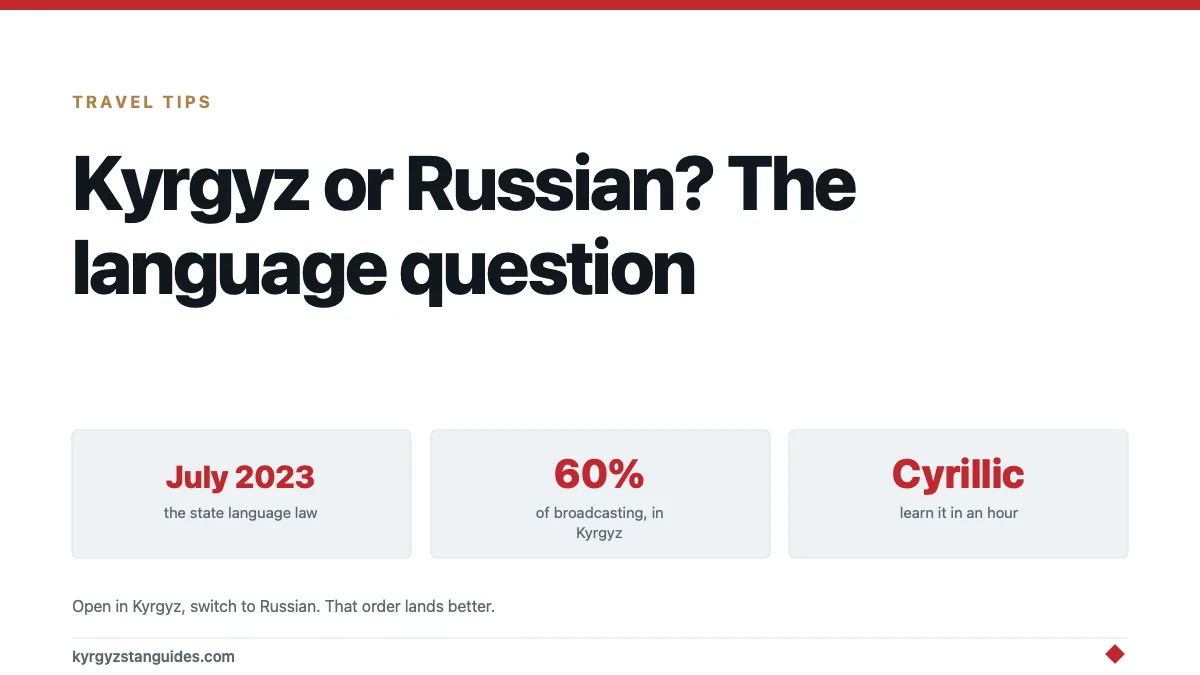
On 17 July 2023, President Japarov signed the Constitutional Law on the State Language. It sets the framework for Kyrgyz in public life and it has teeth.
What it requires:
Fluency in Kyrgyz for state employees — government officials, members of parliament, central bank staff, police, judges, prosecutors, defence lawyers and notaries. Officials who can't speak Kyrgyz were warned they would be dismissed.
At least 60% of television and radio broadcasting in Kyrgyz.
Official documents in Kyrgyz, translated into other languages where necessary.
Reduced use of Russian in education, healthcare, the courts and administration.
RFE/RL reported on the dismissal warnings as the law took effect, and the full text is on Refworld.
Why it is contested
Because it is not only a language policy.
The case for it is straightforward decolonisation. Kyrgyz is the language of the titular nation of a sovereign state, and for most of the twentieth century it was subordinate in its own territory, administration, science, higher education and advancement all ran in Russian. A generation of urban Kyrgyz grew up with weak command of their own language. Reversing that is a normal thing for a post-colonial state to attempt, and analysis of linguistic decolonisation in Kyrgyzstan treats it in those terms.
The case against is partly practical and partly geopolitical. Practically, Russian is the working language of the labour migration economy that supplies close to a fifth of GDP, and of much technical and medical training. Geopolitically, Moscow noticed: Russia's foreign minister called the law undemocratic and discriminatory, and Russian diplomatic reaction was pointed.
President Japarov's position has been that Russian retains its constitutional status as an official language and isn't being discriminated against.
Both things are happening at once: Russian keeps its legal standing, and its practical share of public life is being reduced.
The Uzbek question
There is a third language, and it's the one with no legal protection.
Uzbek is the first language of a substantial population in the south: in Osh, Jalal-Abad and the villages of the Fergana valley. It has no official status. After 2010, Uzbek-language schooling and broadcasting contracted sharply, with many schools switching to Kyrgyz or Russian instruction.
The stated reason was integration and the practical need for graduates to pass national exams and find state employment, both of which run in Kyrgyz. The effect was the narrowing of a minority language in the places where it's most spoken.
You will hear Uzbek constantly in the southern bazaars and almost nowhere official. That gap is worth noticing, because it complicates the decolonisation framing: the same argument that elevates Kyrgyz over Russian also elevates it over Uzbek, and the two look quite different depending on which end you're at.
What this means for you
Learn a few words of Kyrgyz, not only Russian. This matters more than it did ten years ago. Salamatsyzby (hello), rakmat (thank you) and jakshy (good) will get a warmer response than the Russian equivalents, particularly outside Bishkek. Our phrases guide covers the basics.
Russian is still enormously useful. This is not a reason to abandon it. In Bishkek, in transport, in bazaars and with anyone over forty, Russian is the practical lingua franca and will remain so for a long time.
Learn the Cyrillic alphabet. Both languages use it. An hour of study makes road signs, shop names and bus destinations legible, which changes how independently you can move around — as our guide to Kyrgyz place names explains, the names themselves are readable once you can sound them out.
Do not assume Russian is welcome everywhere. It's not resented in the way it is in some post-Soviet states, and Kyrgyzstan is notably relaxed about this. But opening in Kyrgyz and switching if needed is better manners than opening in Russian.
Do not offer opinions on the language law. As with 2010 and 1916, you're walking into a domestic argument with a foreign-policy dimension. Listen.
English is spreading faster than people expect. Guesthouse owners, guides and younger people in the tourism economy increasingly have workable English. Ten years ago that was rare.
Why it is worth understanding
Because it's the same tension the whole country lives with, expressed in grammar.
Kyrgyzstan's founding trauma is a flight from Russian troops. Its most important current economic relationship is with Russia. Its capital operates in Russian and its villages in Kyrgyz. Its surnames were Russified, partly reversed, partly reversed back for migration paperwork.
None of that resolves into a simple position, and Kyrgyzstanis do not generally pretend it does. Holding several incompatible things at once isn't a contradiction here; it is the normal condition.
FAQ
What language is spoken in Kyrgyzstan?
Kyrgyz is the state language and Russian has official status. Kyrgyz dominates in rural areas and the south; Russian is widely used in Bishkek and in business and administration.
Do I need Russian to travel in Kyrgyzstan?
It helps a great deal, especially in the north and in cities. English is increasingly available among younger people and in the tourism sector, and a few words of Kyrgyz go a long way everywhere.
What did the 2023 language law change?
Signed on 17 July 2023, it requires Kyrgyz fluency from state employees including judges, police and MPs, mandates at least 60% Kyrgyz-language broadcasting, and requires official documents in Kyrgyz.
Is Russian still an official language in Kyrgyzstan?
Yes. Russian retains official status under the constitution, though its practical role in administration, education and healthcare is being reduced.
Which alphabet does Kyrgyz use?
Cyrillic, with a few additional letters. Learning it takes about an hour and makes signs, menus and destinations readable.
Should I speak Kyrgyz or Russian to people?
Open in Kyrgyz where you can (a greeting and a thank-you) and switch to Russian or English as needed. That order is better received than the reverse, particularly outside the capital.