Kyrgyz place names are descriptions. Almost every one of them tells you what's there, the colour of the water, the shape of the mountain, whether the pass is passable, whether the valley is any good.
Once you can read perhaps twenty words, a map of this country stops being a list of unpronounceable labels and becomes something closer to a terrain report written by the people who used it. This is the single highest-value hour of language learning a traveller here can do.
The colours
Turkic languages use a small set of core colour terms, and they carry more than colour. Research on basic colour terms in Kazakh. Closely related to Kyrgyz: sets out the same five that dominate the map.
| Kyrgyz | Colour | What it usually signals |
|---|---|---|
| Ak | white | Clear water, snow, or "good" |
| Kara | black | Dark rock, spring-fed water, or "plain/great" |
| Kyzyl | red | Red rock and sandstone |
| Sary | yellow | Yellow-brown ground, dry pasture |
| Kök | blue/green | Sky-blue water, green grass |
| Boz | grey | Grey steppe, scrub |
| Ala | dappled | Mottled, snow patches on dark rock |
Two of these need a note, because the literal translation misleads.
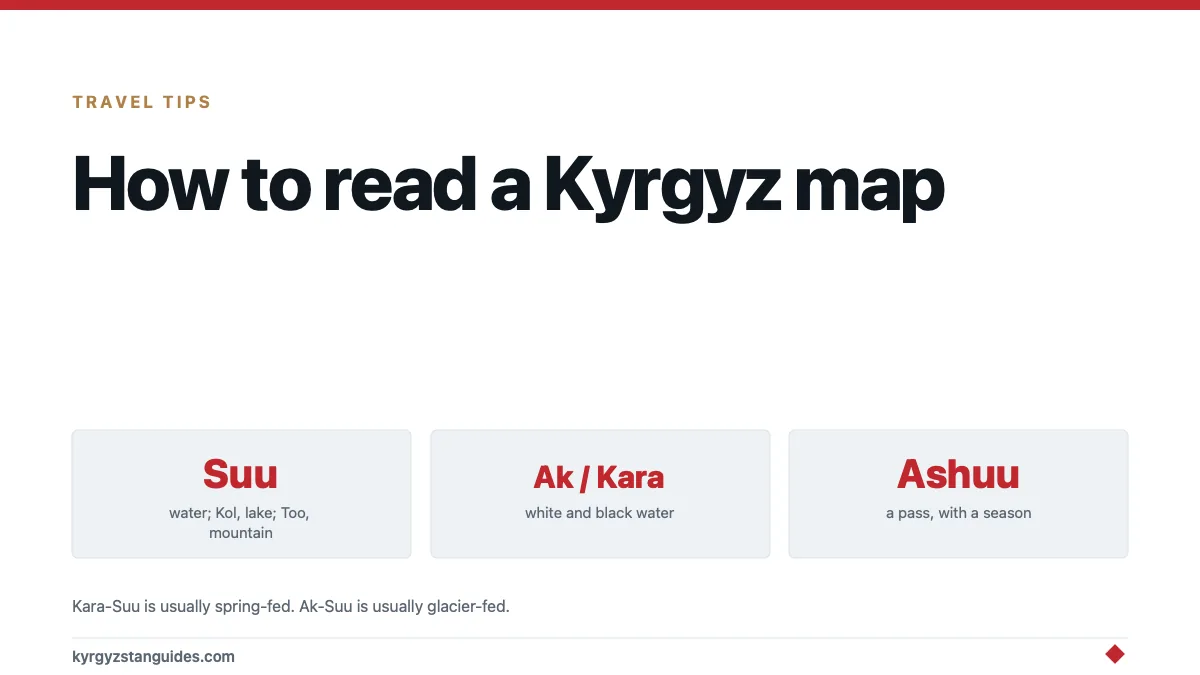
Kara on a river name often means spring-fed rather than black. Glacier-fed water is milky with rock flour and looks white; spring-fed water is clear and therefore looks dark. So Ak-Suu and Kara-Suu aren't describing pigment. They are describing where the water comes from, and one of them is much better to drink.
Ala is why the mountains are called Ala-Too: dappled mountains, snow on dark rock. The same word gives Ala-Archa. Dappled juniper.
The landscape words
| Kyrgyz | Meaning |
|---|---|
| Suu | water, river |
| Köl (Kul) | lake |
| Too | mountain |
| Tash | stone |
| Ashuu | pass |
| Bel | saddle, low pass |
| Bulak | spring |
| Say | gully, dry riverbed |
| Jar | cliff, riverbank |
| Dobo | hill, mound |
| Örük | apricot |
| Archa | juniper |
| Terek | poplar |
| Jailoo | summer pasture |
| Kyshtoo | winter quarters |
A Kyrgyz reference on the origins of geographical names gives the same pattern with more examples (Ak-Buura as white foam, Torugart as low pass) and the principle is consistent: the name describes the feature.
Combine those with the colours and most of the map falls open. Too-Ashuu is simply "mountain pass". Ala-Bel is "dappled saddle". Kyzyl-Suu is red water. Ak-Terek is white poplar.
The size and quality words
These are the ones that make the map funny, and occasionally useful.
- Chong, big - Kichi / Kichine, small - Uzun. Long - Jangy, new - Eski, old - Jakshy, good - Jaman — bad
A Jaman- anything was named by someone who had been there. If a valley is called bad, that's a field report, not an insult, and it's usually about grazing or footing.
Chong-Kemin and Kichi-Kemin are simply big and little Kemin, which is how a great many paired valleys are named here.
Famous names, decoded
Issyk-Köl, hot lake. It never freezes, despite sitting at 1,600 m in a country that reaches -30°C, because of its volume and slight salinity. The name is a straightforward observation. Our Issyk-Kul guide covers the rest.
Chatyr-Köl: roof lake, often rendered as celestial lake. At over 3,500 m the name earns itself.
Song-Köl. Usually given as "last lake", which fits: it's the last one out there. Our Song-Kul guide has the practical detail.
Jeti-Ögüz, seven bulls, for the row of red sandstone formations. Go and count them; opinions differ.
Kara-Köl: black lake, of which there are several.
Tash-Rabat — stone caravanserai. Precisely what it is.
Sary-Chelek, yellow bucket or yellow vessel, for the shape of the basin.
Kel-Suu — "come, water", or "the water came", for a lake that appears and changes level dramatically.
Ala-Archa — dappled juniper, for the national park nearest Bishkek.
Suusamyr, contested. One reading takes suu with an Iranian word for beaver or otter, which would make it an animal name rather than a description. Not every name is transparent, and the ones that aren't usually have a pre-Kyrgyz layer underneath.
Why this is actually useful
Not trivia. Four concrete uses.
Water. Knowing that ak-suu tends to mean glacier-fed and kara-suu tends to mean spring-fed is genuinely practical information in a valley, and it pairs with our guide to whether the water is safe. Neither is a substitute for filtering.
Navigation. A name containing ashuu is a pass, and a pass has a season. A name containing say is a dry gully that isn't dry during rain.
Repetition. There are many places called Kara-Köl, Ak-Suu and Kyzyl-Suu. If you're agreeing a destination with a driver or a guesthouse, the region matters as much as the name, and this is a very common source of confusion.
Conversation. Asking what a place name means is one of the better questions you can ask here. People generally know, often disagree with each other, and enjoy the argument. It goes well with the basics in our Kyrgyz phrases guide.
The names that aren't Kyrgyz
A useful thing to notice as you travel: not every name on the map is in this language.
Russian and Soviet names are still common, especially in the north and in towns founded as forts or factory settlements. Some have reverted — Frunze became Bishkek, Przhevalsk became Karakol. And others haven't. A settlement called something ending in -ovka was almost certainly a Slavic farming village, which is the layer our piece on the Russian community covers.
Persian and Sogdian layers show up in the south, where the settled Persianate world reached furthest, and in older river names across the country.
Mongol and older Turkic layers are there too, sometimes visible and sometimes only to specialists.
This is why some names decode cleanly and others resist. When a name will not come apart into Kyrgyz words, it's often because it isn't Kyrgyz: it is something older with Kyrgyz pronunciation laid over the top, in a valley that has had a great many occupants.
A note on spelling
You will see the same place spelled several ways, and all of them can be correct.
Kyrgyz is written in Cyrillic, and transliteration into Latin script has never been standardised. A Kyrgyz phrase reference will show you the alphabet, which makes road signs readable much faster than you would expect. Köl appears as kol, kul and kel. Jeti appears as jety and djety. The letter ы comes out as y or i depending on who typed it.
Expect Issyk-Kul / Ysyk-Köl, Song-Kul / Son-Kul / Songköl, Jeti-Oguz / Jety-Ögüz. These are spelling variants, not different places, and search engines and booking sites are inconsistent about them. It's worth trying two spellings before concluding something doesn't exist.
FAQ
What does "suu" mean in Kyrgyz place names?
Water or river. It appears constantly in compounds like Ak-Suu (white water), Kara-Suu (black water) and Kyzyl-Suu (red water).
What does Issyk-Kul mean?
Hot lake. The lake is slightly saline and very deep, and doesn't freeze despite the altitude and winter temperatures.
What is the difference between Ak-Suu and Kara-Suu?
Literally white water and black water, but in practice the distinction usually reflects the source: glacier-fed water looks milky-white from suspended rock flour, while spring-fed water runs clear and appears dark.
What does "too" mean in Kyrgyz?
Mountain. Ala-Too means dappled mountains, and Too-Ashuu means mountain pass.
What is a jailoo?
A high summer pasture where herding families move with their animals for the warm months — the counterpart is kyshtoo, the winter quarters lower down. Most yurt stays in Kyrgyzstan take place on a jailoo.
Why is the same place spelled different ways?
Kyrgyz uses Cyrillic and there's no standard Latin transliteration, so the same name appears with different vowels and consonants depending on the source. Issyk-Kul and Ysyk-Köl are the same lake.