You'll meet someone called Aizhan Bakytovna. You will meet someone called Nurlan uulu Azamat. You'll meet Ms Sydykova, whose brother is Mr Sydykov, and you will meet a guesthouse owner who introduces herself with one name and whose passport says something structurally different.
None of this is inconsistency. Kyrgyz naming has been through three systems in a century, all of them are still in use, and which one a person carries says something about when they were born, where their family has worked and what they think about it.
It's worth twenty minutes of your attention, because getting someone's name right is the cheapest form of respect available to a traveller.
The traditional system
Before Russian administration, Kyrgyz naming was patronymic rather than surname-based. You were your father's child, and lineage was traced orally. Often a long way back.
The two words to know:
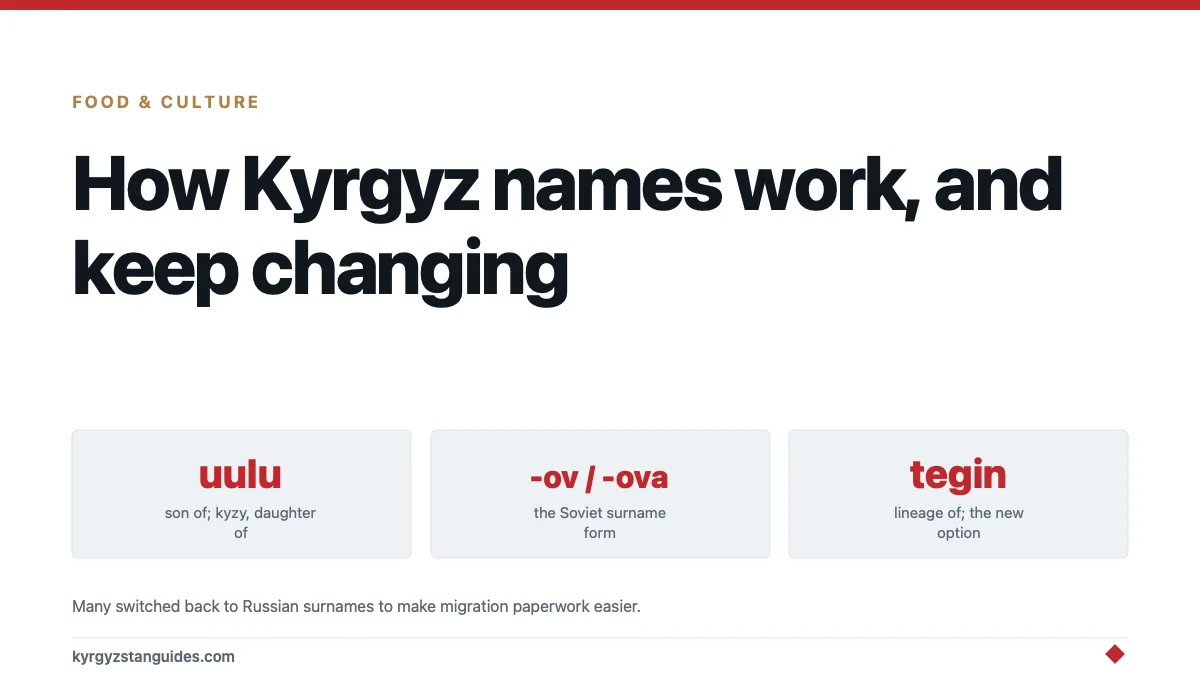
- uulu, son of - kyzy — daughter of
So Azamat Nurlan uulu is Azamat, son of Nurlan. Aizhan Bakyt kyzy is Aizhan, daughter of Bakyt.
There is no family surname in this system, which is the crucial difference. A father and his children do not share a name component. A brother and sister carry different suffixes. This isn't a variation on European naming; it's a different way of encoding who someone is.
Lineage mattered enormously in a society organised around descent (knowing seven generations of ancestors was a real cultural expectation, not a saying) and the epic of Manas is in part a genealogical document for exactly that reason.
The Soviet system
Russian administration, and then the Soviet state, needed the population legible to a bureaucracy built for Slavic names. So Kyrgyz names were restructured into the Russian three-part format:
Given name + patronymic + surname
The patronymic takes Russian endings: -ovich / -evich for men, -ovna / -evna for women. The surname takes -ov / -ev for men and -ova / -eva for women.
So a man whose father was Bakyt became Bakytovich. A woman, Bakytovna. The family surname was formed from an ancestor's name plus the Russian ending, and became heritable in the European way.
| Element | Traditional | Soviet |
|---|---|---|
| Son of Bakyt | Bakyt uulu | Bakytovich |
| Daughter of Bakyt | Bakyt kyzy | Bakytovna |
| Family name | none | Bakytov / Bakytova |
This is the system most official documents still use, and it's why the surnames on this country's football team and its ministries list look Russian while the given names don't.
What happened after 1991
Independence produced a wave of people dropping the Russian endings and going back to uulu and kyzy. This was a straightforwardly political act and it was widespread in the 1990s.
Then, in the 2000s, it substantially reversed. Reporting by 24.kg on the current reforms notes the same pattern from the other end — the legal flexibility now on offer is a response to decades of people moving back and forth between the two systems. Large numbers of Kyrgyz citizens went back to Russian-style surnames.
The reason was labour migration. Hundreds of thousands of Kyrgyz citizens work in Russia, and a Russian-format name makes the paperwork, the landlords and the police marginally easier. A name is an identity document before it is a statement, and when your income depends on that document functioning smoothly in Moscow, the statement gets deferred.
That is the most honest thing in this whole subject. The naming question in Kyrgyzstan has never been purely about culture. It has been about culture colliding with the economics of who employs whom.
The current law
Legislation has now made the traditional forms a full legal option rather than a workaround.
President Japarov signed amendments to the Family Code and the law on civil status acts giving parents a genuine choice when registering a child. The reported options include:
- The father's name plus uulu (son) or kyzy (daughter) - The grandfather's name with no ending added - The grandfather's name plus tegin, meaning lineage of - A surname drawn from an ancestor up to seven generations back
The consistently stated principle, reported by The Times of Central Asia and others, is that nobody is compelled to change anything. Earlier proposals were more forceful; RFE/RL covered a 2015 push to systematically de-Russify names that didn't become law in that form.
tegin is the interesting addition. It creates something the traditional system never had. A heritable family name that's Kyrgyz rather than Russian in form. That is not a restoration of the old system. It is a third thing, built to do the job a modern state needs a surname to do, in the local language.
Practical notes for travellers
Respect for elders, not first names. With an older person, the safest address is given name plus the Russian patronymic — Bakytovna, Nurlanovich. It sounds formal to a Western ear and reads as ordinary courtesy here. Our phrases guide covers the greetings that go with it.
"Eje" and "baike." Far more useful in daily life. Eje for an older woman, baike for an older man, attached after the name or used alone. Aizhan eje. It is warm rather than stiff and it's what you'll actually hear.
Don't assume a shared surname means marriage. Or that different surnames mean no relation. The grammar of Russian surnames makes husbands and wives differ by one letter and siblings differ by gender ending.
Booking and ID. Name order on Kyrgyz documents may not match the order used in conversation. When a guesthouse or a driver asks for a name for a permit, relevant for border-zone areas, give it exactly as printed in your passport and let them handle theirs.
Ask. "How should I call you?" is a good question in any language and people here answer it generously, often with the story of why their name is what it is.
Why the subject is worth caring about
Because it's the compressed version of the country's last hundred and fifty years.
A pre-literate oral genealogy, replaced by an imperial filing format, partially reclaimed at independence, quietly surrendered again for economic reasons, and now legislated back as an option rather than an obligation. Every one of those stages is still walking around in the form of living people with names from different eras.
It is the same story the Russian community, the Dungan villages and the language question all tell from their own angles. Names are just where it is written down.
FAQ
What do uulu and kyzy mean in Kyrgyz names?
Uulu means "son of" and kyzy means "daughter of." They follow the father's name, so Azamat Nurlan uulu is Azamat, son of Nurlan.
Why do Kyrgyz people have Russian surnames?
Russian and Soviet administration restructured Kyrgyz names into the Russian given name–patronymic–surname format, with -ov/-ova surnames and -ovich/-ovna patronymics. Those documents largely carried through to the present.
What does tegin mean?
"Lineage of." It's a newer option that attaches to an ancestor's name to create a heritable Kyrgyz-form surname, filling the role a family name plays without using Russian endings.
Is Kyrgyzstan forcing people to change their names?
No. The current legislation makes traditional formats a legal choice for parents registering children and for those who want to change, while explicitly leaving existing names alone.
How should I address someone in Kyrgyzstan?
For older people, given name plus patronymic, or the respectful forms eje for a woman and baike for a man after their name. Among younger people and in casual settings, the given name alone is fine.
Why did many Kyrgyz people switch back to Russian surnames after the 1990s?
Largely because of labour migration to Russia. Russian-format names simplify documentation and daily life for migrant workers, so many families reverted for practical reasons.