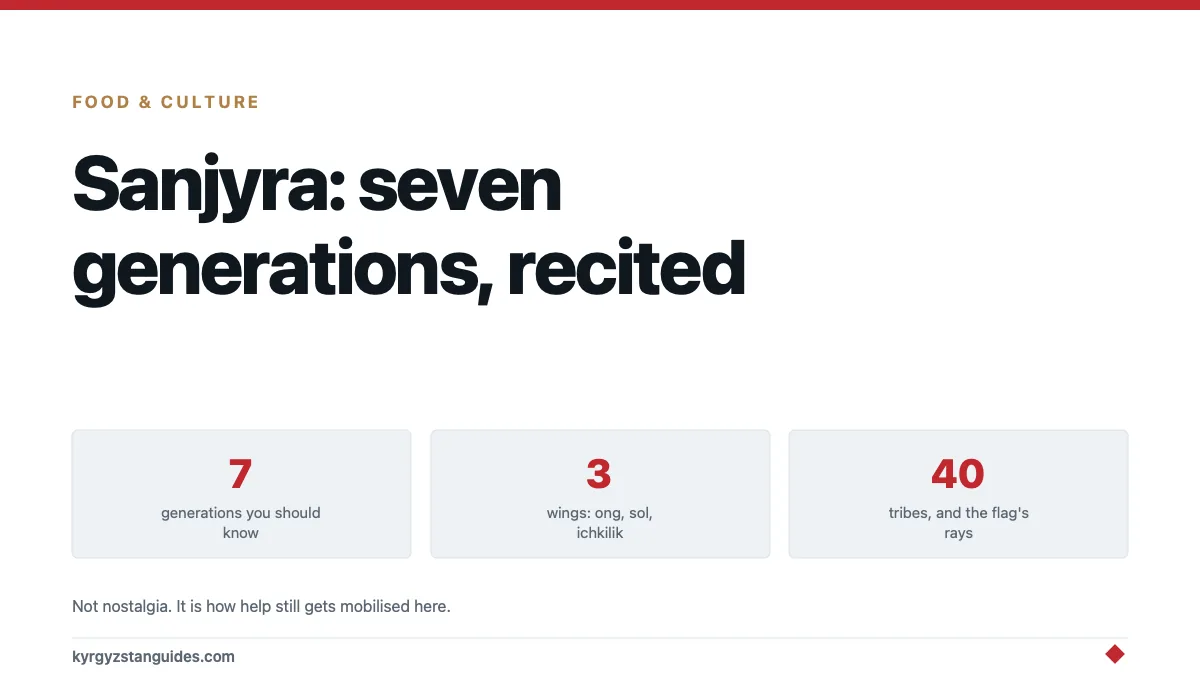
A traditional expectation here is that you can name your ancestors back seven generations, in the male line, in order.
The practice is called sanjyra, the oral recitation of descent, and it isn't a party trick. It determined who you could marry, which pasture your family used, who was obliged to help you, and where you stood.
It also still shapes Kyrgyz politics, and it's the thing sitting underneath the forty rays on the flag.
What sanjyra is
An oral art form, recited rather than written, listing ancestors on the straight male line and branching out into the structure of clans and tribes.
It is history, law and identity at once. A person who could recite their sanjyra could establish their relationship to any other Kyrgyz they met, which in a mobile society without written records was the entire basis of social organisation.
The knowledge was compulsory in the real sense. Not knowing your ancestors was a serious deficiency, and it is still a mild embarrassment.
Accounts of how sanjyra encodes history and genealogy treat it as a historical source in its own right, alongside its social function.
The structure
The genealogy divides the Kyrgyz into three large groupings.
| Grouping | Kyrgyz | Broadly |
|---|---|---|
| Right wing | Ong kanat | North, west and parts of the south |
| Left wing | Sol kanat | North-west, Talas |
| Inner | Ichkilik | The south, especially the Fergana valley |
The right and left wings are traced from the sons of Dolon Biy, Ak Uul and Kuu Uul, with the Ichkilik as a separate grouping.
Below the wings sit tribes (uruu), below those clans, and below those extended families. A Kyrgyz person's identity in the traditional system is a position in that tree. Ethnographic accounts of Kyrgyz family-kin groups set out how the levels nest.
The forty rays on the flag are the forty tribes united in the epic of Manas, and the country's name is traditionally derived from kyrk — forty. The legendary layer includes the tale of the forty maidens.
Why it still matters
Because the tree did not dissolve when the state arrived.
Marriage. Exogamy — marrying outside your clan — was the rule, and knowing your descent was how you knew who was ineligible. Seven generations is roughly the boundary. This still operates in many families.
Mutual obligation. Clan networks are how help is mobilised: for a funeral, for a toi, for a hospital bill, for a job.
Politics. Kyrgyz politics runs along these lines to a degree outsiders consistently underestimate. Voting has been studied as an uruu and village-based phenomenon rather than a purely programmatic one, and the composition of any government is read here in terms of which regions and which networks are represented.
Regionalism. The north–south division that shapes so much, visible in 2010, in internal migration, in religiosity, maps loosely onto the wing structure.
The manaschi and the genealogist
Sanjyra and the epic are the same tradition doing two jobs.
A manaschi recites Manas — hundreds of thousands of lines, memorised, performed in a trance-like state, without a text. A sanjyrachy recites descent. Both are oral specialists in a society that had writing available and largely did not use it for this.
That is worth pausing on. The Kyrgyz weren't illiterate; Arabic and later Cyrillic script were both available. The knowledge was kept oral because oral transmission had properties writing didn't: it travelled with people who moved seasonally, it couldn't be confiscated, and a reciter could adapt the telling to the audience in front of him.
The cost is obvious. Oral genealogy is revisable, and versions of sanjyra disagree. Sometimes usefully, in favour of whoever is reciting. Historians treat it as a source that needs handling rather than a record to be trusted flat.
The benefit is that the system survived seventy years of a state that actively discouraged it, because there was nothing to destroy. Our piece on the Kyrgyz Miracle notes the same thing about Manas itself — the fullest recorded versions came from Kyrgyz who were outside the Soviet Union entirely.
What this isn't
Two clarifications, because the subject invites misreading.
It isn't tribalism in the pejorative sense. Nobody is at war along these lines. It is a kinship network functioning as a social safety net in a country where the formal one is thin, which is a rational adaptation rather than a failure to modernise.
It isn't a caste system. There is no hierarchy of clans in the sense of higher and lower birth. Descent determines relationship, not rank.
The closest Western analogue is probably the way extended family and regional origin still quietly shape opportunity in a great many countries, with the difference that here it is explicit, named and recited.
How it shows up in conversation
You will encounter this more than you expect.
"Where are you from?" is a real question. When Kyrgyz people ask each other, the answer is a region and often a village, and it locates the person in a way that goes beyond geography.
Ancestors come up. Someone may tell you about a great-great-grandfather with a precision you would find unusual at home.
Surnames don't encode it. As our guide to names explains, Russian-format surnames flattened a system that had never used family names. The clan information lives in what people know, not in their documents. Which is one reason the tegin naming option, drawing on an ancestor up to seven generations back, matters more than it looks.
Do not ask directly which clan someone belongs to. It's not secret, and it is also not a question a stranger asks. If it comes up, it comes up.
Do not try to map it onto politics out loud. Foreigners producing analyses of which clan controls what are tiresome and usually wrong.
Why a traveller should know
Because it answers the question most visitors eventually ask: how does anything work here?
A country with limited state capacity, an economy built on remittances, and a population that moved en masse from villages to a capital in thirty years does not hold together on institutions alone. It holds together on knowing who your people are and what you owe them.
The seven generations aren't nostalgia. They are the infrastructure.
FAQ
What is sanjyra?
The Kyrgyz oral genealogy: the recitation of male-line ancestors and the structure of clans and tribes. Traditionally every person was expected to know seven generations.
What are the Kyrgyz tribal groupings?
Three: the right wing (ong kanat), the left wing (sol kanat) and the ichkilik or inner group, with the right and left wings traced from the sons of Dolon Biy.
Why forty rays on the Kyrgyz flag?
They represent the forty tribes united in the epic of Manas. The country's name is traditionally derived from kyrk, meaning forty.
Does clan still matter in Kyrgyzstan?
Yes, in marriage rules, mutual obligation networks and politics. Research has examined voting as an uruu and village-based phenomenon rather than a purely programmatic one.
Is Kyrgyz clan structure a hierarchy?
No. Descent establishes relationship rather than rank. There is no system of higher and lower birth between clans.
Should I ask someone which clan they belong to?
Not directly. It isn't secret but it isn't a question a stranger asks. Let it come up naturally if it does.