In the 1960s a small Soviet republic with no film tradition, no film school and a population under three million started producing cinema that got noticed in Moscow, then in Europe. Critics gave it a name: the Kyrgyz Miracle.
Sixty years later almost nobody arriving in Bishkek has heard of it. This is a shame, because these films are the single best preparation for the country you're about to travel through: better than any guidebook, including this one.
What the Kyrgyz Miracle was
Kyrgyzfilm, the state studio in Frunze — as Bishkek was then called: began turning out features in the late 1950s. Within a decade the output was disproportionate to the republic's size and unusual in character: heavily shaped by documentary technique, shot largely on location in mountains and villages, and concerned with ordinary Kyrgyz life rather than Soviet allegory.
That last part is the interesting bit. These were state-funded films made under censorship, and yet a surprising number of them are genuinely about grief, love, dislocation and the cost of modernisation, with the ideology sitting awkwardly on top rather than driving the story.
The engine of it was one writer.
Chingiz Aitmatov
Aitmatov is the most important Kyrgyz writer of the twentieth century and he is central to the Miracle. A large proportion of his novels and novellas were adapted for the screen, and he wrote or co-wrote many of the screenplays himself.
His prose does something that adapts unusually well: it treats landscape as a participant. Mountains, steppe and rivers in Aitmatov aren't backdrop, and directors who filmed him inherited that instinct.
If you read one thing before you travel here, read Aitmatov. If you watch one thing, watch a film made from him.
The four to start with
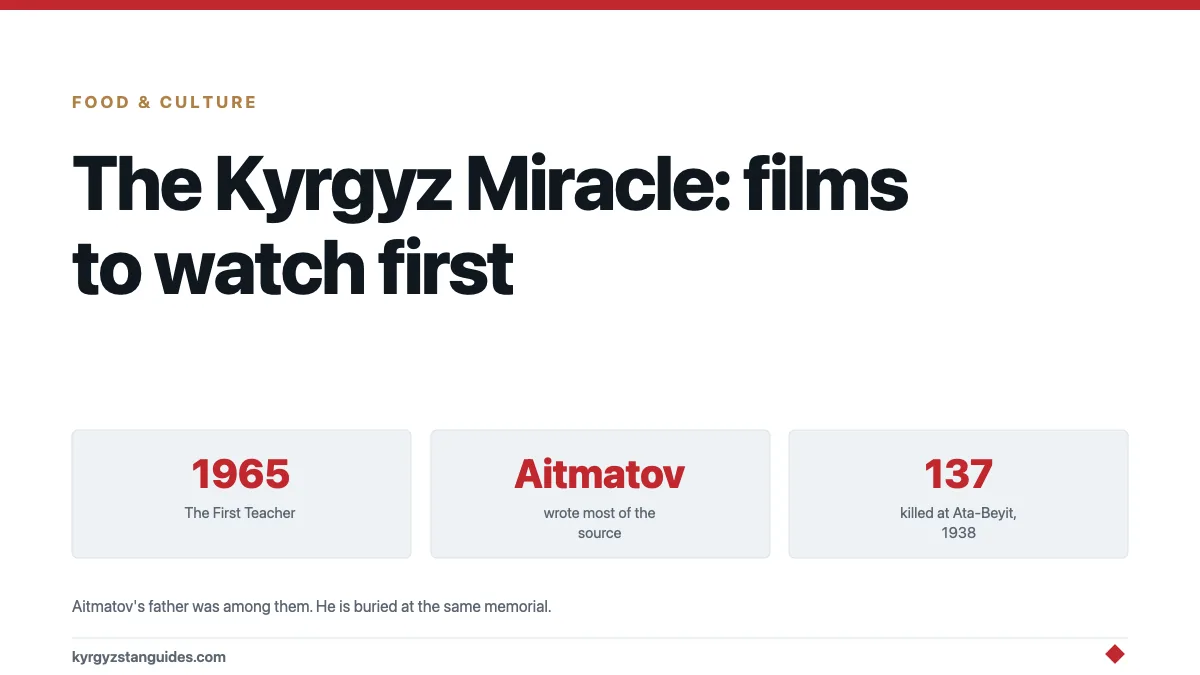
The First Teacher (1965) — directed by Andrei Konchalovsky, from Aitmatov's story. Duishen, a former beggar turned Soviet activist, arrives in a remote village to open a school. It's the foundational film of the movement and it's far harder than its premise suggests. The Times of Central Asia's sixtieth-anniversary piece argues that Konchalovsky turned Aitmatov's drama into a tragedy — the literacy campaign is shown as both liberation and violence, which was not a safe thing to put on screen in 1965.
Watch it and then go to a village school in Naryn region. The building will be from roughly this period.
Jamilya (1968). From the Aitmatov novella that made his name internationally. A wartime love story in a village where the men have gone to the front. Louis Aragon called the source book the most beautiful love story in the world, which is the kind of blurb that usually ruins a thing; in this case it more or less holds.
The White Ship (1976) — from Aitmatov's novel, set on Issyk-Kul. A boy invents a mythology to survive the adults around him. It is the bleakest of the four and the one that lingers.
Anything by Aktan Arym Kubat, for the modern side. Kubat is the contemporary director most associated with reviving this tradition, working with non-professional actors in real villages. He told UNESCO's Courier that he lives among the heroes of his films, which is a good description of the method.
What happened to it
The Soviet Union collapsed and the studio funding went with it.
Kyrgyzfilm had been financed as a republic-level institution inside a system that subsidised national cinemas for ideological reasons. When that system ended, there was no domestic market remotely large enough to replace it. A country of five million with cinemas closing doesn't sustain a film industry.
Kyrgyz film has never fully recovered. What exists now is largely festival cinema made on international co-production money, plus a commercial local industry producing comedies and melodramas for Kyrgyz audiences, which is a real thing that outsiders tend to miss entirely.
The Open Society Foundations have written about reviving the Kyrgyz Miracle, and Amsterdam's Eye Filmmuseum has programmed retrospectives under that title, so the reputation survives abroad better than the industry does at home.
The Aitmatov places you can visit
A few of these are real locations, which is part of why the films travel so well.
Sheker, Aitmatov's home village in Talas region, is where he grew up and where much of the village material in his fiction comes from. It's not set up for tourism and that's rather the point.
Issyk-Kul is the setting of The White Ship, and specifically the forested northern slopes rather than the beach resorts. The lake in that book is an object of longing seen from a distance, which is how it looks from the mountains above the north shore.
Aitmatov's grave at Ata-Beyit, outside Bishkek. Ata-Beyit ("grave of the fathers") marks a mass burial from the Stalinist purges, where 137 members of the Kyrgyz intelligentsia were killed on a single night in 1938. Among them was Aitmatov's father, Törökul.
The location stayed secret for more than fifty years. It's said to have been passed on as a deathbed confession by a guard who was there, and kept by his daughter until independence in 1991. The memorial complex was built in 2000, with Aitmatov himself among its founding organisers. He died in 2008 and was buried there that June, beside his father. The Cultures of History Forum’s study of the site traces how its meaning has been rewritten by successive Kyrgyz governments since.
It is a sombre place and a necessary one, and it explains more about his work than any critical essay.
That reframes the films. The man whose stories became the Soviet republic's proudest cultural export was the son of one of the people that state killed in 1938: and he wrote, and was celebrated, inside it for decades afterwards. Nothing about the Kyrgyz Miracle is as simple as a golden age.
Where to actually watch them
This is the practical problem, and it isn't trivial.
Online. Several of the classics are on YouTube, uploaded by studios and archives, often with English subtitles of variable quality. Mosfilm's official channel carries some Soviet-era co-productions with proper subtitles.
In Bishkek. Ask at the Kyrgyz National Film Studio or at cultural centres about screenings. There is no permanent repertory cinema for this material, which is itself a comment on the situation.
Festivals. The Bishkek International Film Festival programmes retrospectives. Timing varies; check before building a trip around it.
Read first if you can't find the films. Aitmatov is widely translated. Jamilya, The White Ship and The Day Lasts More Than a Hundred Years are all findable in English.
Why this improves the trip
Because Kyrgyzstan is a country where the interesting things are not visually obvious.
You can photograph Song-Kul beautifully and understand nothing about it. These films are about the interior of the life that happens in those places, what it costs to leave a village, what the older generation lost when the young ones went to the city, how the Soviet period was experienced rather than how it is summarised.
Turn up having watched two of them and the conversations you have in guesthouses and yurt camps change. Mention Aitmatov to almost any Kyrgyz person over forty and you'll get a response, usually a strong one.
FAQ
What is the Kyrgyz Miracle?
The name critics gave to the unexpected flowering of cinema from the Kyrgyz SSR in the 1960s, when the Kyrgyzfilm studio produced work that drew international attention despite the republic's small size and lack of film tradition.
Who was Chingiz Aitmatov?
The most prominent Kyrgyz writer of the twentieth century. Many of his novels and novellas were adapted into films, several with screenplays he wrote himself, and he was the driving literary force behind the Kyrgyz Miracle.
What is the most famous Kyrgyz film?
The First Teacher (1965), directed by Andrei Konchalovsky from Aitmatov's story, is generally treated as the foundational work of the movement.
Are Kyrgyz films available with English subtitles?
Some are. Several classics are on YouTube via studio and archive channels with subtitles of varying quality, and festival retrospectives abroad usually screen subtitled prints.
Is there still a Kyrgyz film industry?
Yes, though much smaller. It splits between internationally co-financed festival cinema and a domestic commercial industry making comedies and melodramas for Kyrgyz audiences.
Which Aitmatov book should I read before visiting?
Jamilya if you want something short and beautiful, The White Ship if you want the harder book, and The Day Lasts More Than a Hundred Years if you want his most ambitious.