The red flag has a yellow sun on it, and in the middle of the sun is a shape that looks like a wheel with crossed spokes.
That is the tunduk — the wooden crown at the top of a yurt, seen from directly below. The image on the national flag is what you see lying on your back inside a yurt, looking up through the roof opening at the sky.
Once you know that, you start seeing tunduks everywhere: on the coat of arms, on the currency, on buildings, on gates, on the backs of chairs. It's the most-used symbol in the country and the one most visitors never identify.
How a yurt is actually built
The tunduk is one part of a structure, and the structure is genuinely clever engineering.
| Part | What it is |
|---|---|
| Kerege | The lattice wall: expanding wooden trellis sections, tied together in a ring |
| Uuk | The curved roof poles, one end into the kerege, the other into the crown |
| Tunduk | The circular crown at the apex, holding the tops of all the uuk |
| Bosogo | The door frame, always wooden and often carved |
| Kiyiz | The felt covering, laid over the frame |
| Jip / boo | The woven bands that tension and bind the whole thing |
There are no nails and no permanent joints. The lattice expands like a concertina; the roof poles slot into the crown; the whole frame is held in compression and tension by woven bands and by the weight of the felt.
A yurt can be put up by a family in a couple of hours and taken down faster. It loads onto animals. It survives wind that flattens tents, holds heat at -20°C, and stays cool in summer because the felt can be rolled up at the base to let air through.
That is a design refined over a very long time for one problem: a shelter for a family that moves with animals between seasonal pastures. Our yurt stay guide covers the experience of sleeping in one.
Why the tunduk is the part that became the symbol
Because of what it does, not what it looks like.
The tunduk is the only opening. Smoke from the hearth goes out through it and daylight comes in through it. It is the yurt's window, chimney and clock — you can tell the time from where the light lands on the floor.
That gives it a set of meanings that Kyrgyz sources state consistently: it represents the universe seen from inside the home, the unity of a family under one roof, and continuity between generations.
The practice that makes this concrete: a tunduk is inherited. It passes down, often to the youngest son who stays with the parents, and a family's tunduk can be considerably older than anyone using it. To say a family's tunduk has fallen is to say the family has ended.
That is why it's on the flag. It's not a picture of a building. It's a picture of a household continuing.
The flag itself
Adopted on 3 March 1992, a few months after independence.
Red for valour and bravery, and by tradition connected to the banner of Manas.
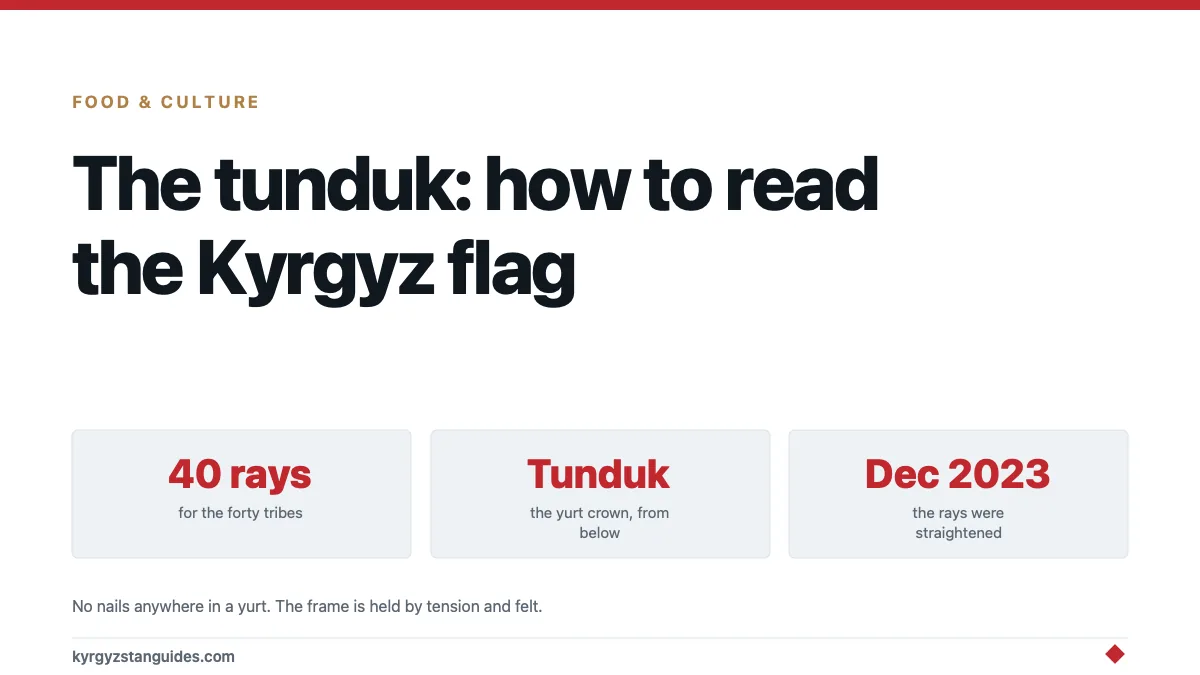
The sun, with 40 rays: for the forty tribes united in the Manas epic, the same forty that give the country its name in the traditional etymology (kyrk = forty).
The tunduk at the centre, crossed by two sets of three lines.
It's one of the few national flags whose entire content is drawn from a single building and a single poem, and both of those are still in use.
The flag argument
Worth knowing because it has been in the news repeatedly.
In December 2023 Kyrgyzstan changed the flag. Not the colour, the tunduk or the forty rays, the shape of the rays.
The original rays were wavy. The argument was that this made the emblem read as a sunflower, which in Kyrgyz carries a distinctly unflattering meaning: a person who turns whichever way suits them. Parliament straightened the rays and, in the same revision, increased the slats on the tunduk from three to four.
It passed its first reading on 29 November and its second and third on 20 December. President Japarov signed it on 22 December 2023; it was published and came into force on 26 December.
It wasn't treated as a technicality. RFE/RL reported the public outcry, and Eurasianet read it as a nation-building exercise rather than a design decision.
The revealing part is what the argument was about. Nobody proposed changing the colour, the number of rays or the presence of the tunduk. The dispute was entirely over whether the rendering made the yurt crown legible enough. A country arguing about whether its flag sufficiently resembles a roof is telling you what the roof means.
If you see both versions around, and you'll, because old flags don't vanish on a schedule, that's why.
Where you'll see it
On every yurt you enter. Look up. The carving and the joinery vary a lot, and an old tunduk is visibly different from a new one.
At the World Nomad Games and in the opening ceremonies of most public events.
On the som. Yurt and tunduk imagery runs through the banknote designs.
In architecture. Bishkek has buildings with tunduk motifs worked into facades, gates and ironwork, and the shape turns up in monuments across the country.
On graves. Traditional Kyrgyz cemetery architecture frequently uses yurt forms, which isn't accidental — the dead are given a house.
A note on buying one
Souvenir tunduks are sold, usually small and decorative. That is fine.
Two cautions:
A genuine old tunduk is a family object, not a souvenir, and anybody selling one is selling something that came out of a household. Consider what you're doing.
Size and export. A real one is large, heavy and wooden, and export of antique items is regulated. Our souvenirs guide covers the sensible purchases; small carved miniatures, shyrdak felt and a kalpak are the ones that travel.
Why it's worth understanding
Because it reframes the yurt from a photogenic tourist experience into what it's: a piece of portable architecture that solved a hard engineering problem so well that the country put a picture of its ceiling on the national flag.
Kyrgyz knowledge of yurt-making is recognised by UNESCO on its Representative List of Intangible Cultural Heritage, jointly with Kazakhstan, covering the craft of making the frame, the felt and the woven bands.
You'll sleep in one for a night and find it more comfortable than you expected. That isn't rustic charm. That is three thousand years of iteration.
FAQ
What is the tunduk?
The circular wooden crown at the top of a Kyrgyz yurt, holding the upper ends of the roof poles. It is the yurt's only opening, serving as window and smoke hole.
What does the Kyrgyz flag mean?
A red field for valour, a yellow sun with forty rays for the forty tribes of the Manas epic, and at the centre a tunduk — the yurt crown seen from inside, looking up.
When was the flag of Kyrgyzstan adopted?
On 3 March 1992, shortly after independence.
What are the parts of a yurt called?
Kerege (lattice walls), uuk (roof poles), tunduk (crown), bosogo (door frame), kiyiz (felt covering) and woven bands that tie and tension the structure.
Is yurt-making protected heritage?
Yes. The traditional knowledge and skills of making Kyrgyz and Kazakh yurts are inscribed on UNESCO's Representative List of the Intangible Cultural Heritage of Humanity.
Can I buy a tunduk as a souvenir?
Small decorative versions are widely sold and travel easily. A genuine full-size one is a heavy family object and antique export is regulated, so think carefully before buying a real one.
The cradle feast that follows a birth, and the cradle itself, are covered in beshik toi.