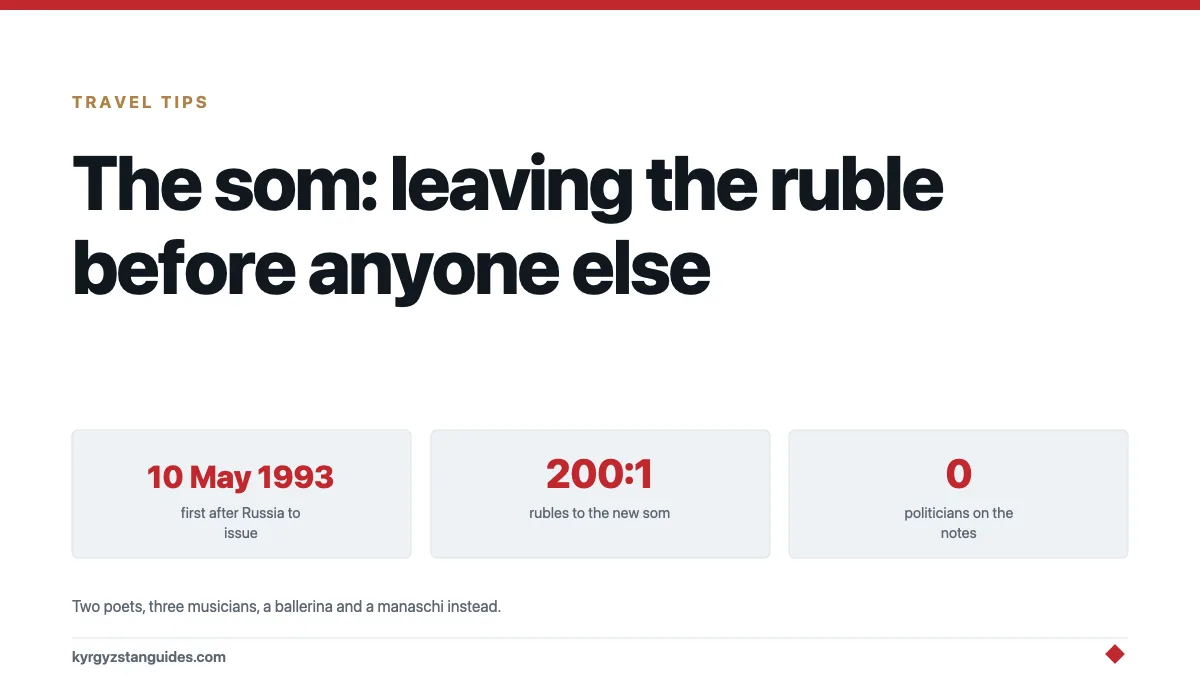
On 10 May 1993, Kyrgyzstan introduced its own currency. It was the first country in the former Soviet Union other than Russia to do so.
The exchange rate was 200 Soviet rubles to 1 som. The first notes came in denominations of 1, 5 and 20 som, plus tyiyn notes of 1, 10 and 50 — small, plain, and officially described as "banknotes of the transitional period", because nobody was confident the arrangement would hold.
It held. Thirty years on, the som is one of the more stable things about Kyrgyzstan — the currency that an average pension of 12,898 som is measured in, and the decision to issue it's arguably the single boldest economic move the country has made.
Why it was a gamble
When the Soviet Union dissolved in 1991, the ruble did not. The successor states continued to use it, which meant fifteen independent governments sharing a currency issued by one of them.
That arrangement was unworkable and it unravelled fast. Each government had its own fiscal policy and its own reasons to want credit; none could control the money supply; Russia's central bank progressively restricted credit flows and then withdrew, and the ruble zone collapsed.
Kyrgyzstan jumped first, in May 1993, with IMF support. It was a small, landlocked, resource-poor republic with no reserves and no monetary institutions, voluntarily cutting itself loose from the currency of its largest trading partner.
The immediate cost was real: Uzbekistan and Kazakhstan reacted badly, trade friction followed, and inflation in the first years was severe. The long-run benefit was that Kyrgyzstan controlled its own monetary policy from the start rather than inheriting a crisis from someone else's.
AKIpress has published a timeline of Kyrgyz currency development since 1993, and the National Bank of the Kyrgyz Republic holds the official record of each note series.
What the name means
Som means "pure" in Kyrgyz and a number of Turkic languages, in the sense of pure metal — the word used for a coin of unalloyed gold or silver.
Uzbekistan's currency is the so'm. Kazakhstan's tenge comes from the same family of trade-weight words. These aren't coincidences; they're a shared monetary vocabulary older than any of the modern states.
Tyiyn is the subunit (100 to the som) and the word means squirrel. Squirrel pelts were a unit of small-value exchange in the fur trade, and the name outlived the practice. You will essentially never encounter tyiyn in circulation; inflation has made it a historical curiosity.
What is on the notes
Worth a look, because the currency is a deliberate statement about what the country decided to be.
The notes carry cultural and historical figures rather than politicians. Going up the denominations, according to the National Bank's own catalogue:
| Note | Portrait | Reverse |
|---|---|---|
| 1 som | Abdylas Maldybaev, composer | |
| 5 som | Bübüsara Beyshenalieva, ballerina | |
| 10 som | Kasym Tynystanov, who built Kyrgyz literacy | |
| 20 som | Togolok Moldo, poet and musician | Tash-Rabat |
| 50 som | Kurmanjan Datka, the "Alai Queen" | Uzgen minaret and mausoleum |
| 100 som | Toktogul Satylganov, musician | Toktogul hydro station |
| 200 som | Alykul Osmonov, poet | Issyk-Kul |
| 500 som | Sayakbay Karalaev, manaschi | Manas mausoleum |
| 1,000 som | Yusuf Balasaguni, Karakhanid poet | Sulaiman-Too, Osh |
Read that list as a statement of national identity and it is a remarkable one. Two poets, three musicians, a ballerina, a linguist, an eleventh-century philosopher, one military leader, and no politician of any era, including the present one.
Set it against the currencies of several neighbours, which put living or recent presidents on the paper. Kyrgyzstan put a man whose job was to recite the Manas epic from memory on its 500.
Kurmanjan Datka is the one to look up
Of everyone on the notes, the 50 som is the one with the story.
Kurmanjan Datka, born in 1811 in the Alai, is known as the Queen of Alai, the only woman to hold the rank of datka in the region, and effectively the political leader of the southern Kyrgyz during the Russian conquest.
The episode she is remembered for: after her son was sentenced to death by the Russian authorities, she attended the execution and did not intervene, on the grounds that resisting would have brought reprisals down on her people. Whether that is exactly how it happened is argued over. That it is the story Kyrgyzstan chose to put on its money is not.
She is on the 50 with the Uzgen minaret behind her, and Uzgen is worth a stop if you are travelling between Osh and Jalal-Abad. An eleventh-century Karakhanid complex that almost nobody visits.
Practical notes for a traveller
It's a cash country, still. Cards work in Bishkek and in larger towns, and stop working reliably outside them. Our guides to money and ATMs and what actually works for paying cover the detail.
Carry small notes. A 5,000 som note is difficult to break in a village shop or a shared taxi. Break large notes in supermarkets and pay small everywhere else.
Exchange in Bishkek or Osh. Rates in exchange offices in the cities are good and the spread is narrow. Rates in villages, if you can exchange at all, aren't.
USD and EUR cash exchange easily. Other currencies are harder. Take clean, unmarked notes — torn or written-on bills get refused.
Do not change money on the street. There is no reason to; official exchange offices are everywhere and competitive.
Prices are quoted in som. Occasionally in dollars for large items such as property or vehicles. If somebody quotes you a price in dollars for a tour, confirm which currency you are actually paying in.
Bargaining is limited. As covered in our bargaining guide, most prices here are fixed. The bazaar is the exception, not the rule.
Why the story is worth knowing
Because the som is the clearest example of Kyrgyzstan doing something before its neighbours and taking the consequences.
The same pattern appears elsewhere: the first Central Asian state in the WTO in 1998, which built the re-export bazaar economy; visa-free entry for a long list of countries, which built the independent travel and CBT sector; a parliamentary system after 2010, unique in the region at the time.
None of those were unambiguous successes. All of them were choices a small country made to be more open than the states around it, usually because openness was the only asset it had.
The som is the first of them, and the one that has lasted longest.
A fourth chapter is being written into the same constitutional law: the digital som, defined as the national currency in digital form and legal tender from 1 January 2027.
FAQ
When was the Kyrgyz som introduced?
On 10 May 1993, replacing the Soviet ruble at a rate of 200 rubles to 1 som. Kyrgyzstan was the first former Soviet state other than Russia to issue its own currency.
What does "som" mean?
Pure, in the sense of pure metal, a coin of unalloyed gold or silver. The subunit, the tyiyn, means squirrel, from the use of pelts as small-value currency.
Why did Kyrgyzstan leave the ruble zone early?
The post-Soviet ruble zone was unworkable, with multiple governments sharing a currency issued by one of them. Kyrgyzstan exited first, with IMF support, to gain control of its own monetary policy.
Who is on Kyrgyz banknotes?
Cultural figures rather than politicians, including the musician Toktogul Satylganov, the Manas reciter Sayakbay Karalaev, the opera singer Bübüsara Beyshenalieva and the writer Kasym Tynystanov.
Is Kyrgyzstan a cash country?
Largely, outside Bishkek and the bigger towns. Cards work in cities; carry som in cash for villages, shared taxis and mountain areas.
Where should I exchange money in Kyrgyzstan?
At official exchange offices in Bishkek or Osh, where rates are competitive and spreads narrow. Bring clean, unmarked US dollars or euros; damaged notes are often refused.