Kyrgyzstan has spent four years building one of Central Asia's most developed virtual-asset legal frameworks, has issued two state-linked stablecoins, and is preparing to make a central bank digital currency legal tender. It also has a winter electricity deficit, and its two remaining legal mining farms run on power it imports.
For a traveller almost none of this is usable. It is worth understanding anyway, because the gap between what is announced and what exists is unusually wide here, and a lot of what circulates about it is wrong.
Crypto is not money here, and the law says so twice
The governing statute is the Law on Virtual Assets, No. 12 of 21 January 2022, in force since late July 2022 and amended five times since, most recently on 19 January 2026.
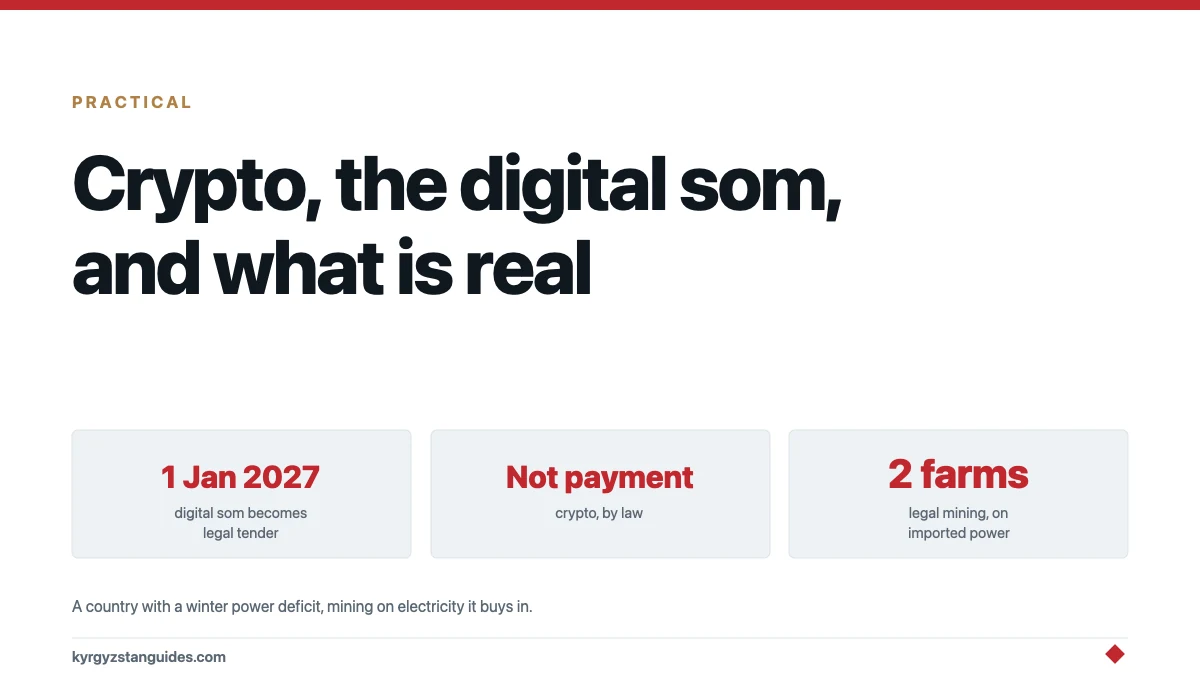
Its central provision is blunt. Article 5(2): virtual assets are not a means of payment, a currency and/or a security on the territory of the Kyrgyz Republic. Article 4 repeats the point in its definition. That is not regulatory caution, it is the operative rule: no merchant can be required to accept crypto, and advertising must state explicitly that virtual assets are not state-guaranteed and are not a means of payment here.
The law also restricts who may even use the vocabulary. Since the January 2026 amendments, only miners, issuers, placement operators and licensed service providers may put "virtual asset", "cryptocurrency" or "digital asset" in a company name or advertising campaign.
A further tightening in the same amendments: only backed virtual assets may be issued in Kyrgyzstan, in national or foreign currency. Stablecoins are a defined category, and their issuance rules, backing and backing ratio are set by the President rather than by the law itself.
Exchanges are licensed, and the numbers are real
Licensing is mandatory. A virtual-asset service provider must be a Kyrgyz-registered legal entity holding a licence; a crypto exchange must specifically be a joint-stock company. Licences run for an unlimited term and applications are decided within a month. The regulator in practice is the State Service for Regulation and Supervision of the Financial Market.
This is not a paper regime. On 9 February 2026 the service issued exchange-operator licences to six companies at once — Big Crypto, Bill Pay, Active Invest, Kasheron, Marten Finance and CorEx Markets.
The fiscal scale is the part that surprises people. In 2025 the virtual-asset sector paid almost 1.7 billion som into the budget: 1.48 billion from exchange operators and 206.17 million from mining. Reported aggregate market turnover exceeded $31 billion, against a national GDP of roughly nine.
A caution on counts: you will read that Kyrgyzstan has two hundred-odd licensed exchangers. That figure comes from a source I could not open, and no official register count could be verified. Six licences on one day in February 2026 is the number that is checkable.
Mining, on electricity the country does not have
Mining sits under its own tax regime — Chapter 60 of the Tax Code, a flat 10% levied not on profit but on the amount paid for electricity consumed, including VAT and sales tax. It replaces profit tax, VAT and sales tax entirely. Mining is barred from free economic zone regimes, and covert mining on other people's hardware is separately defined and prohibited.
The energy figures are where this collides with the rest of the country. Miners consumed 218.6 million kWh in 2024 and 213.3 million in 2025, about 1.1% of national consumption. Monthly load ran above 20 million kWh through the second half of 2025, then fell to 5.7 million in November and to zero in December, as the farms shut for winter.
By July 2026 there were two legal mining farms left — one at Kemin, one at the Kambar-Ata HPP-2 site. The energy minister's description of them is the detail worth keeping: they run only on imported electricity, including from Russia. In his words, they don't use ours.
Registered mining entities went from two in 2022 to eleven by mid-2025, then contracted, with certificates revoked by ministerial orders in November 2025. Set that against a country that imports power every winter and has declared an energy emergency running to the end of 2026, and the trajectory makes sense. The electricity tariff for energy-intensive industry including mining was cited at 6.06 som per kWh in 2025, against 3.34 for ordinary industrial users.
The digital som: legal tender from 2027, a test platform now
This is the part most often reported as already happening. It is not.
The legal basis is Chapter 4¹ of the Constitutional Law on the National Bank, inserted by Constitutional Law No. 74 of 16 April 2025. It defines the digital som as the national currency in digital form and legal tender on the territory of the republic, makes the National Bank its exclusive issuer and platform operator, and makes it an unconditional liability of the National Bank backed by all of its assets.
The date is the thing. The consolidated text carries an explicit note that the amendments introduced by that law take effect on 1 January 2027. Until then the digital som has no legal-tender status.
What exists now is a test platform. Six commercial banks were connected to it in April and May 2026. The president instructed the National Bank to build and pilot-test the platform by 31 December 2026, and Cabinet planning documents place the pilot from the fourth quarter of 2026 through the second quarter of 2027, covering peer-to-peer transfers without intermediaries and financed from National Bank resources.
The phasing, as reported: first full infrastructure inside the National Bank and commercial banks with transfers between banking apps; then connection of the Central Treasury for social and government payments after an audit; then offline payments for areas with poor connectivity. That last phase is the one that would matter in a country where a third of the population lives in mountain villages.
No source I could find gives a firm go-or-no-go decision date for actual issuance. It lands in a country where a national QR standard has already moved a cash economy onto phones in about four years. The legal switch flips on 1 January 2027; whether anything is circulating by then is a separate question.
Two state stablecoins, announced
In November 2025 Kyrgyzstan launched two tokens within a week.
USDKG is a gold-backed, dollar-pegged stablecoin. Its issuer is a joint-stock company, Virtual Asset Issuer, whose sole founder is the Ministry of Finance. The company was registered in late October 2025 at a cost to the budget of 438,480.75 som, with initial issuance reported at 50 million USDKG.
KGST is pegged one-to-one to the som and issued on BNB Smart Chain by a limited company, announced through the secretariat of the presidential National Agency for the Development of Virtual Assets and Blockchain Technologies. Reserves are stated to be held in Kyrgyz state banks.
Beyond those bare facts, be careful. The widely repeated figures for USDKG — $500 million in ministry gold, expansion to $2 billion, named auditors, specific chains, an international exchange listing — come from press releases and crypto outlets, not from any Kyrgyz government or news-agency source I could verify. The same goes for the announced national crypto reserve: no decree, law or holdings figure could be found. Treat all of it as announced rather than operational.
What a visitor can actually do
Short version: nothing with crypto, and nothing with the digital som.
Crypto is not legal tender and not a means of payment by statute. No shop, guesthouse or driver can be asked to accept it, and if one offers to, that is an informal arrangement outside the law rather than a service. The digital som does not acquire legal-tender status until 1 January 2027 and currently exists as a bank-to-bank test platform.
Licensed exchange offices do exist if you genuinely need to convert, and they are supervised. But for actually paying for things, the position is the same as it has always been: som in cash, plus cards where they work. Our guide to money, ATMs and cards covers what does function day to day, and our page on paying in Kyrgyzstan explains why the local wallet apps will not open for you.
One related number, since I could not source it when this page first went up and now can. There are two border cash rules. The EAEU declaration threshold is $10,000 — above that you declare. Separately, and more restrictively, a Kyrgyz Cabinet ban in force since 16 January 2023 caps what a non-resident or foreign citizen may take out at $5,000 in cash, against $10,000 for residents. Our money guide sets out both, and the enforcement.
FAQ
Can you pay with crypto in Kyrgyzstan?
No. Article 5(2) of the Law on Virtual Assets states plainly that virtual assets are not a means of payment, a currency or a security in Kyrgyzstan. Advertising is legally required to say so. Som in cash remains the only legal tender.
Is cryptocurrency legal in Kyrgyzstan?
Yes to owning and trading it through licensed providers; no to using it as money. The Law on Virtual Assets of 21 January 2022 licenses exchanges and exchangers through the State Service for Regulation and Supervision of the Financial Market. A crypto exchange must be a joint-stock company.
When does the digital som launch?
Its legal-tender status takes effect on 1 January 2027 under Constitutional Law No. 74 of 16 April 2025. As of 2026 it exists as a test platform with six commercial banks connected, with a pilot running from late 2026 into 2027.
Is crypto mining legal in Kyrgyzstan?
Yes, under a special tax regime — Chapter 60 of the Tax Code, a flat 10% charged on the amount paid for electricity rather than on profit. By July 2026 only two legal farms remained, at Kemin and the Kambar-Ata HPP-2 site, and the energy minister said they run only on imported electricity.
Does Kyrgyzstan have a national stablecoin?
Two were announced in November 2025: USDKG, gold-backed and dollar-pegged, issued by a company whose sole founder is the Ministry of Finance; and KGST, pegged to the som on BNB Smart Chain. Most of the detail circulating about their backing comes from press releases rather than verifiable government sources.
How much does crypto contribute to Kyrgyzstan's budget?
Almost 1.7 billion som in 2025 — 1.48 billion from exchange operators and 206.17 million from mining — on reported market turnover of over $31 billion.