Drive the Bishkek–Osh road and you'll spend an hour beside an enormous turquoise reservoir with a town at one end of it. Most people photograph it and move on.
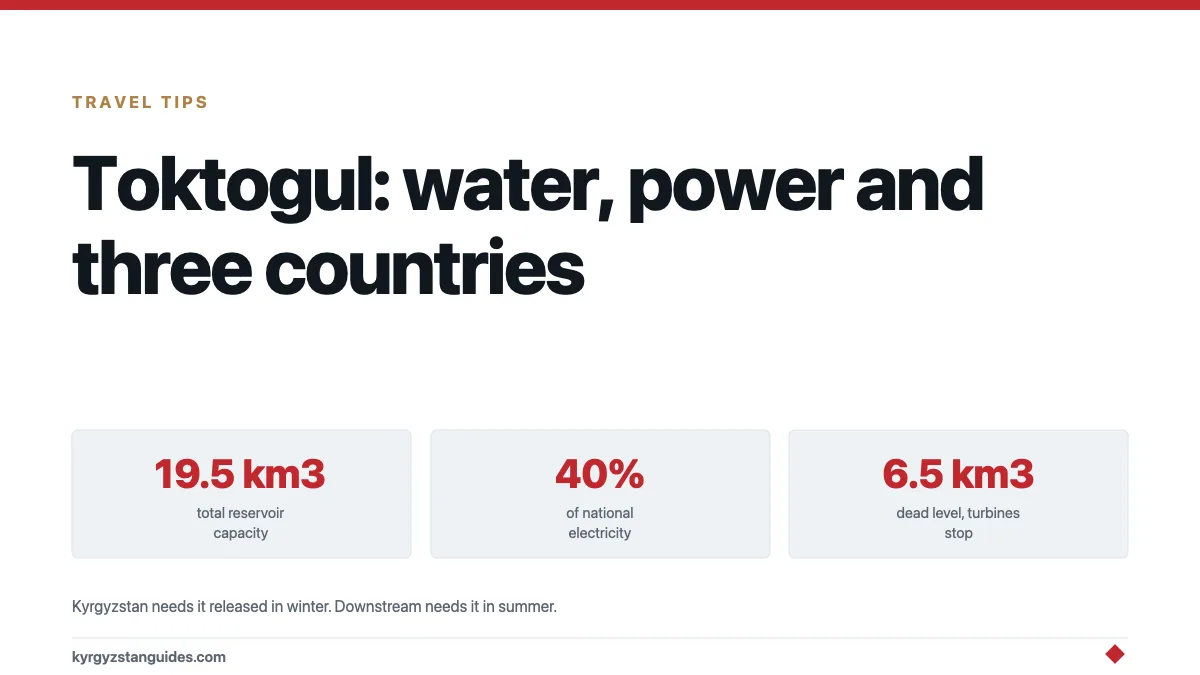
That reservoir holds 19.5 cubic kilometres of water. It produces around 40% of Kyrgyzstan's electricity. And how much water comes out of it in January rather than July is, without exaggeration, the central political question of Central Asia.
This guide explains the argument, because once you understand it a great deal about the region stops looking random. Including why the power goes off.
The basic problem
Kyrgyzstan is upstream. Uzbekistan and Kazakhstan are downstream. Those three facts generate everything that follows.
The Toktogul dam sits on the Naryn river, the main feeder of the Syr Darya, one of the two great rivers of Central Asia. Water stored behind it either passes through turbines to make electricity, or is held back, or is released downstream for irrigation. It cannot do all three at once. And the canal network the irrigation share flows into loses somewhere between a third and four fifths of it.
Here is the conflict in one line:
Kyrgyzstan needs the water released in winter, to generate heat and light. Uzbekistan and Kazakhstan need it released in summer, to irrigate crops.
Those are opposite requirements from a single reservoir, and there's no engineering solution to them. It is a distribution question, which means it is a political one.
How the Soviet system handled it
Neatly, because it was all one country.
Under the Soviet arrangement, Kyrgyzstan stored water through the winter and released it in summer for downstream cotton and wheat. In exchange, the downstream republics sent gas, coal and electricity upstream for Kyrgyz winter heating. Everybody got what they needed in the season they needed it, and no money changed hands because it was internal accounting.
In 1991 that became international trade between five governments with their own budgets, currencies and grievances, and the barter stopped working. Kyrgyzstan, short of fuel, began running Toktogul hard in winter to keep the lights on, dumping water downstream in the cold months when nobody could use it and leaving less for the irrigation season.
That is the whole post-Soviet water dispute, in one paragraph. It isn't about hostility. It's about a system designed for one state being operated by five.
The wider regional picture (the Amu Darya, the Aral Sea, Turkmen and Tajik water use) makes the same point at larger scale. Analysis of whether all five states can reach a comprehensive agreement keeps arriving at the same conclusion: bilateral and trilateral deals work, basin-wide ones have not yet.
Where the level actually is
The numbers are worth knowing because they get quoted constantly in the region and are rarely explained.
| Measure | Volume |
|---|---|
| Total capacity | 19.5 km³ |
| Active (usable) capacity | 14 km³ |
| Dead level, turbines stop below this | 6.5 km³ |
| Level on 1 January 2026 | 9.14 km³ |
| Level on 1 April 2026 | 7 km³ |
Read the last two rows together. Over a single winter the reservoir dropped more than two cubic kilometres and ended the season within about half a cubic kilometre of the point where the turbines can't run at all.
That is the margin the country operates on. It's also why power cuts are a live issue rather than a historical one. The reserve is thin, and a dry year eats it.
The deal that's currently holding
There is a functioning arrangement, which is genuinely newer and more hopeful than most coverage of Central Asian water suggests.
Kazakhstan, Kyrgyzstan and Uzbekistan have signed trilateral agreements setting the operating mode of Toktogul: Kyrgyzstan commits to holding water back over winter for summer release, and in exchange the downstream states send electricity upstream over the cold months.
Between September 2025 and April 2026, Kazakhstan alone supplied more than 1.5 billion kilowatt-hours to Kyrgyzstan under this arrangement. The Times of Central Asia has tracked the successive agreements as they have been renewed.
If that sounds familiar, it should. It is the Soviet barter, reconstructed as a treaty between sovereign states, one year at a time.
Kambarata-1
The long-term proposal is another dam upstream, and it is enormous.
Kambarata-1, on the Naryn above Toktogul, is designed at 256 metres high, or 261 by the World Bank’s figure, with 1,860 MW of installed capacity and around 5.6 billion kWh of annual generation. Cost estimates have ranged from $3.5 to $6 billion, with figures around $4.5–5 billion cited more recently and the World Bank working on revised projections.
The politically significant part isn't the engineering. In June 2024, Kyrgyzstan, Uzbekistan and Kazakhstan agreed to jointly develop, finance and operate it. All three, together.
That is a substantial change. For thirty years upstream dams were treated downstream as threats. A jointly owned dam is a different object: if Tashkent and Astana hold equity in the reservoir, the release schedule is a shareholder matter rather than a standoff. The World Bank's project pages set out the structure.
Whether it gets built is another question. A $5 billion dam in a seismic zone, on a river three countries depend on, isn't a project that fails quietly.
What this means for a traveller
More than you would think.
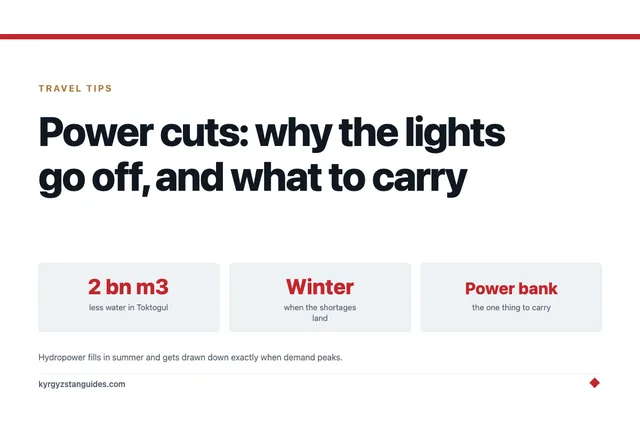
Power cuts are a water story. If you're here in winter and the electricity is rationed, the reason is in the reservoir, not the grid.
The reservoir is genuinely worth stopping at. The Bishkek–Osh road runs along it, and our Toktogul guide covers the town. The scale only registers in person.
Low water looks dramatic. In a drawn-down year you can see the bathtub ring on the shore and, in places, structures that are normally submerged. It photographs well and means something bad.
The gorge below it is the good bit. Chychkan gorge, downstream on the same road, is where the Naryn system is at its most spectacular, and it is where the trout farms are.
It connects to the glaciers. The Naryn is fed by snowmelt and ice from ranges that are losing mass. Less ice means a different runoff pattern, which means every calculation above gets harder. That is the part nobody has a treaty for.
Don't bring it up as a gotcha. Water isn't an abstract issue in these villages. Ask, listen, and expect a more informed answer than you would get on the same subject at home.
FAQ
What is the Toktogul reservoir?
Kyrgyzstan's largest reservoir, on the Naryn river, with a total capacity of 19.5 km³. Its hydropower plant is the country's largest power station and supplies around 40% of national electricity.
Why is Toktogul politically important?
Kyrgyzstan needs water released in winter for electricity, while Uzbekistan and Kazakhstan need it released in summer for irrigation. One reservoir can't satisfy both, making its operating schedule a regional negotiation.
What is the dead level of Toktogul?
6.5 billion cubic metres. Below that the turbines can't operate. The reservoir stood at 7 billion cubic metres on 1 April 2026, after falling from 9.14 billion on 1 January.
What is the Kambarata-1 dam?
A proposed 256-metre dam on the Naryn above Toktogul with 1,860 MW capacity, to be jointly developed by Kyrgyzstan, Uzbekistan and Kazakhstan under a June 2024 agreement. Cost estimates run from $3.5 to $6 billion.
How does Kyrgyzstan get electricity in winter?
Partly from Toktogul, and partly through trilateral arrangements under which Kazakhstan and Uzbekistan supply power upstream so Kyrgyzstan can hold back water for summer irrigation.
Can you visit the Toktogul reservoir?
Yes. The Bishkek–Osh highway runs along its shore and the town of Toktogul sits at its edge, making it an easy stop on the drive south.
For where all this water actually goes — and why not one Kyrgyz river reaches an ocean — see Kyrgyzstan’s rivers.