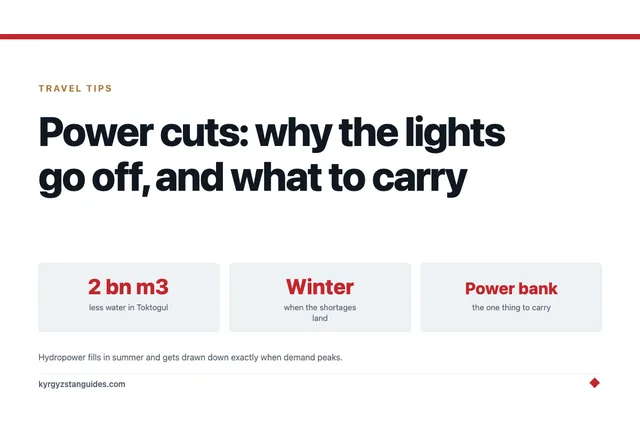
Kyrgyzstan runs short of electricity every winter. The gap is put at about 20% of annual domestic demand, and the country covers it with imports while the Toktogul reservoir is drawn down to levels that make the news. Kambarata-1 is the answer the state has settled on, and it is the largest thing the country has ever tried to build.
It is also, as of now, not built. Understanding what stage it is actually at is more useful than the announcements.
What is being proposed
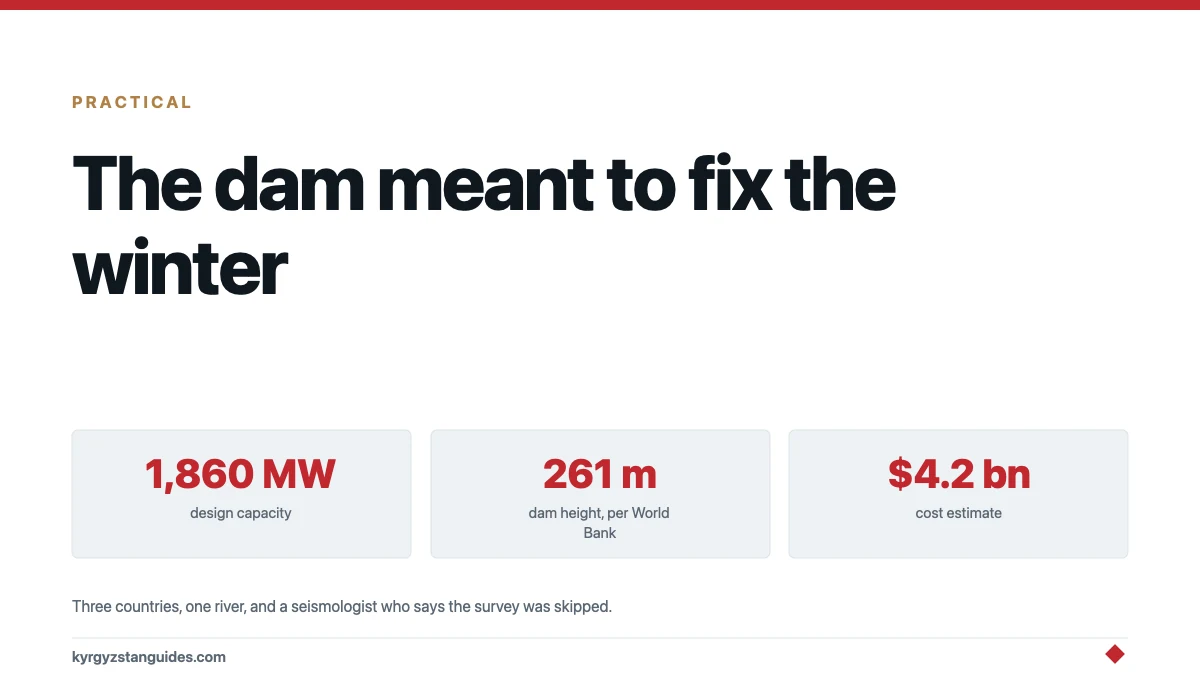
A dam on the Naryn upstream of the existing cascade, with a design capacity of 1,860 MW and annual generation of roughly 6,000 GWh. The dam height is given as 261 metres by the World Bank and 256 by other reporting; the reservoir as 5.2 or 5.4 cubic kilometres depending on the source. Cost estimates run from $4.2 billion to €4-6 billion, with pledged or indicated financing reported around $5.6 billion.
Its position in the system is the point. It sits above Kambarata-2 and the Toktogul reservoir, so it is intended to add winter generation and reduce flood risk to the plants below it. Kyrgyzstan's winter problem is that it must choose between releasing water for power and holding it for downstream irrigation; a big new upstream store changes that arithmetic.
The idea is not new. First construction began in 1986 and stopped with the Soviet collapse in 1991. President Japarov revived it in 2022 with site-preparation works.
Three countries, and who owns what
What makes this different from previous attempts is that the downstream neighbours are inside it rather than objecting to it. A ministerial agreement was signed in June 2024 by Kyrgyzstan, Kazakhstan and Uzbekistan for joint development, which the World Bank called groundbreaking — a fair description given the history of water disputes on this river.
The reported ownership split in the joint venture is Kyrgyzstan 34%, Uzbekistan 33%, Kazakhstan 33%. Phase one is run by the Kyrgyz Ministry of Energy; phase two by a joint-venture entity still to be established.
On money, be precise about what has actually been committed. The World Bank has approved preparation funding only: $5 million in 2023 and $13.6 million in 2024. Up to $1.5 billion in concessional financing sits under a multiphase approach and has not been approved. The EBRD is considering around €1.3 billion and the EIB around €900 million, and a donor coordination committee includes the World Bank, ADB, EBRD, AIIB and the OPEC Fund. Safeguard documents were released through August 2025 — a stakeholder plan on the 8th, a draft environmental and social impact assessment on the 15th, a resettlement framework on the 16th.
The problem it is meant to solve, in numbers
To see why a country of seven million is contemplating a four-billion-dollar dam, look at the reservoir it already has. Toktogul supplies around 40% of Kyrgyzstan’s electricity, and below roughly 5.5 to 6.5 billion cubic metres there is not enough head to turn its turbines at all. That is the dead level, and the country keeps approaching it.
The published figures tell the story without commentary. On 6 March 2024 Toktogul held 7.7 billion cubic metres against a normal 17.3, and the deputy energy minister said another two billion would take it to dead water. On 1 January 2026 it held 9.14 billion; by 1 April 2026, 7.0 billion. On 27 December 2024 it was releasing 797 cubic metres a second while only 183 flowed in.
That last pair is the whole problem. Winter is when demand peaks and when the rivers are lowest, so the reservoir is drawn down precisely when it cannot refill. In 2025 Kyrgyzstan generated about 15 billion kWh against demand over 19 billion and imported the difference; between September 2025 and April 2026 Kazakhstan alone supplied over 1.5 billion kWh so that Kyrgyzstan could hold water back.
Kambarata-1 is the structural answer to that: a second large store, upstream, built to generate in winter rather than compete with irrigation in summer. Whether it is the right answer is a separate question, and it is where the objections start.
The objection from the Academy of Sciences
On 11 September 2025 the president of the National Academy of Sciences and director of the Institute of Seismology, Kanatbek Abdrakhmatov, publicly rebutted the Energy Ministry on the dam's safety, arguing that seismic micro-zonation has not been done.
That is not an ordinary NGO complaint. It is the country's senior seismologist, in a country whose seismic record includes the 1911 Kemin earthquake, saying the ground survey for a 261-metre dam is incomplete. The World Bank's position is that a preliminary seismic hazard assessment has been carried out and further detailed investigation including micro-seismic assessment is planned. Both statements can be true; they describe different points on the same unfinished process.
The environmental objections are separate and specific. A 2025 analysis by CEE Bankwatch argues there is an active fault beneath the dam site, that the impact assessment lacks species-level data and fails the World Bank's own no-net-loss standard, and that while only three households are physically displaced, more than 3,500 hectares of winter pasture would be flooded, affecting over a thousand livestock households, along with 80-plus kilometres of trails and eleven bridges. It also notes there is no transboundary environmental-flow plan and that three Ramsar wetlands could be affected.
Against that the project promises up to 7,000 jobs during construction and operation.
What gets flooded, and who is counted
The resettlement arithmetic is where the project looks most awkward, and it is worth reading carefully because the headline number is technically true and substantively misleading.
Three households are physically displaced. That is the figure in the impact assessment, and it sounds trivial for a dam of this size. What the same analysis records alongside it is that more than 3,500 hectares of winter pasture would be flooded, affecting over a thousand livestock households, together with more than 80 kilometres of trails and eleven bridges.
Nobody in those thousand households loses a house. They lose the ground their animals eat on in the months when there is nothing else, and the routes they use to reach it. If you have read our guide to the herding year, you will recognise why winter pasture is the binding constraint in Kyrgyz livestock farming rather than summer grazing: the jailoo is abundant and seasonal, the winter ground is scarce and fixed.
The same analysis argues the assessment lacks species-level data and does not meet the World Bank’s own no-net-loss standard for biodiversity, and that there is no transboundary environmental-flow plan despite three Ramsar wetlands potentially being affected downstream.
Against all of this sits the number the project leads with: up to 7,000 jobs during construction and operation, in a region with very little else.
When, and why nobody can tell you
This is where I have to stop being useful. I cannot give you a construction start date. It has been reported as a launch of works in June 2022, as a restart announced for summer 2025, and as ongoing preparatory work. The World Bank's own project page states no start date. Claims of a first unit in 2028 and diversion tunnels complete by April 2026 appear only in secondary aggregation with no primary source behind them.
For a traveller none of this changes an itinerary. It matters because it is the single biggest thing happening in the Kyrgyz economy, because it explains why the winter power cuts are framed as temporary, and because the argument about it — a senior seismologist against an energy ministry, on a fault line — is a more honest picture of how the country works than any brochure.
FAQ
What is Kambarata-1?
A proposed 1,860 MW hydropower dam on the Naryn river, upstream of the existing cascade including Toktogul. Design generation is around 6,000 GWh a year, with the dam given as 261 m by the World Bank and 256 m elsewhere.
How much will Kambarata-1 cost?
Estimates run from $4.2 billion to €4-6 billion, with indicated financing reported around $5.6 billion. The World Bank has so far approved only preparation money — $5 million in 2023 and $13.6 million in 2024 — with up to $1.5 billion concessional not yet approved.
Who owns Kambarata-1?
A ministerial agreement in June 2024 committed Kyrgyzstan, Kazakhstan and Uzbekistan to joint development. The reported joint-venture split is Kyrgyzstan 34%, Uzbekistan 33%, Kazakhstan 33%.
Is Kambarata-1 safe to build?
That is actively disputed. On 11 September 2025 the president of the National Academy of Sciences publicly argued seismic micro-zonation has not been done. The World Bank says a preliminary hazard assessment exists and further micro-seismic work is planned.
When will Kambarata-1 be finished?
Unknown. No primary source gives a reliable construction start date, let alone a completion date, and the World Bank project page states none. Treat any confident year you see as unsourced.
Why does Kyrgyzstan need Kambarata-1?
Its winter electricity deficit is estimated at about 20% of annual domestic demand. A large upstream reservoir would add winter generation and ease the conflict between releasing water for power and holding it for downstream irrigation.
For where all this water actually goes — and why not one Kyrgyz river reaches an ocean — see Kyrgyzstan’s rivers.