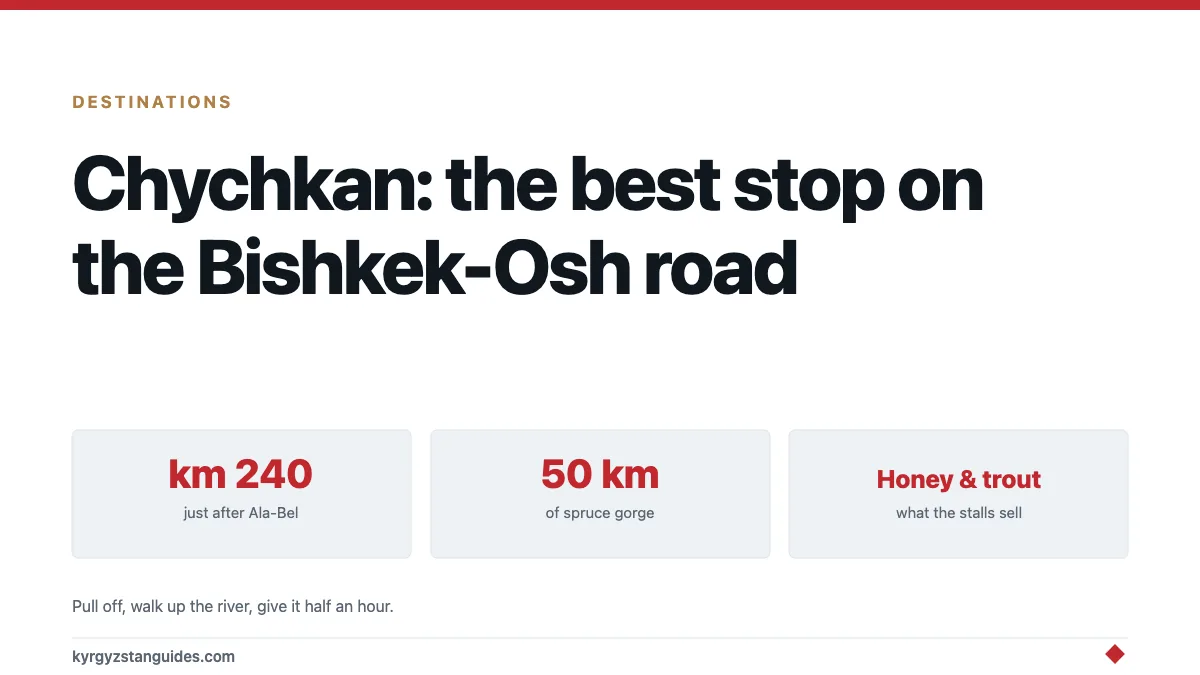
Around kilometre 240 of the Bishkek–Osh highway, not long after you come down off the Ala-Bel pass, the road drops into a spruce-filled gorge at about 2,200 metres and stays in it for something like fifty kilometres. This is Chychkan, and it's where every driver on that route stops. For honey sold from roadside stalls, for trout, and because after several hours of bare high country a forest is a relief.
Most people pass through it on the way to somewhere else and never learn its name.
Where it fits on the road
The Bishkek–Osh highway, the M41, is the spine of the country and one of the more demanding long drives in Central Asia. Our Bishkek to Osh guide covers the journey as a whole.
The sequence matters. You climb out of the Chuy valley and over Too-Ashuu with its tunnel. You cross the huge, flat, treeless Suusamyr basin. You go over Ala-Bel at around 3,180 metres. And then the road tips into Chychkan and everything changes character, from open high steppe to a tight wooded gorge with a river in it.
Below the gorge the road continues towards Toktogul and its reservoir, then on south.
What's actually there
Tien Shan spruce, which is the point. This is one of the more substantial stands of it you'll see from a road in Kyrgyzstan: dark, tall, and quite unlike the juniper and bare slope that dominates most of the country. Our piece on archa juniper covers the tree that grows where the spruce can't.
A game reserve running through the gorge, protecting ibex, argali, roe deer and wild boar. You're not going to see much from a car at speed, but the terrain is genuinely good wildlife country. Our ibex and argali guide explains what lives up there and why it's hard to spot.
The river, fast and cold, running the length of the gorge beside the road.
Roadside stalls, which is what most travellers actually engage with, and which are better than roadside stalls have any right to be.
The honey
Chychkan honey has a real reputation, and the reason is botanical rather than marketing.
The gorge is a mixed, flower-rich environment at altitude, herbs, wildflowers, forest edge, and bees working that produce a complex, strongly aromatic honey quite different from a single-source crop. It isn't the pale sainfoin white honey that Toktogul district is otherwise known for, which our white honey guide covers. It is darker, more herbal, and more variable from jar to jar.
Buying from the stalls is the whole transaction: they're family operations, the honey is local, and the price is a fraction of what a Bishkek shop charges. Taste before you buy: that is expected, and try more than one stall, because they genuinely differ.
The trout
The other thing people stop for.
Trout farms operate along the river and the stalls and small cafes grill or fry it fresh. It's a strange thing to find halfway along a mountain highway in a landlocked country, and it is one of the better meals available on that road, which is a low bar, but it clears it comfortably.
This matters more than it sounds if you are doing the drive. The Bishkek–Osh route is long, the food options are mostly canteen laghman and samsy at fuel stops, and a plate of grilled river trout in a spruce gorge is a considerable improvement.
Why there is forest here and not elsewhere
A fair question, given that most of Kyrgyzstan's mountains are bare.
Tien Shan spruce needs a specific combination: enough moisture, the right aspect, and altitude in a fairly narrow band. Chychkan has it because the gorge traps and holds precipitation coming off the ranges, and because north-facing slopes hold snow long enough to keep the ground wet into the summer.
Turn the valley around and the trees stop. You can see this along the gorge if you look — one wall carrying dense spruce, the opposite wall dry and open, separated by a few hundred metres of river.
The wider picture is that Kyrgyzstan's forest cover is small, fragmented and under pressure from grazing and firewood cutting. A gorge like this is not a remnant of something that used to cover the country; it's one of the few places the conditions ever allowed. Nomad's Land's entry on the gorge notes the reserve status, which is part of why it has held.
Stopping properly
The gorge is fifty kilometres long and almost nobody gets out of the vehicle for more than ten minutes.
If you are driving yourself, pull off, walk a few hundred metres up the riverbank away from the road, and give it half an hour. The noise of the traffic drops away faster than you expect and you're standing in proper spruce forest with a cold river and mountains above.
There is basic accommodation in the gorge, a tourist base and a few guesthouse options, for anyone who wants to break the drive rather than grind through it in one day. That is worth considering: Bishkek to Osh in a single push is around twelve hours on a hard road, and splitting it's more pleasant than heroic.
If you are in a shared taxi, you'll stop here anyway, because the driver wants tea. Use the time.
When to go through
Summer and early autumn are straightforward.
Winter is a different proposition. Too-Ashuu and Ala-Bel both sit high, both get snow, and the road closes or becomes seriously difficult: as our passes guide sets out. Chychkan itself is lower and wooded, but getting to it means crossing the high ground either side.
Spring brings meltwater and the river runs hard. Autumn is arguably the best of it, when the honey stalls are fully stocked from the summer's work.
FAQ
Where is Chychkan gorge?
On the Bishkek–Osh highway at around kilometre 240, just after the Ala-Bel pass, at about 2,200 metres. It runs for roughly fifty kilometres north of Toktogul town in the Jalal-Abad region.
What is Chychkan known for?
Honey and trout. Roadside stalls sell honey from the gorge's flower-rich slopes, and trout farmed in the river is grilled or fried at small cafes along the road. The Tien Shan spruce forest is the other draw.
Is Chychkan honey worth buying?
Yes. The gorge's mixed herb and wildflower environment produces a dark, strongly aromatic honey quite different from the pale sainfoin honey the Toktogul area is otherwise known for. Taste before buying and try several stalls.
Can you stay overnight in Chychkan gorge?
There's a tourist base and some basic guesthouse accommodation. Breaking the Bishkek–Osh drive here is a reasonable alternative to doing the whole twelve-hour journey in one day.
Is there wildlife in Chychkan gorge?
A game reserve runs through it, protecting ibex, argali, roe deer and wild boar. You're unlikely to see much from a moving car, but the terrain is genuine wildlife country.
When can you drive through Chychkan gorge?
Summer and early autumn are straightforward. In winter the Too-Ashuu and Ala-Bel passes either side of the gorge take snow and can close, which is the constraint rather than the gorge itself.