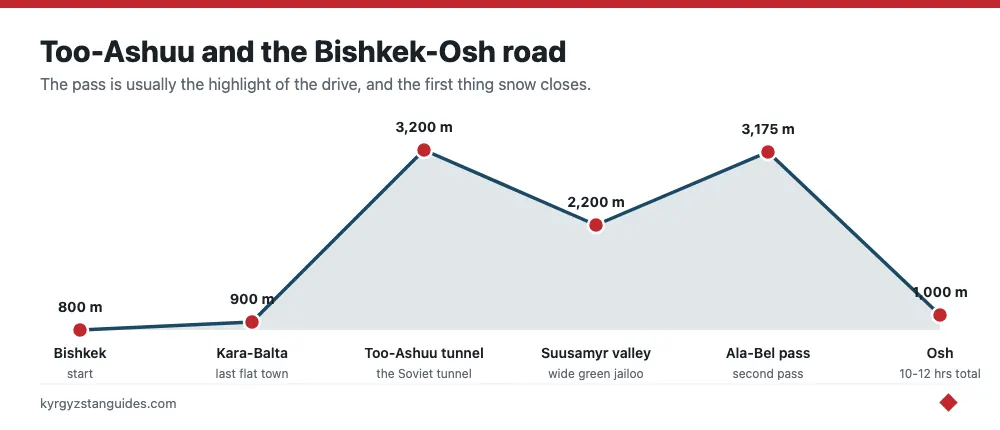
Somewhere around three hours south of Bishkek, the Bishkek-Osh highway stops climbing gently through farmland and starts switchbacking up bare rock toward a wall of peaks. That’s Too-Ashuu: a 3,586-meter pass over the Kyrgyz Range, crossed today mostly via a 2.5-kilometer tunnel bored through the mountain rather than over the old high route. It’s one stretch of road every traveler doing the Bishkek-Osh drive experiences, whether they mean to stop there or not, and it’s worth knowing what it's before you’re staring at it from a shared taxi window.
The short version: Too-Ashuu is the physical and psychological divide between northern and southern Kyrgyzstan. North of it's the Chuy Valley and Bishkek’s flat, Russified lowlands; south of it, the road drops toward the Suusamyr Valley and eventually the very different cultural world of Osh and the Fergana Valley edge. Crossing it's the moment the trip actually starts feeling like Kyrgyzstan’s interior.
The tunnel versus the old high road
Most traffic today goes through the Too-Ashuu Tunnel, a Soviet-era bore completed in 1962 that lets vehicles skip the highest, most exposed section of the original road. It’s narrow, poorly lit, unventilated by modern standards, and often has standing water or ice near the entrances even in summer — not a pleasant few minutes, but a fast one, and vastly safer than the alternative in bad weather.
The old high road still exists, climbing over the actual pass summit above the tunnel, and it’s occasionally used when the tunnel is closed for maintenance or accident clearance, or by drivers and cyclists specifically chasing the view. It’s a rough, exposed switchback route with serious drop-offs, and it’s not something a standard shared taxi will take unless it has no other choice. If you’re driving yourself or have hired a private driver and want the scenery, ask specifically for the old road in clear weather — but treat a negative answer as the right one if conditions look uncertain.
Why it’s a highlight even from a moving car
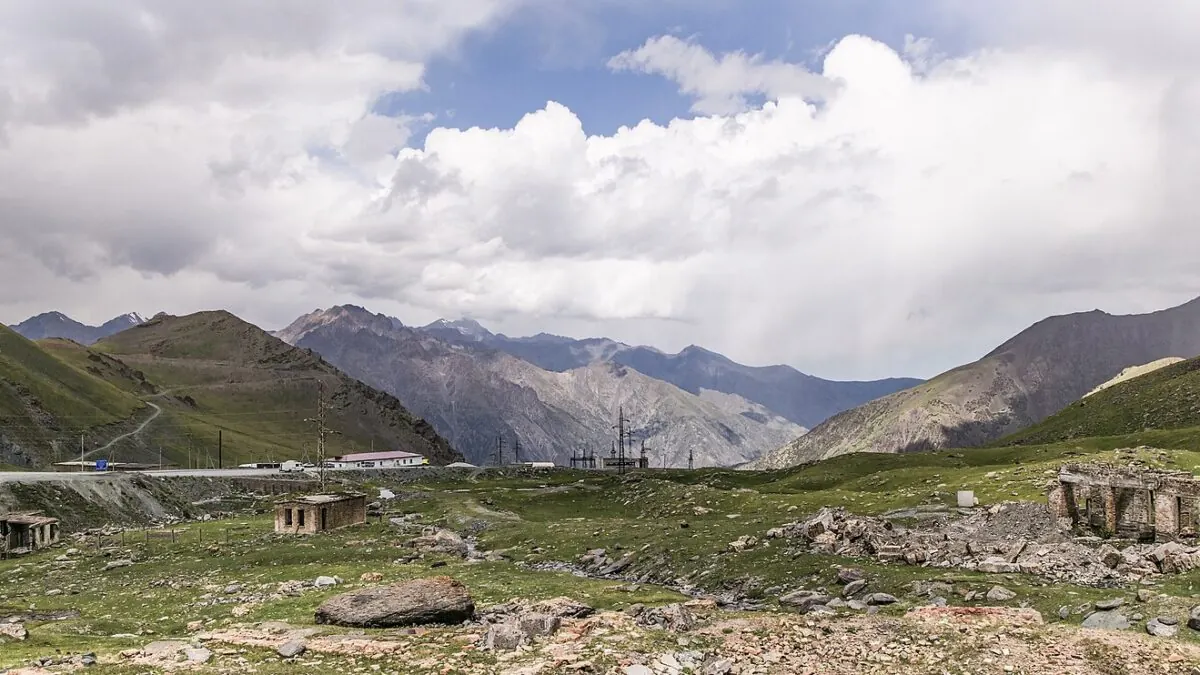
The approach to Too-Ashuu from the north is the payoff. The road climbs out of green, gentle valley farmland into increasingly bare, jagged rock, with switchback after switchback stacked up the mountainside and views back down the valley that keep expanding as you climb. Even sealed inside a marshrutka doing the standard Bishkek-Osh run, this stretch is the visual highlight of the entire highway — more dramatic than most of what follows on the drier southern side of the range.
Drivers on the shared-taxi and private-transfer routes between Bishkek and Osh typically don’t stop for long here, since the tunnel approach roads are narrow with limited safe pull-offs, but a few viewpoint turnouts exist on the northern switchback section before the tunnel entrance. If you’re in a private vehicle, these are worth the two minutes it takes to get out and look back down the valley — the light in early morning or late afternoon is particularly good for photos here.
Winter closure risk
This is the practical detail that matters most for trip planning. Too-Ashuu sits high enough that snow and ice regularly disrupt travel from late autumn through early spring, and the approach roads on both sides can close temporarily after heavy snowfall until they’re cleared. The tunnel itself stays open more reliably than the old high road, but even tunnel access can be suspended during severe storms or avalanche risk, and the emergency ministry asks drivers to keep 500 metres between vehicles through the avalanche sections on the approach cuttings.
If you’re traveling the Bishkek-Osh route between November and April, build slack into your schedule. A same-day flight connection in Osh booked right after a winter road trip is a genuine risk. Locals treat winter closures on this stretch as a routine possibility rather than a rare event, and shared-taxi drivers will often know current conditions better than any website, though recent traveler reports on Caravanistan are worth scanning too. Flying between Bishkek and Osh is the reliable fallback in winter if your schedule can’t absorb a delay.
What comes after the pass
South of the tunnel, the road descends into the wide, high-altitude Suusamyr Valley, a summer pastureland dotted with yurts and grazing herds that’s strikingly different from the terrain just crossed. It’s a natural rest-stop zone, and roadside cafes here do a reliable trade in fresh horse dairy products and simple meals for drivers making the long haul south. From there, the highway continues over at least one more significant pass before eventually dropping toward Osh and the Fergana Valley’s edge.
The full Bishkek-Osh drive typically runs 10-12 hours by shared taxi or private car depending on stops and conditions, and Too-Ashuu is usually the first major landmark, arriving within the first few hours out of the capital. Travelers heading to Osh by road rather than flying should treat this pass as the trip’s real starting gate rather than just another bend in the highway.
Practical notes before you go
- Check road conditions before winter departures — ask your guesthouse or driver directly rather than relying only on online sources
- Bring a jacket even in summer; temperatures at the tunnel entrance are noticeably colder than in Bishkek
- If prone to motion sickness, take something before the switchback climb — this section has the sharpest turns on the whole route
- Private drivers can be asked to stop briefly at the northern viewpoints; shared taxis generally won’t
- Flying Bishkek-Osh is a legitimate backup plan in winter, not a failure of nerve
None of this makes Too-Ashuu a destination in its own right. It’s a pass you cross, not a place you plan a trip around. But for anyone doing the overland Bishkek-Osh route as part of a wider look at getting around Kyrgyzstan, it’s worth knowing what to expect before the road starts climbing. Travelers weighing a winter crossing should also read up on Kyrgyzstan in winter more broadly, and anyone starting from the capital can pair this with a look at things to do in Bishkek before setting off south.
Who built it, and when
The tunnel is older than most people crossing it assume. The Kyrgyz Ministry of Foreign Affairs, in its published material on the pass, dates the bore to 1962 and puts it at the 129th kilometre of the Bishkek–Osh highway, 2,500 metres long, with the portals at about 3,200 metres — several hundred metres below the 3,586 m saddle the old road went over. It was reconstructed once, in 2000, and the ministry describes its present condition as satisfactory but needing periodic repair. That phrasing is doing some work. A tunnel from 1962 was not designed for the volume of freight now moving between the two halves of the country.
The sentence that matters most in that document is the flat one: this is the only road link between northern and southern Kyrgyzstan. Not the fastest, not the best — the only one. When Too-Ashuu shuts, the country is functionally cut in two for road traffic, and the alternative is a flight or a long detour through Kazakhstan and Uzbekistan. That single fact explains why a queue of trucks forms at the portal the moment weather looks uncertain, and why drivers push through conditions they would refuse anywhere else.
Sources disagree on the numbers, which is normal for this pass. You'll see the tunnel given as 2.2 km, 2.5 km and 2.7 km, and the pass itself as anything from 3,180 m to 3,586 m — the spread mostly comes from people quoting the tunnel portal height and the old road summit interchangeably. The ministry's 2,500 m and 3,200 m are the figures to trust for the tunnel; 3,586 m is the pass proper, which only the old high road actually crosses.
A second tunnel is on the table
Kyrgyzstan has been openly shopping for an investor to build an alternative tunnel, and the proposal is public. The foreign ministry's outline covers the 113–144 km section of the Bishkek–Osh highway, running from the village of Sosnovka through to the Suusamyr valley in Zhayil district, at an estimated $170–250 million depending on the specification — roughly $10–35 million per kilometre. No start date has been announced, and the project has been circulating in one form or another for years, so treat it as an intention rather than a schedule.
For a traveller this isn't academic. If the second bore is ever built, the drive changes character completely: the current single-point-of-failure crossing becomes a routine piece of highway, and the reason to stop and look at Too-Ashuu largely disappears. Until then you're driving a piece of 1960s Soviet engineering that the country cannot function without, which is exactly what makes it worth putting your phone down for.
FAQ
How high is the Too-Ashuu pass?
The pass itself is 3,586 metres, but most traffic never reaches that height. The tunnel portals sit at about 3,200 m, and only the old high road crosses the true summit. That gap is why published figures for the pass vary so widely.
When was the Too-Ashuu tunnel built?
1962, according to the Kyrgyz Ministry of Foreign Affairs, with a single reconstruction in 2000. It is 2,500 metres long and sits at the 129th kilometre of the Bishkek–Osh highway. Older guides that date it to the 1980s are wrong.
Is the Too-Ashuu tunnel safe to drive through?
It is in use daily by freight and passenger traffic, but it is narrow, dimly lit and poorly ventilated by modern standards, with ice and standing water near the portals even in summer. Keep your headlights on, do not overtake inside, and expect a few unpleasant minutes rather than a dangerous crossing.
Does Too-Ashuu close in winter?
Yes, intermittently. Snow and avalanche risk close it for hours or days at a time through winter and spring, and there is no road alternative — it's the only road link between north and south Kyrgyzstan. Check conditions before committing to a winter Bishkek–Osh drive.
How long does it take to drive from Bishkek to Too-Ashuu?
Roughly three hours in normal conditions for the 129 km, longer if you stop or if trucks are queuing at the portal. The climb only becomes dramatic in the final stretch of switchbacks.
Is a new Too-Ashuu tunnel being built?
It's proposed, not under construction. The government has published an investor-facing outline for an alternative tunnel on the 113–144 km section, from Sosnovka to the Suusamyr valley, costed at $170–250 million. No start date has been announced.
The last real town before this climb is Kara-Balta, built on a uranium combine and an oil refinery that have both stopped: see the Kara-Balta guide.