Most advice on driving Kyrgyzstan's mountain roads is written from the seat of a rental car. This one is written from the traffic code, Government Resolution No. 421 of 4 August 1999 in its current edition of 31 October 2025, read through the justice ministry database's own API because the site itself serves only a JavaScript shell.
That distinction matters more than it sounds. Several rules travellers are told about are not in the code, and at least one that is in the code has quietly lost force.
The uphill vehicle has right of way
This is the rule that decides what happens on a single-lane mountain section, and it is the one worth memorising.
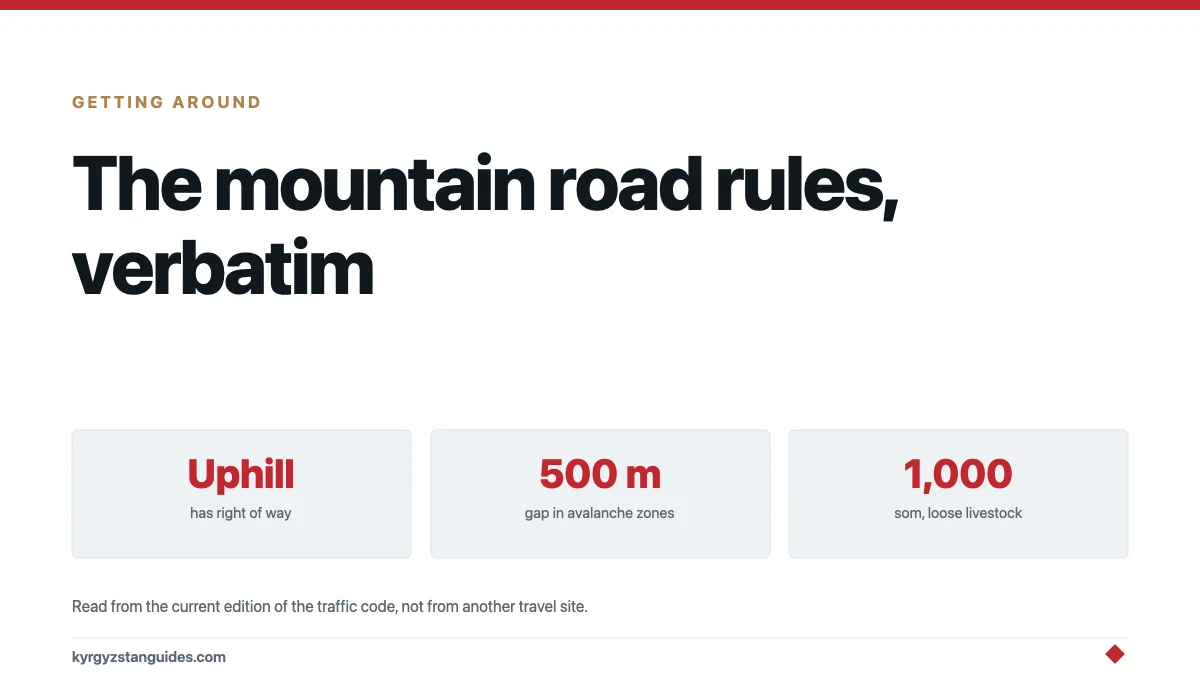
Clause 11.6 states that where oncoming passing is difficult, the driver on whose side the obstruction lies must give way — and then adds specifically that on grades marked with signs 1.13 and 1.14, where there is an obstruction, the driver travelling downhill must give way.
Sign 1.13 is a steep descent, 1.14 a steep climb. Annex 1 of the code repeats the instruction from the other direction: when meeting is difficult, yield to the vehicle coming uphill.
The logic is mechanical rather than ceremonial. A loaded vehicle that stops on a climb may not restart on loose surface, and reversing uphill on a blind bend is far worse than reversing downhill. On a Kyrgyz mountain road this is not a courtesy, it is what the local drivers are expecting you to do.
There is no separate mountain-driving chapter in the code. The rule lives inside clause 11.6, which is part of why it is so often missed.
What the same annex says about how to drive a grade
Descending: low speed, clutch engaged, in gear. Do not coast in neutral.
Climbing: choose a low gear that will take you over without changing. If you have to stop, secure the vehicle against rolling back.
At the top of climbs, overtaking into the oncoming lane, U-turns, stopping and parking on the carriageway are all prohibited. That amendment dates from Government Resolution No. 136 of 3 March 2009.
Clause 11.5 adds that overtaking involving entry into the oncoming lane is forbidden at the end of a climb and on other sections with limited visibility.
The horn rule people get wrong
You will be told that sounding your horn outside towns is banned, or that it is compulsory on blind bends. Neither is what the code says.
Clause 11.1 permits a horn blast outside built-up areas to warn of an intended overtake. Clause 2.6 permits it to prevent a crash. Clause 13.10 permits it at intersections of equal rank. Sign 3.26 bans it in the marked zone except to prevent an accident.
The change worth knowing: clause 19.9, which allowed a headlight flash to be used instead of the horn, has lost force under a resolution of 26 May 2021. Older guidance still describes the light-signal alternative as current. It is not.
Clause 19.10 does still require all motor vehicles outside built-up areas to run with dipped headlights, in daylight as well as at night.
The 500-metre rule, which is not in the code at all
The most specific mountain instruction in Kyrgyzstan does not come from the traffic police. It comes from the Ministry of Emergency Situations, and it is repeated verbatim in avalanche bulletin after avalanche bulletin: on avalanche-prone stretches, keep at least 500 metres between vehicles.
The same bulletins name the hazard sections by kilometre, and the same sections recur. On the Bishkek–Osh road, kilometres 121 to 138 across Too-Ashuu and kilometres 198 to 255 across Ala-Bel and the Chychkan gorge. On Bishkek–Naryn–Torugart, kilometres 292 to 305 at Dolon. On Balykchy–Kazarman–Jalal-Abad, kilometres 326 to 349 at Kok-Art. On Karakol–Enilchek, kilometres 45 to 90 at Chon-Ashuu. On Suusamyr–Talas–Taraz, kilometres 1 to 14 at Otmok.
If you are driving one of those and the ministry has issued a bulletin that week, the 500-metre gap is the single most useful thing in this article. It exists so that one avalanche does not take a queue of cars.
Tourist groups and solo travellers are also required to notify the ministry of a trip ten working days in advance through its online form.
Breakdown and emergency, from the code and from the ministry
Clause 7.2 requires the warning triangle at least 15 metres behind the vehicle inside built-up areas and at least 30 metres outside them. Clause 2.3.5 requires a reflective vest during a forced stop or crash outside built-up areas at night or in poor visibility.
Emergency numbers: 112 is the unified number, confirmed on the Ministry of Emergency Situations' own contacts page. Also 103 ambulance, 102 police, 101 fire, and 161 for the ministry's rescue dispatcher in Bishkek. The FCDO additionally lists a 24-hour mountain rescue line on +996 312 651 404.
One negative finding worth stating plainly, because we looked hard for it: we found no state-run or free national roadside-assistance service in Kyrgyzstan. Equivalent searches return Kazakhstan's scheme instead. What exists is commercial 24-hour tow operators based in Bishkek. Ministry rescuers do attend ordinary breakdowns in practice — they pushed a failed car out of the Kolbaev tunnel in March 2026 — but that is not a service you can rely on being dispatched.
No winter tyre law
We ran a full-text keyword scan of the 31 October 2025 edition. There is no winter-tyre or snow-chain mandate in the traffic rules.
The Ministry of Transport advises winter tyres, and did so publicly in October 2025 when it restricted trucks on Too-Ashuu and Ala-Bel and closed Otmok entirely. Advice is not a requirement, and a rental company's contract may impose one where the law does not.
This is a place where we would ignore the law and follow the advice. Too-Ashuu tops out somewhere between 3,125 and 3,150 metres depending on which ministry page you read, and it is snow-covered for a long season.
What actually happens on these roads
A sample from the Bishkek–Osh road alone, all from official or news reporting:
In March 2018, an avalanche of 2.5 million cubic metres at kilometre 146. In January 2025, an avalanche at kilometre 132 on Too-Ashuu caught six cars and a minibus, with four people pulled from one buried vehicle. In February 2026, an 80-cubic-metre rockfall at kilometre 400 near Kara-Kul struck a passing minibus, killing a fifty-year-old man and blocking the road entirely. In July 2026, a rockfall at kilometres 121 to 122 closed one lane for two hours with no casualties. In February 2026, controlled avalanche releases at kilometres 132, 133 and 136.
The wider figures are worse than the anecdotes. The emergency ministry reported more than 340 mudflows in the first half of 2026, described as a record for thirty to forty years, with eight killed, three injured and 236 evacuated, and preliminary damage of 399 million som. Around 40 per cent of mudflow damage falls on roads. Kyrgyzstan has more than 1,200 potentially dangerous gorges.
A caution on those numbers: the ministry gave 280 mudflow events in one briefing and more than 340 a week later, and the evacuation figures differ too. We are quoting the range rather than picking one.
The network you are driving on
The road department maintains 18,633 kilometres of public roads. By surface, 5,712 kilometres are asphalt and 1,887 are black gravel, against 9,406 kilometres of gravel and 1,617 of earth. That is roughly 59 per cent unpaved.
The alternative North–South road from Balykchy opened on 1 June 2026 and runs 06:00 to 20:00, June to November only, with the country's longest tunnel at 3.89 kilometres under Kok-Art. It cuts a thirteen-hour drive to about six. Two avalanche galleries are still unbuilt, with completion expected in 2028.
For the passes individually, see when Kyrgyzstan's passes open and our guide to Too-Ashuu. For the avalanche picture, avalanche safety in Kyrgyzstan. If you would rather not do any of this yourself, hiring guides and drivers is the sensible option.
FAQ
Who has right of way on a narrow mountain road in Kyrgyzstan?
The vehicle travelling uphill. Clause 11.6 of the traffic rules states that on grades marked with the steep descent and steep climb signs, where there is an obstruction, the driver going downhill must give way. The annex on those signs repeats it: yield to the vehicle coming up.
Are winter tyres compulsory in Kyrgyzstan?
Not by law. A full-text check of the current edition of the traffic rules found no winter-tyre or snow-chain requirement. The Ministry of Transport advises them and imposes truck restrictions on the high passes in winter, and a rental contract may require them, but the traffic code does not.
How far apart should vehicles drive in an avalanche zone?
At least 500 metres. That instruction is repeated verbatim in every Ministry of Emergency Situations avalanche bulletin, which also name the hazardous sections by kilometre, including Too-Ashuu at kilometres 121 to 138 and Ala-Bel at 198 to 255 on the Bishkek–Osh road.
What is the emergency number in Kyrgyzstan?
112 is the unified emergency number, confirmed on the Ministry of Emergency Situations' contacts page. Also in use are 103 for ambulance, 102 for police, 101 for fire and 161 for the ministry's rescue dispatcher. The FCDO lists a 24-hour mountain rescue line on +996 312 651 404.
Is there roadside assistance in Kyrgyzstan?
We found no state-run or free national service. Commercial 24-hour tow operators work out of Bishkek, and emergency ministry rescuers have assisted with ordinary breakdowns, but there is no scheme you can call on the way an automobile association works elsewhere. Carry a tow rope and a working phone.
Can I use my headlights to signal instead of the horn?
Not as a rule of the road any more. Clause 19.9, which allowed a light signal in place of the horn, lost force under a resolution of 26 May 2021. Guidance still describing it as current is out of date. Dipped headlights remain compulsory outside built-up areas, day and night.