Most independent travel here eventually involves hiring somebody: a driver to a trailhead, a horseman for three days on the jailoo, a guide over a pass.
The arrangements are informal, the conventions are real but unwritten, and almost nobody explains them to visitors. This is the version that saves the awkward conversations.
Who you are actually hiring
A driver takes you from A to B, waits if agreed, and is not a guide. They may know the area well and they aren't being paid to interpret it.
A horseman (jylkychy in the loose sense) brings horses, tack and himself, handles the animals, and generally cooks and camps with you. He is not a mountain guide and may not speak English.
A guide knows the route, makes the decisions and is responsible for the group. Certification varies enormously; internationally recognised mountain guide qualifications are administered through the IFMGA, and very few people working here hold one.
A fixer or agency arranges the above and takes a margin. Sometimes worth it, often not.
A CBT coordinator allocates all of these at set local rates, as our community tourism guide explains and the association's own account describes. In CBT areas this is the simplest route and the fairest one.
Confusing these is the origin of most disappointments. Somebody hired as a driver isn't failing when he doesn't explain the history of a valley.
How rates work
Prices are broadly standard within an area, particularly through a CBT office, where they are often written on a board.
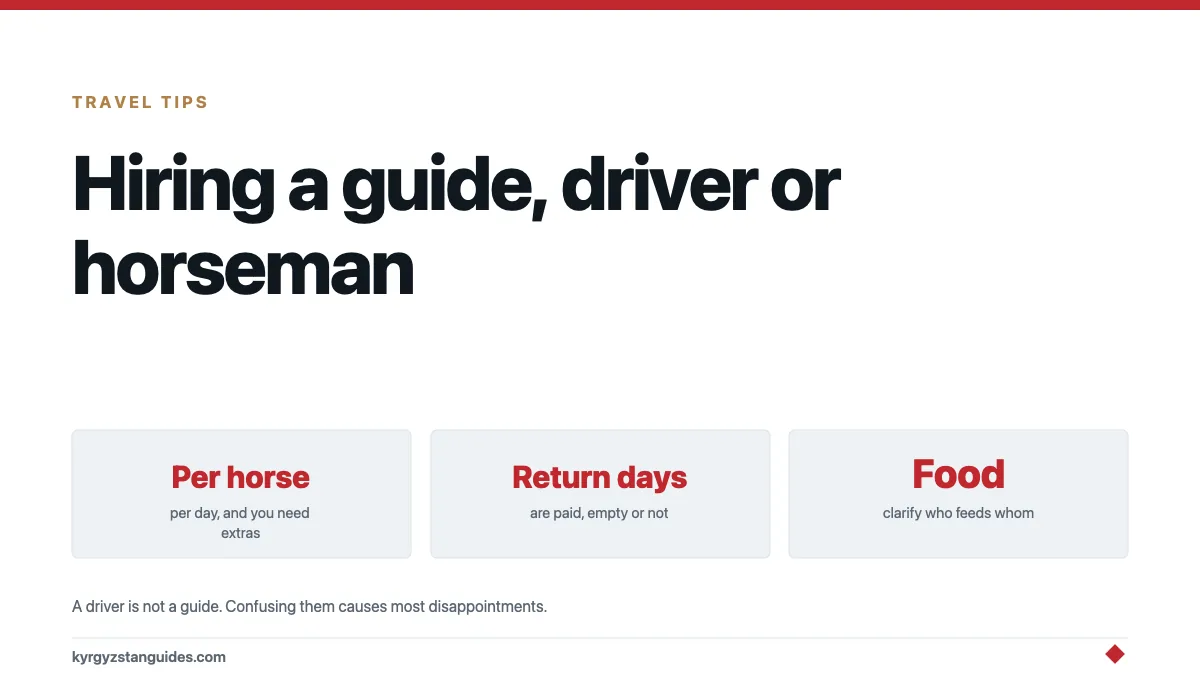
Horses are priced per horse per day, and you generally need more than you think: one per rider, one for the horseman, and one or two for baggage.
Drivers are priced per vehicle per day, not per person, plus fuel considerations on long trips. Our budget guide has current figures.
Guides are per day. A guide's day includes the day they walk out afterwards.
Return days are paid. If a driver takes you four hours into a valley, he drives four hours back empty, and that's part of the job.
Agree the total before starting. Write the number down, in som, with both of you looking at it. This is normal practice and nobody finds it rude.
What is included and what isn't
This is where misunderstandings actually happen.
Food. Clarify whether you're feeding the horseman or the guide. Usually yes, and usually it's assumed rather than stated.
Their accommodation. On a multi-day trek, where do they sleep and does someone pay for it.
Park and permit fees. Frequently not included. Border-zone permits are a separate arrangement entirely.
Fuel. For drivers, usually included in the day rate, and worth confirming for very long distances.
Equipment. Horses come with tack. Tents, sleeping bags and stoves usually do not.
Who carries what. Baggage horses have a limit and it is lower than you would guess.
Choosing well
Ask about risk, not about scenery. A guide who talks about turnaround times, river crossing timing and weather is telling you something a brochure can't.
Prefer local knowledge over English. As our piece on education and English notes, fluency and competence are separate variables. The horseman with forty words of English and thirty years in the valley is the better hire.
Check the horses, not the man. Condition, tack, whether the saddle fits. Our horse trekking guide covers what to look at.
Ask for a recommendation from your guesthouse. Reputation is local and real.
Winter is different. Ski touring and avalanche terrain require a guide with this season's snowpack knowledge, not merely a certificate. Ask what they have seen in their own pits this month.
Check they're registered with the Mountain Rescue Service if you're going anywhere serious. Our rescue guide explains why it matters.
Working with them
They are staff, not servants, and also not your friends until they're. The register is straightforward and warm.
Eat together. Separating yourself at mealtimes reads badly and you will miss the best part of the trip.
Their judgement on the mountain outranks yours. If a horseman says the river is too high, it is too high.
Do not push past a refusal. A guide who declines a pass is not being unadventurous.
Pace is theirs. On horses particularly, the animals set it.
Ask questions. Most are pleased to be asked and you'll learn more than from any guidebook.
Where the money goes
Worth knowing, because it changes how you feel about the rate.
In a CBT area, the coordinating office takes a small commission and the rest goes to the horseman, the driver or the household. The office rotates work between families rather than sending everyone to the best-reviewed one, which is deliberate: it stops a single operator capturing the village's tourism income.
Booked through a foreign agency, a substantially larger share stays outside the country.
This matters more here than in most places. As our piece on the tourism industry sets out, tourism is only around 3.8% of GDP and the international segment is a small fraction of that. What it does well is put foreign currency directly into rural households in places with almost no other income. And that only happens if the money actually reaches them.
The practical version: hiring locally, at the local rate, paid in cash, is the highest-impact thing a visitor does here. It is also usually cheaper. Those two facts align, which is not always the case in travel.
Paying
Cash, in som, small notes. As our paying guide explains.
Pay at the end unless a deposit was agreed for horses or fuel.
Tipping isn't built in but is appreciated for good work on a multi-day trip. Ten per cent is generous and there is no fixed convention.
Pay what you agreed even if the weather ruined the trip. The horses still walked.
If something went genuinely wrong, say so directly and calmly rather than adjusting the payment silently. Reputation matters here more than the money.
FAQ
Do I need a guide to trek in Kyrgyzstan?
Not for well-known routes in good conditions, but a guide is strongly advisable for glacier travel, border zones, winter touring and anything remote where rescue is limited.
How are horse treks priced in Kyrgyzstan?
Per horse per day. You need one per rider, one for the horseman and usually one or two for baggage, so the count rises faster than people expect.
Is a driver the same as a guide?
No. A driver takes you from place to place and isn't being paid to interpret the area or make route decisions.
Do I pay for my guide's food and accommodation?
Usually yes, and it's often assumed rather than stated. Clarify it when agreeing the rate.
Should I tip guides and drivers in Kyrgyzstan?
Tipping isn't built into the rates but is appreciated for good work on multi-day trips. There is no fixed convention and around ten per cent is generous.
How do I find a reliable guide?
Through a CBT office, which sets local rates and allocates fairly, or on a recommendation from your guesthouse. Ask about risk management rather than scenery.
If you are driving yourself instead, read the mountain road rules first: the uphill vehicle has right of way, and that is in the traffic code rather than in local custom.