Do you actually need a guide to travel Kyrgyzstan? For most of the country, no — and the travelers who book a full two-week guided tour are usually paying $1,500-3,000 more than they needed to. Cities, the Issyk-Kul circuit, marshrutka travel, and the best-known treks are all realistic on your own. But there is a shorter list of places where a guide is not a luxury: border zones that require permits, unmarked passes, glacier routes, and multi-day horse treks.
So the real question is not guided versus independent for the whole trip. It is which two or three days of your itinerary deserve hired help. This guide sorts the country into what is easy solo, where guides genuinely earn their fee, what both approaches cost, and the middle path that experienced travelers here almost always end up taking.
What is easy on your own
Bishkek and Osh are straightforward cities with cheap taxis on the Yandex Go app, hostels used to walk-ins, and enough English in tourist-facing places to function. The entire Issyk-Kul loop — Cholpon-Ata, Karakol, the south-shore canyons — runs on public transport and needs no planning beyond showing up at the bus station before mid-morning. Marshrutkas connect every sizable town; they are cramped, cheap, and reliable, and our transport guide covers the routes and fares.
Trekking-wise, the Karakol area is the independent traveler’s playground. Ala-Kul, Altyn-Arashan, and the Jyrgalan valley all have worn paths, other hikers in season, GPS tracks that match reality, and yurt camps or guesthouses at the key overnight stops. Thousands of people do them unguided every summer. The same goes for Song-Kul, where the CBT office in Kochkor handles horses and yurts so smoothly that a guide adds little.
The language barrier is real but smaller than it looks. Russian and Kyrgyz dominate, English is thin outside hostels and CBT offices, and yet the practical vocabulary of travel — town names, numbers, tomorrow, how much — plus a translation app on an offline pack covers 90 percent of interactions. Kyrgyz hospitality does the rest: getting invited to tea by people you cannot converse with is a standard, and standardly wonderful, part of the trip. Download offline maps before leaving Bishkek, keep a screenshot of your destination written in Cyrillic, and the country is far more navigable than its guidebook reputation suggests.
Where a guide helps
Four situations justify the money. First, border zones: the spectacular country along the Chinese frontier — Kel-Suu, the Inylchek Glacier, parts of the Ak-Sai valley — requires a border-zone permit. Agencies will tell you it must be sponsored by one of them; the rules say otherwise, and foreigners may apply as individuals to the State Registration Service. In practice most people still buy the legwork, which bundles you with a driver-guide anyway. See the border-zone permit rules. You cannot simply show up. Second, route-finding: away from Karakol, Kyrgyz trails are unmarked and unmapped in places, streams swell by afternoon, and a local who knows which side of the valley holds the path saves hours and occasionally saves the trip.
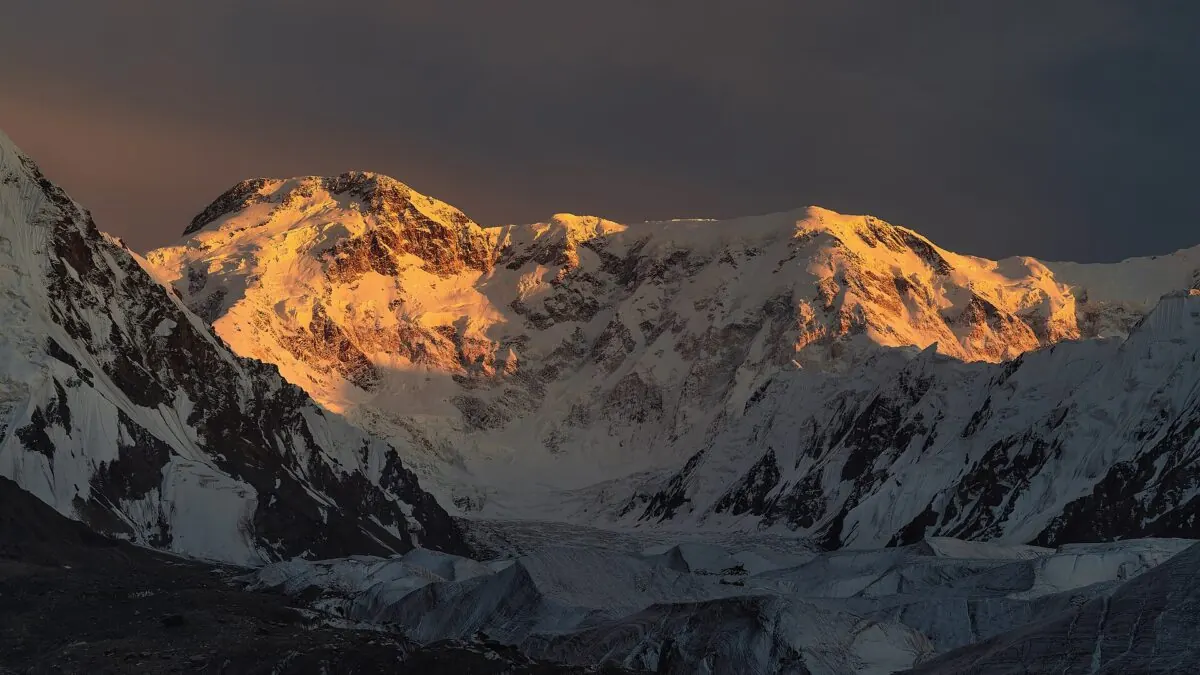
Third, horse treks: unless you are an experienced rider with your own tack, a multi-day horse trip needs a horseman anyway — the guide is not optional overhead, he is the person keeping the horses from walking home at night. Fourth, altitude and glaciers: objectives like Pik Lenin’s camps above base camp involve crevassed terrain where a rope and someone who has crossed it before are basic safety equipment, not indulgence.
There is also a blunt safety fact behind all four: Kyrgyzstan has no organized mountain rescue service worth relying on. No helicopter is coming for a sprained knee at 3,600 meters; evacuation means horses, hours, and whoever happens to be nearby. On busy Karakol trails that risk is diluted by other hikers. Deep in an empty valley, a local guide is your communication line, your evacuation plan, and your weather forecast rolled into one person — which reframes his daily rate considerably.
What each approach costs
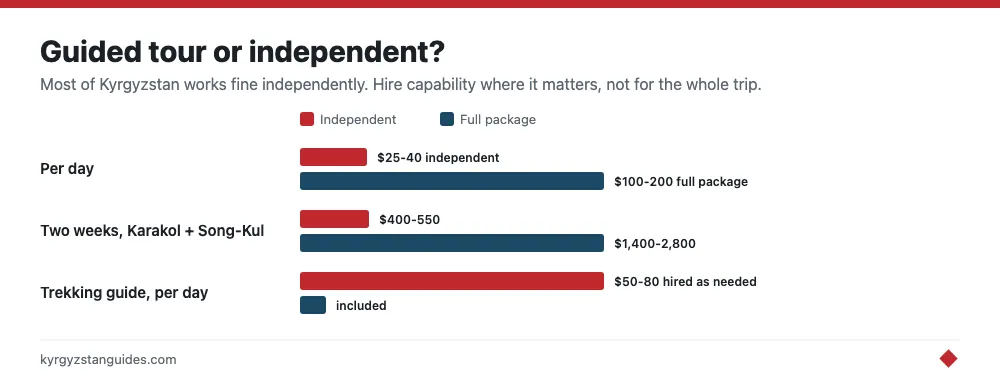
Independent travel here is cheap: $25-40 a day covers hostels or homestays, marshrutkas, and hearty café meals, with yurt nights around $15-22 including food. Hiring capability on top of that is priced per day — roughly $50-80 for an English-speaking trekking guide, $17-29 for a CBT horseman, $40-70 for a car and driver to a trailhead split between passengers. Full-package tours land around $100-200 per person per day depending on group size and comfort.
Run the numbers on a real two-week trip and the gap gets vivid. Independent: around $400-550 covers beds, food, marshrutkas, a Song-Kul horse trek, and the Karakol treks. The same fortnight as a private guided tour: $1,500-2,800 per person, sometimes more. The guided version is not a scam — you are paying for a 4WD instead of a minibus, a translator at every interaction, and zero logistics friction. But most of what it buys on the easy days is convenience you may not value at $100 a day. The smarter question is whether the difference, spent selectively, could instead buy you the two or three hard days you cannot do alone at all.
The middle path most travelers should take
The pattern that works: run your own trip on the easy 80 percent, and buy help by the day for the hard 20. Concretely, that means marshrutkas and guesthouses everywhere the roads go; the CBT office in each region for horses, yurts, and local day guides at fixed rates; an agency only for the border-zone segment or a technical objective. Solo women report the same structure works well here — our solo female travel guide goes deeper — because homestay networks put you inside families rather than alone in hotels.
A note on shared departures: in July and August, Karakol and Osh agencies run fixed-date group trips to Kel-Suu, Inylchek, and the Alay valley. Joining one gets you the permit, the 4WD, and the guide for a third of the private price. Two or three travelers teaming up on a driver achieves the same math anywhere in the country — hostel notice boards in Bishkek and Karakol exist largely for exactly this purpose, and a group assembled over breakfast can be at a trailhead by noon.
Quick answers
Is Kyrgyzstan hard to travel without a guide?
No. Cities, the Issyk-Kul lake circuit, and the popular treks around Karakol are all manageable independently using marshrutkas, shared taxis, and CBT offices for logistics. The hard parts are border-zone permits, unmarked high routes, and multi-day horse treks — and for those you hire help for just that segment, not the whole trip.
How much does a guide cost in Kyrgyzstan?
Expect roughly $50-80 per day for an English-speaking trekking guide, 1,500-2,500 KGS (about $17-29) per day for a local horseman-guide booked through CBT, and $100-200 per person per day for full-service organized tours that bundle transport, meals, and accommodation.
Do solo travelers need a tour for Song-Kul?
No. The standard route is to reach Kochkor by marshrutka, then book a horse trek or a driver plus yurt stay through the CBT office there. It is one of the easiest big experiences in the country to arrange independently, usually with only a day or two of notice in summer.
FAQ
Where in Kyrgyzstan do you actually need a guide?
A short list: border zones that require permits, unmarked passes, glacier routes and multi-day horse treks. Cities, the Issyk-Kul circuit, marshrutka travel and the best-known treks are all realistic on your own.
How much do people overspend on guided tours?
Travellers who book a full two-week guided tour are typically paying $1,500 to $3,000 more than they needed to, because most of the itinerary is ground you could cover independently.
What is the right way to think about it?
Not guided versus independent for the whole trip, but which two or three days of your itinerary deserve hired help. Buying a guide for the hard days and travelling yourself on the easy ones is almost always the better value.