Most travelers arrive assuming Kyrgyzstan runs on the same tipping math as home, and then overthink every bill. It doesn’t. This is not a tipping culture in the American sense, and nobody is standing behind you calculating a percentage.
The honest answer: tipping in Kyrgyzstan is optional and appreciated, not expected. Round up or leave 5-10% for genuinely good restaurant service, tip trekking guides and porters properly at the end of a trip, and don’t worry about the rest. Taxi drivers, hotel staff, and shopkeepers don’t anticipate a tip, and you won't offend anyone by skipping it. Below is where a little cash actually matters and where it doesn’t.
Restaurants: round up, don’t calculate
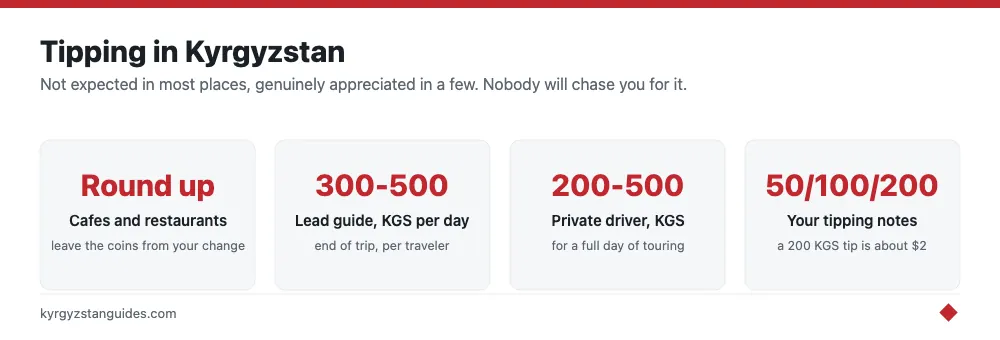
In everyday cafes, canteens, and roadside spots, tipping is simply not the norm. Locals rarely leave anything, and staff don’t expect it. If the service was warm and the meal good, leaving the coins from your change or rounding the bill up to the next round number is a nice gesture, think an extra 30-50 KGS on a 400 KGS lunch.
Sit-down restaurants in Bishkek and Karakol are a small exception. The mid-range and upscale places that cater to a business and international crowd increasingly see 5-10% as a normal courtesy for attentive table service, and until recently many added a separate service charge of 10-15% directly to the bill. That practice has been banned since 1 January 2026 (more on that below), so the bill should now show menu prices only. If you enjoyed the evening, 10% is generous by local standards and always welcome.
One rhythm to learn: you usually pay at the table, and change comes back in full. Leaving a tip means handing it over or leaving it on the table as you go, not assuming it’s folded into a card transaction. Which brings us to the thing that trips up more visitors than any etiquette question.
Carry cash, in small notes
Tips here are a cash transaction. Card machines are common in city restaurants but almost never a way to add a tip, and out in the mountains — exactly where you will most want to reward a guide or a guesthouse family — cards are useless. Keep a stash of small som notes precisely for this.
The 50, 100, and 200 KGS notes are your tipping currency. A US dollar sits around 87-89 KGS, so a 200 KGS tip is a bit over two dollars. Small money to you, meaningful locally, and easy for the recipient to actually use. Handing someone crisp foreign currency feels generous but creates a chore, since they then have to find a bank or exchange booth to spend it. Local cash, always.
Stock up when you have the chance. ATMs are reliable in Bishkek, Osh, Karakol, and most regional centers, and they dispense the mid-size notes you want. If you're heading into a valley for several days, draw cash before you leave town: our guide to getting around Kyrgyzstan covers where the last reliable ATMs sit on the main routes.
Trekking guides and porters: this one matters
Here is where tipping counts, and where being underprepared reflects poorly. Guides, porters, cooks, and horsemen on multi-day trips work hard for wages that are modest even by local standards, and a tip at the end is an established, expected part of how these trips work.
How much is harder to pin down than most advice suggests: no official body sets an amount, and we could find no published CBT guidance that does (more on that below), so ask the CBT office or the operator you booked through what is customary for their guides, porters, cooks, and horsemen before the trip ends. On a group trek, it’s normal to pool tips and hand them over collectively on the final morning, often with a quick word of thanks. If the guide kept you safe, read the weather right, and made the trip better, be generous without hesitation.
A few practical notes so it lands well:
- Bring the cash with you from town. There are no ATMs at a yurt camp or trailhead.
- Tip in som, not dollars, for the reasons above.
- On a pooled group tip, agree the total quietly among yourselves before the last day so no one is caught short.
- An agency booking fee isn't the guide’s tip — the person who actually walked with you is the one to reward.
If you're planning any of the classic routes in our Kyrgyzstan trekking guide, fold a tipping budget into your cash planning the same way you would fuel or permits.
Drivers, hotels, and everyone else
For most other services, you can relax. Metered and app-based taxi drivers in Bishkek don't expect a tip; rounding the fare up to the next round number is more than enough, and often locals don’t even do that. A private driver you hire for a full day of touring is a different case — if they’ve been patient, safe, and helpful, a tip in som at the end of the day is a warm gesture, though not obligatory.
Hotel staff, housekeeping, and porters at the handful of upscale properties will happily accept a small tip but don’t anticipate one; there's no ingrained tipping-the-bellhop custom here. Guesthouse and homestay hosts are best thanked another way entirely. Buying an extra home-cooked meal, complimenting the food sincerely, or leaving a warm review does more than cash, which can feel oddly transactional in someone’s home. At bazaars, tipping makes no sense at all; the equivalent courtesy is simply not haggling too aggressively over a few som with a small vendor.
The through-line across all of it: Kyrgyzstan is a low-pressure place to be a traveler on this front. Nobody is chasing you for a percentage, service is generally friendly regardless, and the country’s cheap prices — covered in our Kyrgyzstan travel budget — mean even generous tipping barely dents your spend.
So carry a few hundred som in small notes, tip your guide properly, round up when the service was good, and forget the mental arithmetic everywhere else. That’s the whole system.
Service charges became illegal on 1 January 2026
This is the single thing that has changed about paying a restaurant bill in Kyrgyzstan, and most advice online still predates it.
Cabinet of Ministers Resolution No. 663 of 14 October 2025, in force from 1 January 2026, prohibits catering venues from charging separately for service, for serving dishes, for setting the table, or for any other staff action. All of it must be inside the price shown in the menu before you order, and the amount you pay must not differ from what the published price list adds up to.
So if a bill arrives with a line reading "service 10%" or "обслуживание 15%", that is not a custom you have failed to understand. It is not permitted. Before the ban, a separately itemised charge of 10 to 15% was normal in Kyrgyz catering, and the public complaints about it are what prompted the measure.
Two things the rule does not do. It does not cap prices, and it does not touch tipping: the text carves out voluntary tips explicitly. Your discretionary cash is untouched.
What actually happened next was predictable and worth budgeting for. The head of the HoReCa Club restaurant and hotel association said plainly that operators would fold the percentage into dish prices, and they did. Reporting in January 2026 found menu prices up, with one account putting the rise at around 20%. Restaurateurs asked the cabinet for talks in February. You are not paying less than you were; you are paying it in one number instead of two.
What a tip is actually worth here
Tipping advice is useless without a sense of scale, so here is the scale. Kyrgyzstan's average monthly nominal wage was 53,759 som across the first half of 2026. Call it something in the region of 2,400 som a working day, nationally, across all sectors.
Set a restaurant tip against that and the arithmetic does the arguing for you. Rounding a 600-som dinner up to 700 is not a grand gesture, and it is not nothing either. This is why the honest advice is to round up, or leave 5-10% only when the service was genuinely good, rather than tip a set percentage by reflex: the percentage habit imported from countries where waiters are paid below minimum wage against expected tips does not describe the situation here.
On guides, drivers and homestays, I am going to decline to give you a number, and say why. Figures circulate freely online, typically 500 to 1,000 som a day for trekking guides and horsemen. Every one I could trace came from a commercial travel site with nothing behind it. No official body, and no published CBT guidance I could find, sets a norm.
What that means practically: ask the CBT office or the operator you booked through what is customary for their people, before the trip ends. They will tell you, the answer will be grounded in what their guides actually earn, and it will be better than a number I invented for you.
FAQ
Do you tip in Kyrgyzstan?
It is optional and appreciated, not expected. Round up or leave 5-10% for genuinely good restaurant service. This is not a tipping culture in the American sense, and nobody will chase you down the street.
Can restaurants in Kyrgyzstan add a service charge?
No, not since 1 January 2026. Cabinet Resolution No. 663 of 14 October 2025 prohibits separate charges for service, serving or table-setting. It must all be inside the menu price, and the total must match the price list.
Did prices go up after the service-charge ban?
Yes. Venues folded the old 10-15% into dish prices. Reporting in January 2026 found menu prices up, with one account putting the rise around 20%. If you are comparing to a 2025 guide, expect higher menu numbers for the same final bill.
Are voluntary tips still allowed?
Yes, explicitly. The resolution carves out voluntary tips. What is banned is the venue adding a compulsory service line to your bill, not you choosing to leave something.
How much should you tip a trekking guide in Kyrgyzstan?
No official or CBT-published norm exists, and the figures circulating online come from commercial travel sites with nothing behind them. Ask the CBT office or operator you booked through — they know what their guides earn.
Should you tip in cash?
Yes, and in small notes. Card tipping is not established, and a tip handed over directly is the one that reaches the person who served you.