The honest answer to “how do I get from Bishkek to Karakol?” is that all three options are fine and the marshrutka is the one most travelers should take. A shared minibus from Bishkek’s main bus station on Alma-Atinskaya 1/1 runs roughly 500-600 KGS and takes about 6-7 hours; a shared taxi does the same run faster for around 1,000-1,500 KGS a seat; a private car costs the most but buys you stops. There is no train and no flight, so the whole decision comes down to those three, plus how much you want to linger on Issyk-Kul’s north shore along the way.
Karakol sits at the far eastern end of Lake Issyk-Kul, roughly 380 km from the capital. The road east is good asphalt the whole way, which is why this is one of the easiest long journeys in the country to arrange on the day, with no advance booking and cash the only currency you need. Prices below are 2026 figures (1 USD is about 87-89 KGS); like everything here, treat them as “around,” not fixed.
The Marshrutka: Cheap, Frequent, and What We’d Take
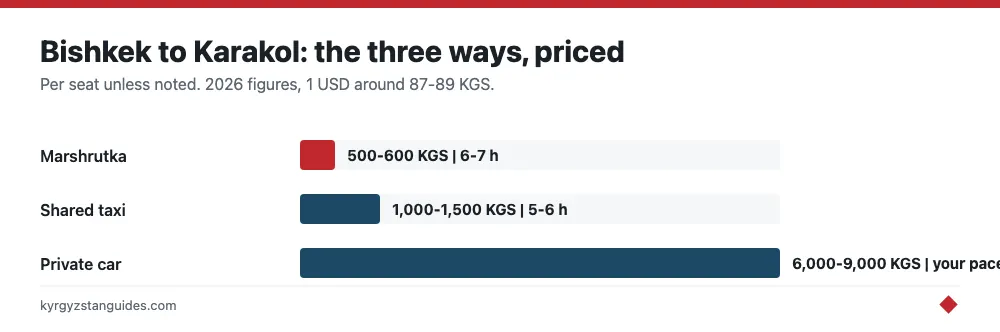
The workhorse option is the marshrutka (a shared minibus) leaving from Bishkek’s Bishkek’s main bus station on Alma-Atinskaya 1/1 (Zapadnyi Avtovokzal, on Jibek Jolu). Direct Karakol services run through the day, cost about 500-600 KGS, and take roughly 6-7 hours depending on how long the driver waits to fill seats and how many people flag it down en route.
A few things worth knowing before you climb in. Marshrutkas leave when full, not on a timetable, so the first departures of the morning fill fastest and get you to Karakol in daylight, aim to be at the station by 8 or 9 am. Say “Karakol” clearly and check the placard in the windscreen; some minibuses only run as far as Cholpon-Ata or Balykchy on the north shore. Pay the driver, usually at the end, and keep small notes because change for a 1,000 can be a hassle. Legroom is tight and bags go under your feet or on your lap, so travel light or accept the squeeze. If the system is new to you, our getting around Kyrgyzstan guide covers the etiquette in more detail.
Shared Taxi: Faster, Pricier, Still Cheap
Parked alongside the marshrutkas at Bishkek’s main bus station on Alma-Atinskaya 1/1 are the shared taxis, usually a Toyota sedan taking four passengers, leaving once all four seats sell. Expect around 1,000-1,500 KGS per seat and a faster run of about 5-6 hours, because a car overtakes where a loaded minibus crawls and skips the constant roadside pickups.
The shared taxi is the sweet spot for a lot of travelers: barely more money than the marshrutka in absolute terms, noticeably more comfort, and an hour or so saved. Confirm the per-seat price before you get in, not after, and clarify whether it’s a genuine shared taxi (you pay one seat) or the driver quoting you the whole car. If you’re tall or carrying a big pack, buying a second seat is normal and cheap here, and it transforms the ride. Two or three people traveling together can simply buy out the remaining seats and leave immediately rather than wait for strangers.
Private Car: When Paying for Control Makes Sense
Hiring a private car and driver for the day is the expensive route. Figure roughly 6,000-9,000 KGS for the one-way trip, more if you load it with stops, but it’s the only option that lets you turn the drive itself into the day out. Guesthouses and agencies in Bishkek arrange these easily, and the price is per car, so split three or four ways it stops looking so steep.
What you’re really buying is the freedom to stop. The north shore of Issyk-Kul is strung with worthwhile detours, and a private driver will pull over for each; a marshrutka will not. If your goal is simply to reach Karakol, this is overkill. If the goal is Issyk-Kul as an experience, it earns its cost.
Comparing Your Three Options
| Option | Price | Time | Best for |
|---|---|---|---|
| Marshrutka | ~500-600 KGS/seat | 6-7 hours | Budget travelers, no fixed schedule |
| Shared taxi | ~1,000-1,500 KGS/seat | 5-6 hours | A bit more comfort and speed |
| Private car | ~6,000-9,000 KGS/car | Your call | Stopping along the north shore |
North-Shore Stops Worth Breaking the Drive For
The Bishkek-Karakol road runs the northern edge of Lake Issyk-Kul for most of its length, and this is where a private car or a patient itinerary pays off. In a marshrutka you’ll glimpse the lake and press on; with your own wheels you can turn the transit day into the trip.
The obvious stop is Cholpon-Ata, the north shore’s main resort town, home to an open-air museum of Bronze Age petroglyphs scattered across a boulder field with the mountains behind. Just east, the Ruh Ordo cultural complex divides opinion but sits right on the water. Push a little further and you reach the quieter eastern beaches near Bosteri and, inland, the trailheads that feed the boz-uchuk and Grigoryevka gorges. For the full picture of the lake and its towns, our Issyk-Kul lake travel guide and dedicated Cholpon-Ata travel guide lay out what each stop is actually worth.
One route note: the road forks at Balykchy, at the lake’s western tip. The northern branch through Cholpon-Ata is the standard, faster way to Karakol and the one nearly all public transport takes. The southern shore road is rougher, quieter, and passes the Skazka “Fairytale” canyon and Jeti-Oguz. Lovely, but not something a Karakol-bound marshrutka will do. If those southern sights are on your list, plan them as separate trips from Karakol rather than expecting the through-service to detour.
Timing your stops matters too. A private car that leaves Bishkek at eight has plenty of daylight to linger in Cholpon-Ata, poke around the petroglyph field, and still reach Karakol comfortably before dark. Leave it later, try to cram in too many stops, and you’ll either arrive after nightfall or find yourself rushing the very places you paid extra to see. Pick one or two stops and give them time rather than ticking off five in a blur.
Practical Tips for the Day
A few small habits make this an easy day rather than a fraught one. Carry your fare in small notes — 100s and 200s. Because drivers rarely want to break a 1,000 for a 500-KGS seat, and there’s no card machine at the roadside. Eat before you leave or grab something at the station; the marshrutka may pause at a roadside cafe near Balykchy, but that’s the driver’s call, not a guarantee. Bring water, but not so much that you’re desperate between stops, since bathroom breaks are informal at best.
Motion sickness is worth planning for. The road itself is flat and fast along the lakeshore, so this is nothing like the switchback ordeal of the Bishkek-Osh run, but a full minibus with fixed windows can still turn queasy on the few winding stretches near the eastern end. Sit toward the front, keep a window cracked, and take a tablet beforehand if you’re prone to it. And download an offline map before you go — mobile coverage is decent along the populated north shore but patchy in between, and it helps to see roughly where you are when the driver announces a stop you didn’t expect.
Language is rarely a real barrier on this route. Drivers and fellow passengers are used to foreigners heading to Karakol, and a place name said clearly plus a bit of pointing sorts out almost everything. Learning to read a few destinations in Cyrillic (“Каракол” for Karakol) removes the last bit of guesswork at the station, where placards sit in the windscreen in Russian script rather than English.
Timing, Weather, and the Return Trip
Leave Bishkek in the morning. Departures thin out badly by mid-afternoon, and you want to arrive in Karakol with daylight to find your guesthouse. The road is open year-round. This is a lakeside highway, not a mountain pass, so it doesn’t close in winter the way the routes to Song-Kul or Osh do. But snow and ice slow everything down from roughly November to March, and services run less often in the cold months.
Coming back is the mirror image: Karakol’s own bus station and marshrutka stands send minibuses and shared taxis to Bishkek through the day at the same rates, again fullest in the morning. If Karakol is your gateway to the eastern mountains rather than the destination, our Karakol travel guide covers the treks, hot springs, and the Sunday animal market you came all this way for.
The Verdict
Take the marshrutka if you’re counting money and don’t mind a slower, fuller minibus — it’s the default for good reason. Upgrade to a shared taxi if a little comfort and an hour saved are worth roughly double the fare, which for most people they're. Hire a private car only when the north shore of Issyk-Kul is the point and you want to stop at will. All three get you there the same day; none needs booking ahead. Show up at Bishkek’s main bus station on Alma-Atinskaya 1/1 in the morning with cash, and you’re on your way.
Frequently Asked Questions
How long does Bishkek to Karakol take?
About 6-7 hours by marshrutka and 5-6 hours by shared taxi, over roughly 380 km of good asphalt along the north shore of Issyk-Kul. A private car can take as long as you like, since the point is to stop along the way.
How much is a marshrutka from Bishkek to Karakol?
Around 500-600 KGS per person in 2026, paid in cash to the driver. Shared taxis cost more at roughly 1,000-1,500 KGS a seat, and a full private car runs about 6,000-9,000 KGS one-way.
Where do buses to Karakol leave from in Bishkek?
From Bishkek’s main bus station on Alma-Atinskaya 1/1 on Jibek Jolu, where marshrutkas and shared taxis park side by side. There’s no advance booking — turn up in the morning, say “Karakol,” and leave when the vehicle fills.
Is there a direct flight or train to Karakol?
No. There is no passenger train to Karakol and no scheduled commercial flights, so road transport from Bishkek is the only practical way there for travelers.
One thing older guidance gets wrong. Bishkek’s Western Bus Station (Zapadnyi Avtovokzal) and the “Akzhol” mini-station both closed on 23 October 2024. Services moved to the municipal Bishkek Bus Station, which had opened that January: east-direction routes — Issyk-Kul, Karakol, Kochkor, Naryn — now leave from Alma-Atinskaya 1/1, and west-direction routes, including Osh and Talas, from Frunze 209. Any source still sending you to the Western Bus Station is out of date.
What time should I catch the Bishkek-Karakol marshrutka?
Be at the station by 8 or 9 am. Marshrutkas leave when full rather than on a timetable, the first morning departures fill fastest, and an early start gets you to Karakol in daylight. Check the windscreen placard too - some minibuses only run as far as Cholpon-Ata or Balykchy.
Is a private car to Karakol worth it?
Only if the drive itself is the day out. At roughly 6,000-9,000 som one-way it is overkill for simply reaching Karakol, but it is the one option that stops for the north shore's detours - petroglyphs, Grigorievka gorge, a beach hour - and split three or four ways the per-person cost stops looking steep.