Ten years ago, travelling independently in Kyrgyzstan without Russian was hard. Today a guesthouse owner's daughter in a mountain village will often switch into workable English before you have finished your first sentence.
That change isn't accidental and it's not evenly distributed. Understanding where it comes from tells you something about the country, and it explains why the quality of conversation you get here varies so much by who you happen to meet.
The system, in numbers
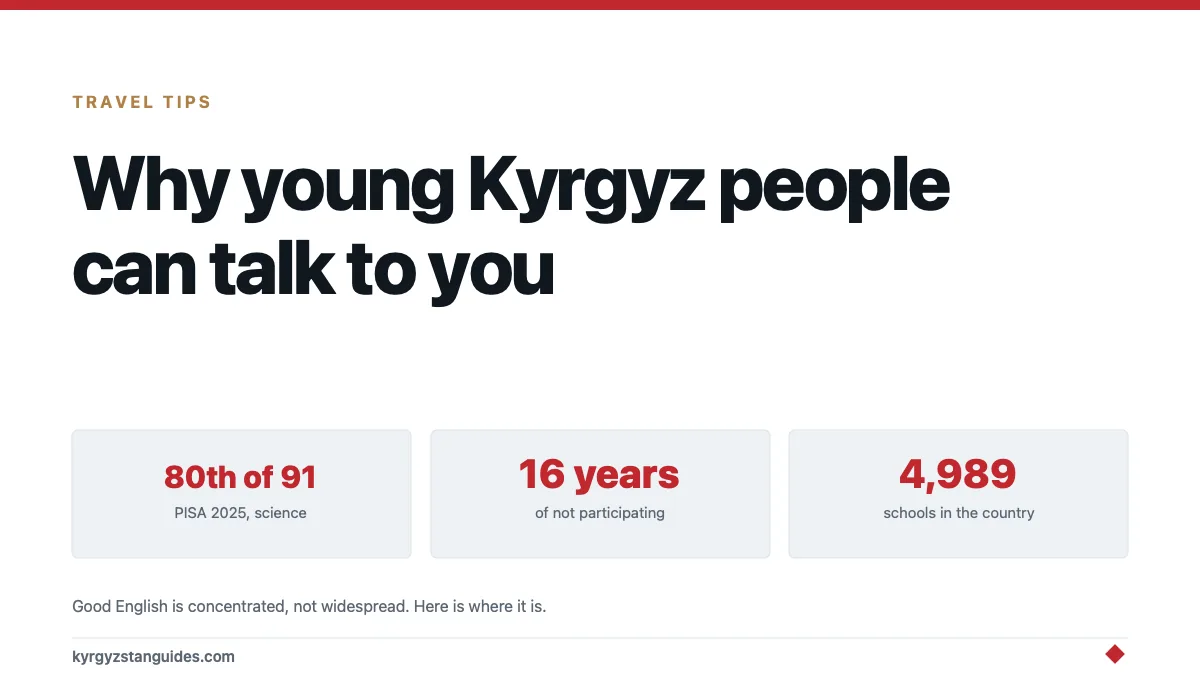
About 2,374 schools as of September 2026 — 2,132 state and 242 private — teaching roughly 1.5 million pupils. (An earlier version of this post gave 4,989 schools; that figure was roughly double the Ministry of Education’s own count and has been corrected.) Those buildings were designed for about 850,000 pupils, which is why many schools run in two or three shifts a day.
Over 98% access to primary and basic secondary education, delivered in buildings running two and three shifts a day. Genuinely high, and a real Soviet inheritance.
Instruction runs in Kyrgyz, Russian and Uzbek, which is how the country's language balance shows up in the classroom.
The country is transitioning to a 12-year school system from the inherited 11-year structure, alongside curriculum reform.
The institution above it, the National Academy of Sciences, is in worse shape than the schools. High enrolment with variable quality is the summary, and the quality part has hard data behind it.
The PISA problem
PISA is the OECD's international assessment of fifteen-year-olds in reading, mathematics and science. Kyrgyzstan participated in 2006 and 2009, finished at the very bottom both times, and then didn't participate for sixteen years.
It returned for PISA 2025, with results published in September 2026. Kyrgyzstan placed 80th of 91 in science. An improvement of eleven positions on its previous participation, and still near the bottom.
Two honest readings of that, and both are true.
It is bad. A country can't build a knowledge economy on those outcomes, and the gap between urban and rural schools within the country is wide.
Going back at all was the harder decision. Sixteen years of non-participation meant sixteen years of not knowing. Choosing to be measured again, publicly, at the bottom of a table, is not what a government does if it is only managing perceptions. Local analysis of what the 80th place actually means is unusually frank about both.
UNICEF and other agencies are working on district-level support for schools and teachers, which is the unglamorous part where outcomes actually move.
What the urban-rural gap looks like
This is the part that matters most and gets the least attention.
A school in central Bishkek and a school in a village in Naryn region are formally the same institution with the same curriculum. In practice they differ in almost every input that determines an outcome: teacher qualifications, subject specialists, textbooks, heating, internet, laboratory equipment, and whether the pupils have a quiet place to work at home.
Rural teacher shortages are chronic, particularly in maths, science and English: exactly the subjects that determine whether a child can leave the village for university. A graduate teacher has the same options as everyone else, including working in Russia for several times the salary.
There is also the seasonal problem nobody plans for. In herding families, children may be on the jailoo with the animals into September and back down before school properly restarts, and winter attendance depends on roads and on whether the school is heated.
So the national PISA figure conceals two different countries. The gap between them is the actual education problem, and it's the same gap that shows up in migration, in healthcare and in almost everything else here.
Where the English came from
English has been the most widely taught foreign language since independence. National proficiency remains low. Both of those are true, and the resolution is that the good English is concentrated.
Universities. English-medium instruction has expanded substantially in Kyrgyz higher education, and a cohort of graduates now works in tourism, NGOs and business.
The tourism economy. Community-based tourism created a direct financial reason for rural young people to learn English, in villages where there was previously none. A guesthouse that can take bookings in English earns more.
Migration that isn't to Russia. As the Russian labour market becomes less reliable, English opens South Korea, Turkey, the Gulf and further. English is now a migration asset the way Russian has been.
The internet. The most underrated factor. A generation learned English from YouTube and games rather than from a classroom, which is why their spoken fluency often outruns their formal instruction. Academic work on English in higher education across Kyrgyzstan, Tajikistan and Uzbekistan tracks the same expansion at university level.
What this means for travelling here
Under thirty, in tourism: usually English. Guesthouse owners' children, guides, drivers who work with foreigners, hostel staff.
Over forty, anywhere: usually Russian, not English. This is the most reliable rule in the country.
In villages: Kyrgyz first. A few words go a long way; see our phrases guide.
In Bishkek: all three, depending on who.
Do not assume the person with the best English is the most knowledgeable. The mountain guide with twenty years of experience and forty words of English knows things the fluent twenty-two-year-old does not. This is worth remembering when choosing who to hire — fluency and competence are separate variables, and in mountain terrain the second one is the one that matters.
Translation apps work well enough. Offline Russian and Kyrgyz packs, downloaded before you leave signal, handle most practical exchanges. Kyrgyz support is weaker than Russian but has improved a great deal.
If you want to contribute
This comes up constantly, so here is the honest version.
Teaching English casually isn't helpful. Dropping into a school for a week is disruptive and leaves nothing behind. Schools need trained teachers on long contracts, not tourists.
If you want to teach seriously, there are real routes, university positions, international schools, long-term NGO placements. They require qualifications and a commitment measured in months or years.
Voluntourism at orphanages is harmful. This is settled among child protection organisations and applies here as everywhere. Do not do it.
The useful thing is much duller. Stay in family guesthouses, pay properly for guides and horses, buy crafts at a fair price, and let people practise English on you without correcting them constantly.
Money into a rural household and unhurried conversation are worth more than a week of well-meaning teaching, and they're what you were going to do anyway.
FAQ
Do people speak English in Kyrgyzstan?
Increasingly, particularly among people under thirty and those working in tourism. Older people are far more likely to speak Russian, and rural areas are Kyrgyz-first.
How does Kyrgyzstan perform in international education rankings?
Poorly. In PISA 2025 it ranked 80th of 91 in science, an improvement of eleven places on its last participation in 2009, after a sixteen-year absence from the assessment.
What language are Kyrgyz schools taught in?
Kyrgyz, Russian or Uzbek, depending on the school. The country is also moving from an 11-year to a 12-year system.
How many schools are there in Kyrgyzstan?
Around 4,989 primary and secondary schools as of 2023, including 445 in Bishkek, with over 98% access to primary and basic secondary education.
Can I volunteer to teach English in Kyrgyzstan?
Short-term casual teaching is generally unhelpful and disruptive. Serious teaching routes exist through universities, international schools and long-term placements, and require qualifications and commitment.
Why is English spreading in Kyrgyzstan?
English-medium university instruction, direct financial incentives in community tourism, migration options beyond Russia, and a generation learning informally through the internet.