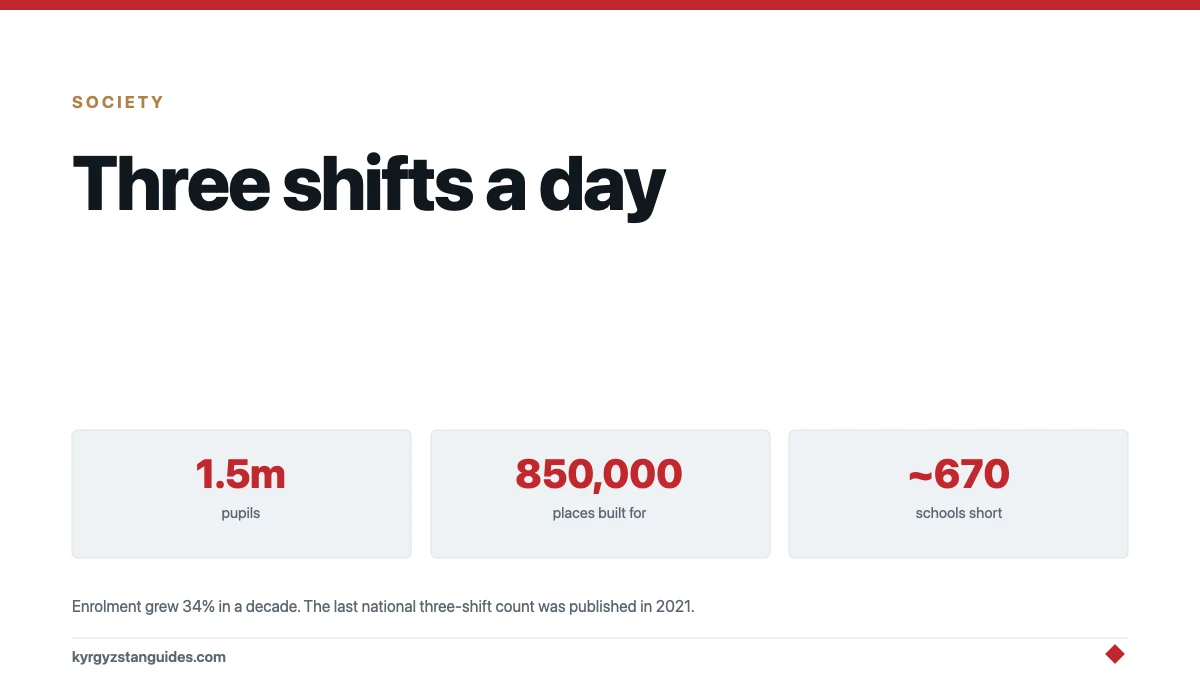
Kyrgyzstan has about 1.5 million schoolchildren in buildings designed for 850,000. That is the whole problem in one line. The country is not failing to build schools — it built 34 new ones in the first nine months of 2026 alone — it is failing to build them faster than children arrive.
The arrival is demographic. Enrolment grew 34 per cent between 2011 and 2020, because the birth-rate bulge of the 2010s is now sitting in classrooms. In September 2026 about 147,000 children started first grade.
The system absorbing them, as of September 2026: 2,374 schools — 2,132 state and 242 private — with roughly 1.5 million pupils and about 97,000 teachers. A year earlier the ministry counted 2,377 schools with 1,491,000 pupils, which was 27 more schools than the year before that. The network is growing. So is the queue.
This post is about capacity, buildings and teachers. We have a separate post on why young Kyrgyz people speak English and what PISA scores show, so this one skips both.
What "three shifts" actually means
The design capacity gap does not produce empty promises. It produces shifts.
One cohort of children comes in the morning, a second at midday, a third in the afternoon. In a three-shift school the last group can be finishing in the dark in winter. As of October 2021, 151 schools were operating in three shifts and the country was estimated to be short by about 670 schools. In the same assessment, 245 state schools were in emergency condition needing demolition or rebuilding and 457 needed major repairs.
Here is the honest limitation of this post: that 2021 figure is the most recent national three-shift count I could find. No newer official aggregate appears to be published. Given the construction drive since, the number may well have fallen, but I am not going to guess a direction and present it as fact. If someone quotes you a current three-shift figure, ask where it came from.
The national average of 1.5 times design capacity rises to roughly double in Bishkek and Osh, which is where the internal migration goes. Covering the resulting gap was estimated in 2022 to need 360 additional schools of 1,000 places each.
Class sizes, and the cap that was removed
Kyrgyz legislation specifies no more than 25 to 30 pupils per class for single-shift teaching. But the hard cap of 30 was formally repealed in 2018, which left the norm without an enforceable maximum.
What gets reported from Bishkek's novostroika districts is classes of 40 to 50, three or four children to a desk, and in one documented case a school built for 190 places serving 1,800 students across four shifts. Those figures come from Kyrgyz reporting rather than from a ministry document I could open, so I am presenting them as reported rather than confirmed. The 25–30 norm and its 2018 de-fanging are well corroborated.
The teacher gap, and the pay rise that fixed most of it
This is the part of the story that has genuinely improved, and it deserves saying plainly rather than being folded into a general complaint.
On 4 April 2022 the government raised pedagogical staff salaries by 80 per cent, junior and technical school staff by 80 per cent, and administrative staff by 50 per cent. The education ministry received over 16 billion som for the year, and the total social-sector increase cost 26 billion som across about 309,000 workers over nine months of 2022. The old hourly system — 97 som an hour for a teacher with a master's degree — was replaced with salaried pay pegged to the 7,040 som minimum subsistence level.
The effect on vacancies:
| Period | Teaching vacancies |
|---|---|
| Before 2021 | reportedly up to 2,000 |
| Start of 2025/26 year | about 800 |
| End of 2025/26 year | more than 640 |
| A separate April 2026 parliamentary figure | 947 subject teachers |
The two most recent figures disagree — 640 against 947 — and both are recently published, so both are given. Either way the gap is roughly a third of what it was.
The distribution is uneven in a way that confirms where the pressure is: Chui region has the largest shortage at 276 vacancies, Bishkek 143, and Osh just 2. The deepest shortages are in Russian-language and primary-grade teaching.
I could not confirm whether any further nationwide teacher pay rise happened in 2023 beyond the 2022 increase, so the 80 per cent figure should be read as a one-off correction rather than the start of a series.
Who is paying for the new schools
The construction programme is funded from an unusually mixed set of pockets:
Twenty schools from the republican budget. Twelve financed by the Saudi Development Fund. One with Russian assistance, alongside a separate Russian pledge of a $500 million package covering nine Russian-language schools. Three from local budgets. The Saudi Development Fund's first phase covered 30 educational institutions for $30 million, and a second-phase credit of 187.5 million Saudi riyals, about $50 million over 25 years with a five-year grace period at 1.5 per cent interest, was ratified for further Bishkek-area construction. A World Bank-supported project was to build 14 schools and repair 16 in emergency condition.
I found no Kuwaiti or Chinese school-construction financing, despite it being sometimes mentioned, and no evidence that the multi-year 2023–2026 target was met in full.
What I can report on pace: by mid-September 2026, 100 social facilities had been completed for the year including 34 new schools and 28 kindergartens, with another 58 educational institutions planned by year end — 49 new schools, 7 kindergartens and 2 major renovations. That is real progress within 2026.
The financing picture behind it is not comfortable, though. Back in January 2022, 186 schools were under construction at various stages against an annual state budget line of about 800 million som, with an estimated additional 14 billion som needed just to finish projects already started. A country that needs 670 schools and can fund a fraction of them a year is going to be running shifts for a long time.
The school year, and the 12-year transition
The 2025/26 year ran 1 September 2025 to 25 May 2026, with holidays set by ministry order:
| Break | Dates |
|---|---|
| Autumn | 5–9 November 2025 |
| Winter | 31 December 2025 – 11 January 2026 |
| Spring | 6–8 March 2026 (three days) |
| May | 1–10 May 2026 |
Six-year-old first-graders in the new twelve-year system get an extra recommended rest period from 24 December to 18 January.
That twelve-year transition began in 2025 and is being run in parallel tracks: grades 1, 2, 3, 5, 7 and 8 moved to the new twelve-year programme in 2025/26, while grades 4, 9, 10 and 11 continue under the old eleven-year one. Two curricula running in the same building at once.
On two things sometimes said about Kyrgyz schools I found no confirmation: organised "potato holidays" for harvest labour, and school closures specifically for heating failure. Both are documented in some other post-Soviet contexts. I could not corroborate either for Kyrgyzstan and am not going to import them.
Language of instruction
From ministry data as of September 2024, across 2,377 schools: 1,368 teach only in Kyrgyz, 274 only in Russian, 18 only in Uzbek, 5 only in English, 3 only in Tajik. Another 709 use multiple languages, of which 548 combine Kyrgyz and Russian.
One unresolved discrepancy: an older count put Uzbek-only schools at 43 and Russian-only at 216. The Uzbek figure differs sharply from the 2024 count of 18, and I could not reconcile them or date the older source properly. If Uzbek-medium schooling really fell from 43 to 18, that is a significant story, but the sourcing does not support asserting it.
What parents actually pay
Officially, textbooks are free. For 2025/26, 4.7 million sets of textbooks and methodology kits were produced and distributed.
In practice parents report shortages and worn-out books, and in some cases paying up to 1,500 som out of pocket for missing textbooks. Supply is uneven by language: Russian-medium schools are provisioned at 65 to 68 per cent of need against 75 per cent for Kyrgyz-medium ones. Officials expect to close the textbook gap only by 2030, when the twelve-year transition completes.
On the informal "school fund" payments that parents are widely described as making, and on uniform costs, I could not find figures with a working source. That is a real gap in this post and I would rather mark it than fill it.
The private alternative
For those who can pay, the numbers are startling next to everything above. Bishkek International School's published fees run from $10,087 for Pre-K to $21,070 for grades 11–12, plus a $250 per-family registration fee, a $2,000 annual English-as-an-additional-language fee from grade 4, a $1,000 non-refundable place deposit and a textbook deposit of $200 to $500.
Twenty-one thousand dollars a year in a country where the average pension is $145 a month. There are at least fourteen international schools in Bishkek.
FAQ
Why do Kyrgyz schools run in shifts?
Because there are roughly 1.5 million pupils in buildings designed for about 850,000. Schools run at an average 1.5 times design capacity nationally and about double that in Bishkek and Osh, so pupils are split into morning, midday and afternoon groups. As of 2021, 151 schools were running three shifts.
How many schools does Kyrgyzstan have?
About 2,374 as of September 2026 — 2,132 state and 242 private — with roughly 1.5 million pupils and 97,000 teachers. The country was estimated in 2021 to be short by around 670 schools.
How much do Kyrgyz teachers earn?
Salaries rose 80 per cent for pedagogical staff on 4 April 2022, replacing an hourly system (97 som an hour for a teacher with a master's degree) with salaried pay pegged to the 7,040 som minimum subsistence level. Teaching vacancies fell from a reported 2,000 before 2021 to between 640 and 947 in recent figures, which disagree.
When does the Kyrgyz school year start and end?
1 September to late May — the 2025/26 year ran to 25 May 2026. Breaks were 5–9 November, 31 December to 11 January, just three days in early March, and 1–10 May.
Is Kyrgyzstan changing to a 12-year school system?
Yes, in parallel tracks from 2025. Grades 1, 2, 3, 5, 7 and 8 moved to the twelve-year programme in 2025/26 while grades 4, 9, 10 and 11 continued on the old eleven-year one. The textbook supply for the transition is expected to be complete only by 2030.
What language are Kyrgyz schools taught in?
As of 2024, 1,368 schools taught only in Kyrgyz, 274 only in Russian, 18 only in Uzbek, 5 only in English and 3 only in Tajik, with a further 709 using more than one language — 548 of those combining Kyrgyz and Russian.
Are textbooks free in Kyrgyz schools?
Officially yes, and 4.7 million sets were distributed for 2025/26. In practice parents report shortages and some pay up to 1,500 som for missing books. Russian-medium schools are supplied at 65–68 per cent of need against 75 per cent for Kyrgyz-medium schools.