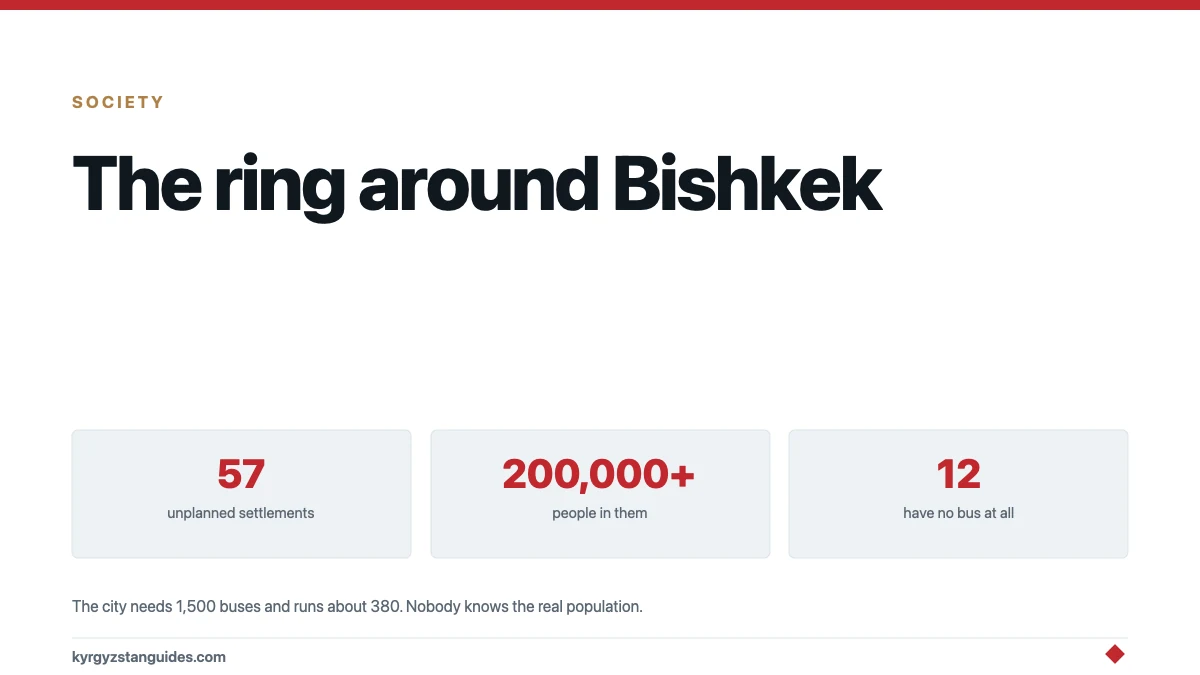
Bishkek officially recognises 57 zhilmassivy — residential mass developments on its edge — with more than 200,000 people living in them. Of those 57, forty-two have no adequate trolleybus access and twelve have no bus service at all. Eighty per cent of the water pipelines serving them are classed as deteriorated. At least a quarter have no gas supply, so households burn coal and whatever else burns.
These are the novostroiki. They are where Kyrgyzstan's internal migration physically lands, and if you arrive in Bishkek by road from Kazakhstan or the north you drive through them before you reach anything a guidebook mentions.
The city's footprint grew one and a half times in twenty-four years, to more than 187 square kilometres, and most of that growth happened this way: people arrived from the regions, occupied land at the edge, built, and waited for the city to catch up.
The direction of travel
Internal migration in Kyrgyzstan has one shape: out of the mountains, into the Chui valley.
Of the roughly 626,000 people the statistics committee records as having changed their place of residence within the country, about 28.3 per cent moved to Chui oblast and 21.2 per cent to Bishkek city. Half of all internal movement in the country goes to one valley and the capital sitting in it. I could not re-open the exact statistics page carrying that 626,000 breakdown to confirm its reference year, so treat the shares as the right shape with an uncertain date.
The population figures themselves are solid. As of 1 February 2026 Kyrgyzstan had 7,413,600 people, of whom Bishkek held 1,362,900 and Chui oblast 984,600. Between the city and the oblast wrapped around it, that is nearly a third of the country in one corner.
Osh is the second destination. The 2022 census put it at 364,000 present population and 353,000 permanent, and recorded 36.8 per cent growth over the preceding thirteen years — the fastest of any city in the republic. What nobody publishes is how much of that is in-migration versus births versus the annexation of surrounding villages, so the growth rate is real but its composition is not established.
Nobody can tell you how many people live in Bishkek
This deserves its own section, because it is the thing most written about Bishkek gets wrong by stating a number confidently.
The 2022 census counted 1,137,882 people in Bishkek. By early 2026 the statistics committee's estimate was 1,362,900. That is over 200,000 added in four years, which is a very fast official growth rate for one city and is itself evidence of the scale of arrival.
But that is the registered and estimated figure. The commonly repeated claim in Central Asian urban commentary is that Bishkek's real population is far higher — you will see 1.5 million, 2 million, occasionally more. I went looking for a sourced figure for the de facto population including unregistered residents, and there is not one. Not from the statistics committee, not from the mayor's office, not from any credible outlet I could reach.
The closest thing to a measurement of the gap is oblique: the Central Election Commission reports that about 11.5 per cent of Bishkek's voting-age population is absent from electoral lists because they have not submitted biometric data. That is a proxy for people present but not administratively captured, and it is the only number of its kind I found.
So the honest statement is this: Bishkek's official population is about 1.36 million, its real population is higher, and the size of the difference is not known. Anyone who gives you a precise figure for the second one is guessing.
The propiska still decides things
The registration system survives. It is governed by a government regulation on the rules of registering and deregistering citizens by place of residence and place of stay, administered by the State Registration Service.
What it gates, in practice: registration at a clinic, prenatal care, enrolment in school and kindergarten, and state child benefits. RFE/RL's Current Time documented a woman who had lived in Bishkek for eight years without registration and could access neither prenatal care nor child allowances.
The mechanism of exclusion is mundane and it is not really the state's doing. Landlords refuse to register tenants — some fear tax or utility consequences, some are themselves abroad. So a family renting in Bishkek can be perfectly legal, paying rent, working, and still administratively invisible for the purposes that matter most, because the person whose signature they need has no reason to provide it.
There is reportedly a reform allowing children to be enrolled in school based on actual residence rather than registered address. I could not verify its exact scope or date from the primary text, so I am reporting that it is described rather than confirming what it does.
What a novostroika actually looks like
The named settlements you will hear about include Ak-Ordo, Archa-Beshik, Ak-Örgö, Selektsionnoe, Chelyabinskiy, Izmaylovskiy, Kelechek and Altyn-Kazyk. Altyn-Kazyk, part of the Ak-Deben village district, borders the city landfill and is described in reporting as an illegal new-construction development.
The legal position is the core grievance. Residents of settlements outside Bishkek's official boundary lack the "red book" land title document, and have petitioned for years to be formally brought inside city limits. In 2023 President Japarov's answer to them, as reported by Kloop, was to wait another year or two while land questions were settled.
Meanwhile the infrastructure arithmetic:
| The 57 recognised settlements | Status |
|---|---|
| Residents | more than 200,000 |
| Water pipelines deteriorated | 80%, with consumption at least double the permitted norms |
| Without gas supply | at least a quarter of settlements, burning coal and waste instead |
| Without adequate trolleybus access | 42 of 57 |
| With no bus service at all | 12 |
| Buses and trolleybuses the city needs | about 1,500; it operates roughly 380 |
That last line is the one to hold onto. The city runs about a quarter of the public transport it needs, which is why the marshrutka does the work it does here, and why coal smoke is a winter fact in Bishkek. Our post on Bishkek air quality touches the consequences.
The 200,000 figure is from 2023 and is the only sourced one. Higher numbers of 300,000 to 500,000 circulate in secondary literature; I could not verify any of them.
The villages at the other end
This is where the data thins out almost completely, and I want to be clear about it rather than fill the gap with atmosphere.
The regions people leave are Naryn, Batken, Talas and Jalal-Abad. Population densities there run around 7 people per square kilometre in Naryn, 24 in Talas and 33 in Batken — among the lowest in the country, though that reflects mountains as much as departure.
What I could not find, from any source: an official count of how many villages have lost most of their population, any list of abandoned villages, or a school-closure count attributable to rural depopulation. These get asserted freely in travel writing. They are not in the published statistics as far as I can tell.
What is documented is the political symptom. On 23 September 2026 deputies in the Jogorku Kenesh raised regional problems together — shortages of schools and kindergartens, gasification, water supply, road condition, healthcare access. One deputy cited the village of Sadovoye, which after an administrative-territorial reform effectively became an enclave, making its infrastructure harder still. That is not a measure of depopulation, but it is what the consequences sound like when they reach parliament.
Nor could I find a dedicated government programme aimed at reversing rural-to-Bishkek migration. There are housing programmes — "My Home 2021–2026" under the State Mortgage Company, and the construction ministry's phased effort to legalise problem buildings. Those address where migrants end up. Nothing I found addresses why they leave.
Why this is worth a traveller's attention
Because it corrects the picture. The postcard version of Kyrgyzstan is 94 per cent mountains and a population on horseback in summer pastures. The actual country is urbanising fast and unevenly, and a third of it now lives in one valley, a large and uncounted share of that in settlements built ahead of the pipes and the buses.
If you take a shared taxi in from Kazakhstan, look left and right for the twenty minutes before the centre. The self-built houses, the unpaved side streets, the water tanks on roofs. That is where the country's internal movement has physically deposited itself, and it is more representative of modern Kyrgyzstan than anything in the centre of town.
FAQ
What are the novostroiki around Bishkek?
Unplanned settlements on the city's edge, built by people arriving from the regions. Bishkek officially recognises 57 of them, with more than 200,000 residents as of 2023. Many lie outside the formal city boundary, which leaves residents without full land title documents.
What is Bishkek's real population?
Officially about 1,362,900 as of February 2026, up from 1,137,882 in the 2022 census. The real figure including unregistered residents is higher, but no credible source publishes an estimate of it — the closest indicator is that roughly 11.5 per cent of the city's voting-age population is missing from electoral lists.
Does Kyrgyzstan still have the propiska system?
Yes. Registration by place of residence is still governed by a standing government regulation and administered by the State Registration Service. Without it, people face difficulty registering at a clinic, getting prenatal care, enrolling children in school or kindergarten, and claiming child benefits.
Where do internal migrants in Kyrgyzstan come from and go to?
They leave Naryn, Batken, Talas and Jalal-Abad, and they go to Chui oblast and Bishkek — those two absorb roughly half of all recorded internal moves. Osh is the second destination, having grown 36.8 per cent in the thirteen years to the 2022 census.
Why do the settlements around Bishkek have no gas or buses?
Because they were built before the infrastructure and the city has not caught up. At least a quarter of the 57 settlements have no gas supply, 42 lack adequate trolleybus access and 12 have no bus service at all. Bishkek needs around 1,500 buses and trolleybuses and operates roughly 380.
Are Kyrgyz villages being abandoned?
Regions like Naryn have very low population density — around 7 people per square kilometre — and the outflow to Chui and Bishkek is well documented. But no official count of depopulated or abandoned villages, or of school closures caused by it, appears to be published, so specific claims about abandoned villages should be treated carefully.
Is the government doing anything to reverse rural-to-urban migration?
Nothing I could find that targets the causes. Existing programmes address housing at the destination — the "My Home 2021–2026" mortgage programme and a phased effort from 2025 to legalise or replace illegally built apartment blocks. No dedicated regional-retention or return-migration programme surfaced in official sources.