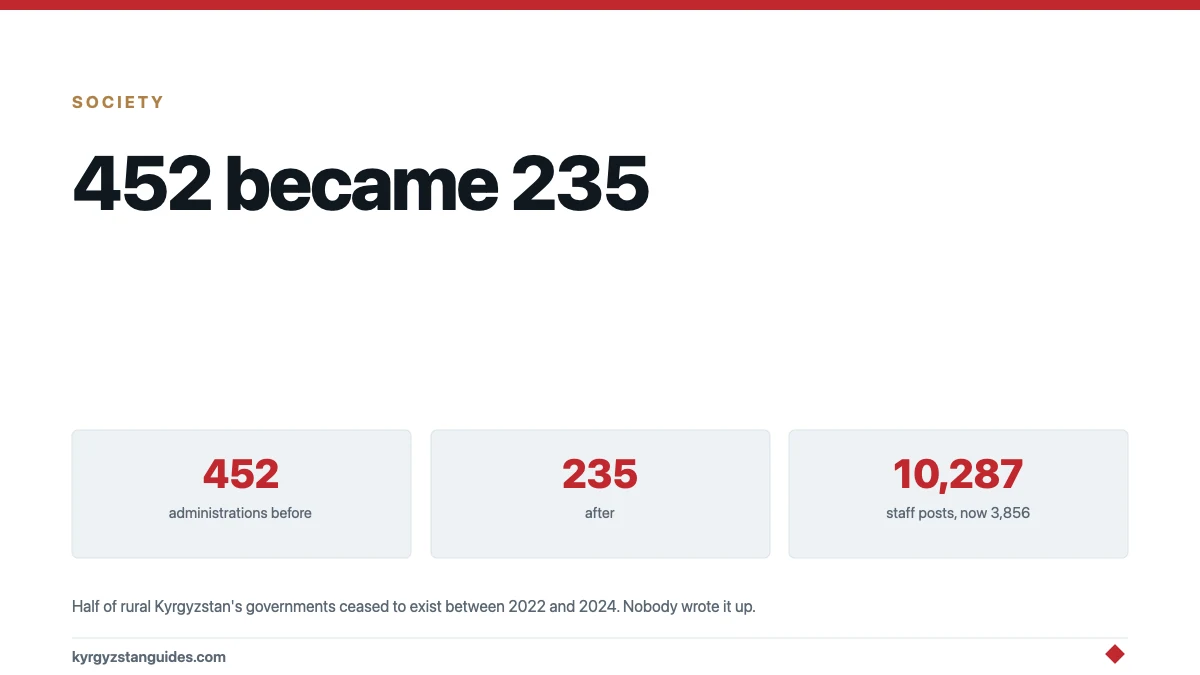
Before the reform, rural Kyrgyzstan was run by 452 aiyl okmotu — village administrations. After it, 235. Nearly half of the country's rural governments ceased to exist as separate entities between 2022 and 2024, their offices merged, their staff cut from 10,287 positions to 3,856, and in March 2025 the Cabinet declared the first stage complete.
If you have spent any time in rural Kyrgyzstan, you know what an aiyl okmotu is even if you never learned the word: the low building with the flag where the village's stamps, certificates, land papers and disputes all live. Our post on the anatomy of a Kyrgyz village puts it alongside the school and the mosque as one of the three institutions every village has. Half of those buildings now answer to a neighbouring village instead.
Nobody has written this up in English beyond wire headlines, which is odd, because it is the largest redrawing of Kyrgyzstan's local map since the Soviet Union ended.
One number to get right first
You will meet the claim that 452 became 217. It is wrong, and the arithmetic shows how the error happened: 452 minus 235 is 217 — 217 is the number of administrations that disappeared, not the number that remain. The Cabinet's own head, Akylbek Japarov, gave the before-and-after as 452 to 235, and the 2024 law fixing the new boundaries lists 235 united rural districts and 33 cities.
How it rolled out
| Stage | What happened |
|---|---|
| 2022 | Pilot in Tyup district, Issyk-Kul: 13 rural districts became 5 |
| 2023 | Naryn region: 63 became 27 |
| December 2023 | Decree extends the merger to Batken, Jalal-Abad, Issyk-Kul, Osh, Talas and Chuy regions, plus the cities of Bishkek and Osh |
| 2024 | Law approves the new boundaries nationwide |
| March 2025 | Cabinet declares the first stage complete: 452 to 235 |
In Issyk-Kul region, only 22 of 61 rural districts remained — a cut of almost two-thirds — with Karakol, Cholpon-Ata and Balykchy each absorbing a neighbouring district outright.
One honest caution about these numbers: no source states whether the 452 baseline already counts the merged Tyup and Naryn units or the pre-merger ones, so the regional figures cannot simply be added up to the national total, and I have not tried.
Bishkek was in the same reform from the other direction: the capital's territory roughly tripled by annexing surrounding villages into its four districts — the administrative half of the story our post on the settlements ringing Bishkek tells from the ground. It is also why town populations in places like Kant jumped between two statistical yearbooks without anyone moving house: the boundaries moved, not the people.
The government's case
Money and manageability. Staff positions across rural administrations fell from 10,287 to 3,856, and the Cabinet puts the cost of running them at 3 billion som against 4.8 billion before. Many of the 452 were tiny — administrations serving a few hundred households, each with its own accountant, land specialist and secretary, many of them running on transfers from Bishkek rather than their own revenue. Merging them, the argument goes, produces units big enough to employ competent staff and plan anything at all.
The reform also changed who answers to whom, though that part predates the mergers: since the 2021 local-government law, the head of a rural municipality is appointed and dismissed by the district akim — the state's man — for a five-year term, not chosen by the local council as before. Merged territories, appointed heads: both halves point the same way, toward the centre.
The case against, which is not hard to find
Freedom House's Nations in Transit survey calls the reform "poorly designed and unpopular", and the complaints on the ground are concrete rather than ideological.
The first is distance. A merged administration sits in one village, which means every other village in the new unit now travels for the stamps and certificates that used to be local — in mountain districts, that can be a real journey rather than an errand.
The second is pasture. A village's summer pastures are allocated through its administrative unit, and merging units means sharing pasture with villages you never shared it with before. In a country where pasture runs through everything from the herd economy to the law, redrawing those boundaries redraws who grazes where — which is precisely the kind of question that used to be settled inside one village and now is not.
Whether the savings justify that friction is a judgement, not a fact, and officials themselves concede the verdict is years away: the government's own line in March 2025 was that the results would take time to assess, with work continuing on digitalisation and financing. There is no announced second stage — anything you read about further rounds of merging is speculation.
What survived the merger
Not everything was centralised, and the distinction matters for how the new units actually work.
The aiyl kenesh — the elected village council — still exists, now at the level of the merged district, and its deputies are still chosen by local vote. What changed is the executive: the council used to matter in choosing the administration's head, and now the district akim appoints him. So a merged unit has an elected assembly debating a budget whose executor answers upward, which is a workable arrangement or a hollow one depending entirely on the people involved — and on that, no two villages give the same answer.
The 2024 boundaries law also carried the reform's second idea in its own title: spatial planning. Each merged unit is supposed to get a development plan treating its villages as one economic space — where the school expands, where the water goes, which village gets the workshop. That is the stated payoff for the pain of merging: planning units big enough to plan. Whether 235 administrations actually produce 235 plans is one of the things the next few years will show.
Why a traveller should care at all
Because the aiyl okmotu is quietly load-bearing for tourism too. Community-based tourism coordinators, pasture committees, aksakal courts, the people who stamp a border-zone permit application or settle whose horse you rented — in a village, administrative capacity is not an abstraction. When the administration moves two villages over, some of that moves with it.
And because it explains things you will actually notice. A village whose signboard names a district you cannot find on an older map; a local who gives the name of their village and then, separately, the name of the aimak it now belongs to; population figures for small towns that leap absurdly between sources. The map changed in 2024, and most of what is written about Kyrgyzstan has not caught up with it.
What I could not establish
Whether the 452 baseline includes or excludes the already-merged pilot districts, as noted above. Any systematic account of how pasture-allocation disputes are being resolved inside merged units — the complaints are documented, the resolutions are not. And any official evaluation of the pilot: Tyup went first in 2022, and if the state has published an assessment of how the pilot actually performed before scaling it nationwide, I could not find it.
FAQ
What is an aiyl okmotu?
The executive administration of a Kyrgyz rural municipality — the office that handles civil registration, land documents, local budgets and village-level disputes. Before the 2022-24 reform there were 452 of them; there are now 235, serving merged districts called aiyl aimaks.
How many village administrations does Kyrgyzstan have now?
235, down from 452, under boundaries fixed by law in 2024, alongside 33 cities. The figure of 217 that sometimes circulates is the number of administrations eliminated, not the number remaining.
Why did Kyrgyzstan merge its villages?
Cost and capacity, by the government's account: staff positions fell from 10,287 to 3,856 and running costs from 4.8 to 3 billion som. Many of the 452 units were too small to fund themselves and ran on transfers from the centre.
What are the complaints about the merger?
Freedom House calls the reform poorly designed and unpopular. Residents of villages that lost their administration now travel further for documents and services, and merged units must share summer pastures that were previously allocated village by village — a genuinely sensitive change in a herding economy.
Who runs a merged rural district?
A head appointed and dismissed by the district akim for a five-year term, under the 2021 local-government law — not elected by the local council, as before the reform era. Critics read the mergers and the appointments as two halves of the same centralisation.
Is there a second stage of the reform?
Not that has been announced. The Cabinet declared the first stage complete in March 2025 and described continuing work on digitalisation and municipal financing, while officials said the results would take years to judge.
Did the reform change Bishkek?
Yes — the capital's territory roughly tripled by annexing surrounding villages into its existing four districts. That is why population figures for Bishkek and for nearby towns jump between statistical editions without anyone actually moving.