Of the six provincial Kyrgyz towns in this series, Kant is the only one whose founding industry is not merely alive but expanding.
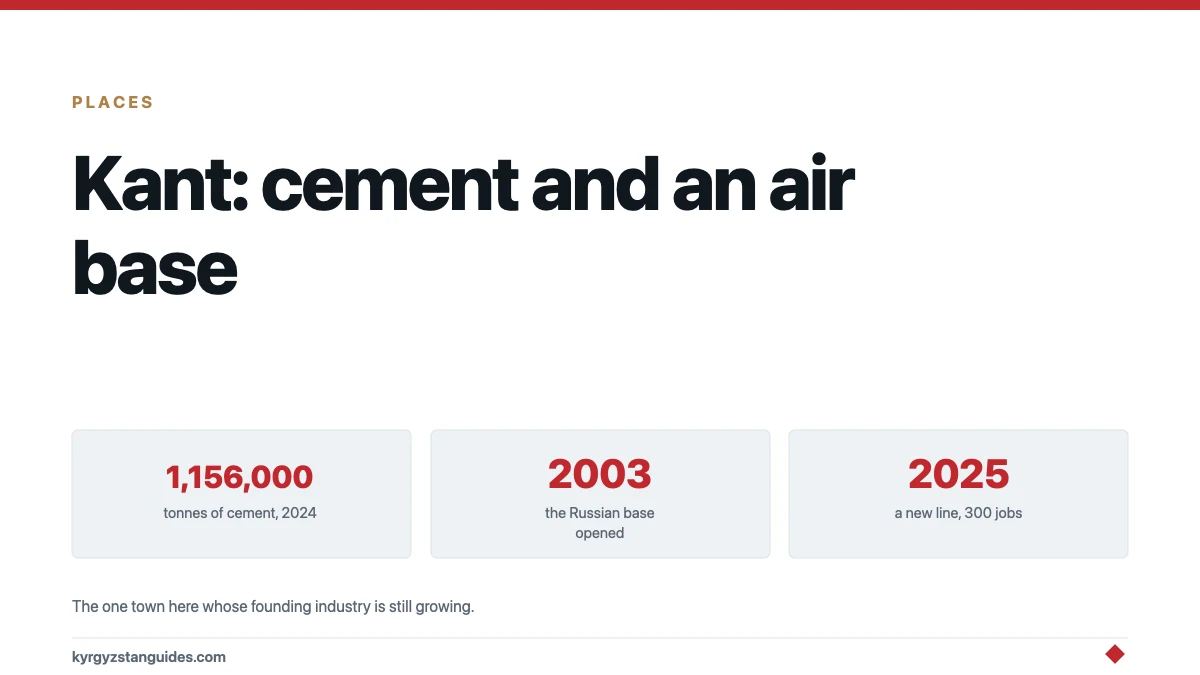
The cement plant made 1,156,000 tonnes in 2024, employs over 800 people, and in June 2025 the president personally started a new production line costing over US$60 million. Next door is a Russian air base that has been there since 2003.
It is 20 kilometres from Bishkek, which makes it the easiest of these towns to reach and the least likely to be visited on purpose.
The name
Кант is the Kyrgyz word for sugar, and the sugar factory is the town's origin story — though local sources caution that the toponym and the plant are not necessarily causally linked.
Sugar is still produced here. The founding dates are contested: the settlement formed no later than 1928, the railway branch was built between 1930 and 1932, and the sugar factory is dated to either 1932 or 1934. The town received city status in 1985 and became a district centre in 1998.
We flag those dates as uncertain for a specific reason: Kant has no working municipal website. The town's own domain returns a server error and the oblast's does not resolve at all. That means there is no official page giving Kant's altitude, area or history, and everything above comes from secondary compilations.
Cement
The Kant Cement Plant was founded in 1964 and is now part of United Cement Group, the largest cement holding in Central Asia with a group capacity of 7.6 million tonnes a year. The plant itself is rated at more than 1.1 million tonnes of cement annually.
2024 output: 1,156,000 tonnes. Workforce: over 800. It paid over a billion som in tax in 2023 and 158 million som more in 2024 than in 2023.
On 16 June 2025 the president started a new dry-process clinker line: 800,000 tonnes of clinker a year, 2,500 tonnes a day, more than US$60 million invested, over 300 new jobs, built with Beijing Triumph Engineering and financed through the Eurasian Development Bank.
The backstory is worth a line, because it shows what the expansion cost. In March 2024 the plant mortgaged all of its property to finance the clinker line. Ongoing modernisation also covers a new compressor station and a closed-loop grinding project.
The air base
Russia concluded a 15-year agreement with Kyrgyzstan in September 2003 on stationing an aviation unit at Kant under the framework of the Collective Security Treaty Organisation. The base opened officially on 23 October 2003.
It became the anchor of Russia's unified military facility structure in Kyrgyzstan and serves as the aviation component of the CSTO Collective Rapid Reaction Force for Central Asia. In early 2017 the presence was extended by a further 15 years, after which the agreement renews automatically every five years.
Russian defence sources have indicated re-equipment with modernised Su-25SM3 attack aircraft. We could not confirm that from a primary document, and we have no figure for personnel or aircraft numbers.
The base is a military site and is not visitable. Its civic footprint in the town is real but small — base personnel distributed humanitarian aid in Kant in July 2025.
Why a cement town matters here
A short digression, because it explains something about the country.
Kyrgyzstan imports a great deal and manufactures comparatively little. Cement is one of the exceptions: it is heavy, it is expensive to transport, and so it tends to be made near where it is used. That gives a cement plant a structural advantage no sewing factory or shoe plant in this country has had, and it is why Kant's founding industry survived when the equivalent plants in Talas and Kyzyl-Kiya did not.
It also explains the timing. The new clinker line was not built because cement got more profitable in the abstract. It was built because Kyrgyzstan is in a construction cycle — mortgage housing programmes, new district capitals, road rebuilds — and somebody has to supply it.
There is a reasonable case that the single most consequential industrial event in northern Kyrgyzstan in 2025 happened in this unremarkable town twenty kilometres from the capital, and that almost nobody outside the industry noticed.
The thing about company towns and armies
Kant is unusual in carrying two anchor institutions at once, and they work differently.
The cement plant is embedded: local hiring, local tax, local suppliers, and an expansion that adds three hundred jobs into the same labour market. When it invests, the town gets the benefit.
A foreign military base is not embedded in the same way. It brings wages, rent and a procurement footprint, and it brings them reliably — but it is a tenant on a treaty clock, renewing every five years after 2032, and its presence is a matter of external politics rather than of anything Kant does.
For a traveller that distinction is mostly academic. For anyone trying to understand why a town twenty kilometres from Bishkek looks and feels the way it does, it is the whole picture: one institution that is growing into the place, and one that is stationed on it.
The town's actual economy
Strip out the 2024 administrative reform and Kant's population went from 22,900 in 2021 to 23,400 in 2023, with the apparent jump to 31,700 in 2024 being a boundary change rather than growth. The figure for the start of 2025 is 32,200.
What supports it: an expanding cement works with well over a thousand jobs after the new line, a foreign military base paying wages and rent into the local economy, Abdysh-Ata — one of Kyrgyzstan's largest beverage producers, based here — and a capital city twenty kilometres away to commute to.
That combination makes Kant the healthiest town in this series by a distance, and it is worth saying because the pattern elsewhere in provincial Kyrgyzstan runs the other way.
What a visitor can see
Not a great deal, and we will not pretend otherwise.
Victory Park is the local gathering place, with monuments to historical events. The cement works and the base dominate the skyline and the approach.
The real reason to stop is that Kant is the district centre for Ysyk-Ata, whose hot-spring sanatorium up the valley is the nearest genuine destination — a Soviet-era spa complex still operating. See Soviet sanatoriums.
Kant is also the first stop on every service east out of Bishkek, so it is somewhere you pass through on the way to Burana Tower and Tokmok whether you mean to or not.
Getting there
This is the one practical thing that trips people up: Kant is served from Bishkek's East bus station, not the main long-distance one.
Two routes run it. Route 355 and route 305, both daily, from 06:00 to 20:31, at roughly 25 to 30 som over 22 to 25 kilometres, operated by local companies including Kant's own transport enterprise. Services are frequent enough that no timetable is needed — turn up and go.
The same station serves Tokmok, Kemin, Orlovka, Ivanovka, Kegety and Chon-Kemin, and Kant is the first stop on all of them.
FAQ
Is there a Russian military base at Kant?
Yes. Russia agreed in September 2003 to station an aviation unit at Kant under the CSTO framework, and the base opened on 23 October 2003. It serves as the aviation component of the CSTO rapid reaction force for Central Asia. The presence was extended by 15 years in early 2017, with automatic five-year renewals after that. It is a military site and cannot be visited.
What is Kant known for?
Cement and sugar. The Kant Cement Plant, founded in 1964, produced 1,156,000 tonnes in 2024 and employs over 800 people; a new clinker line costing over US$60 million was started in June 2025. The town's name is the Kyrgyz word for sugar, after the sugar factory that gave rise to the settlement.
How far is Kant from Bishkek?
About 20 to 25 kilometres east, depending on the source. It is served from Bishkek's East bus station on routes 355 and 305, running daily from 06:00 to 20:31 for roughly 25 to 30 som, frequently enough that you do not need a timetable.
Is Kant worth visiting?
As a destination, not really — there is Victory Park and not much else. As a stop, yes: it is the district centre for Ysyk-Ata, whose Soviet-era hot-spring sanatorium up the valley is the nearest real attraction, and it is the first stop on every eastbound service from Bishkek toward Burana Tower and Tokmok.
Did Kant's population really grow by a third in a year?
No. The apparent jump from 23,400 in 2023 to 31,700 in 2024 is the 2024 administrative-territorial reform, not migration. The underlying trend is modest growth, from 22,900 in 2021 to 23,400 in 2023.
Why is information about Kant so thin?
Because the town has no working municipal website — its own domain returns a server error and the Chuy oblast site does not resolve. There is no official page giving Kant's altitude, area or history, so basic facts like its founding dates come from secondary compilations and should be treated accordingly.