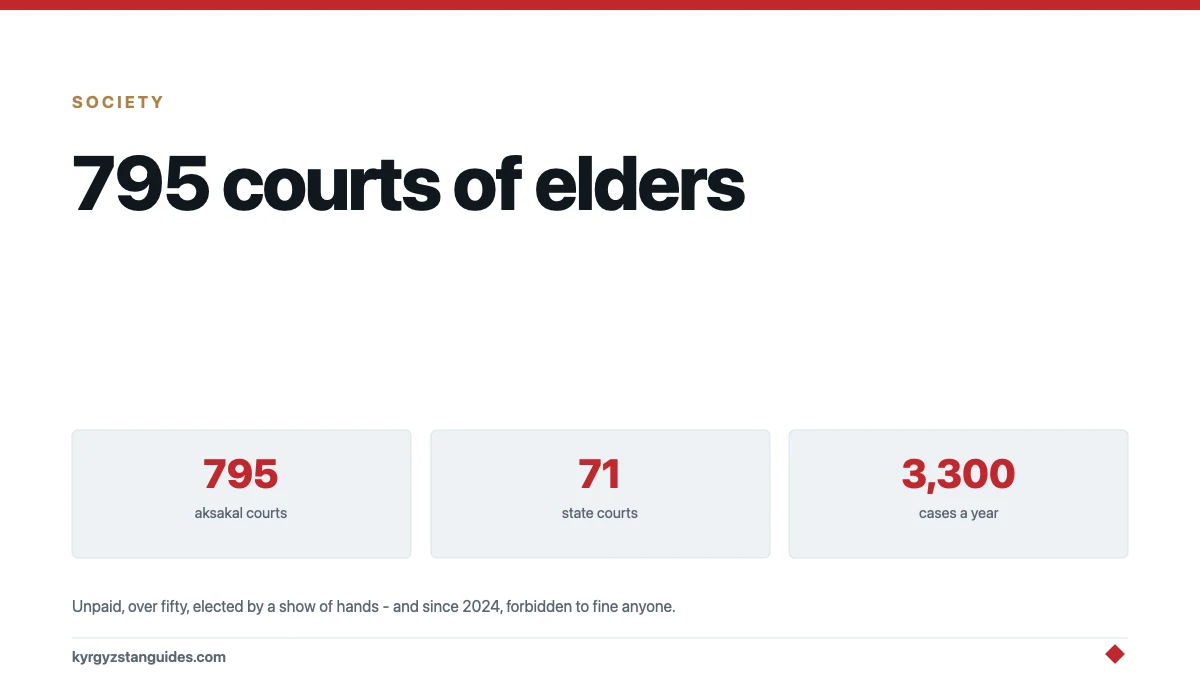
Kyrgyzstan has 71 state courts and roughly 795 courts of elders. The aksakal courts — aksakal means white-beard — sit in villages and city districts across the country, handle around 3,300 cases a year, and operate under a law of their own, rewritten as recently as February 2024. Their members are unpaid locals over fifty, elected by a show of hands at residents' assemblies.
Most writing about Kyrgyzstan mentions aksakals as a politeness — the respected elders at the head of the table. Almost none of it mentions that the respect has statutory form: a parallel lay justice system, ten times more numerous than the state courts it sits beside, with its own procedures, its own sanctions, and its own ways of going wrong.
What the 2024 law actually allows
The governing text is Law No. 52 of 19 February 2024, and its Article 34 is the part worth reading closely, because it settles a question that even serious commentary gets wrong: aksakal courts cannot fine anyone.
The law's list of measures is exhaustive, and the article says so in terms — anything beyond the list is illegal and unenforceable. What a court of elders may impose:
| Measure | What it means |
|---|---|
| Warning | The formal minimum |
| Public apology | To the injured party, before the community |
| Public censure | The community's disapproval, on the record |
| Compensation of damage | Paying for what was broken, lost or eaten |
| Award of property in kind | Handing over the thing itself, with its value recoverable if it no longer exists |
The same article bars any punishment that disgraces or humiliates. You will find older accounts — including reporting from when the previous 2002 law applied — saying elders could levy small fines. Under the current law, they cannot, and a decision that tries is void.
Decisions take effect after ten days, can be appealed to the district or city court, and are enforced, when needed, through a court writ — which is the detail that makes this real law rather than ceremony. Since 2025 the appeal route has its own chapter in the Civil Procedure Code, added by a law signed that summer.
Who sits, and for what
A court has three to nine members — always an odd number — with no more than 70 per cent of one sex, elected for four years by open vote at a residents' assembly. A member must be at least fifty, have at least secondary education, a clean criminal record, and local residence; a recent legal commentary puts the residence requirement at five years, and notes that about 84 per cent of members are men.
They are not salaried. The law funds the courts from local budgets and lets local government provide "benefits and material incentives", which in practice has meant almost nothing: reporting from Bishkek's Sverdlovsk district found the chair receiving 1,720 som a quarter and members 230 — cigarette money for deciding their neighbours' disputes.
What lands in front of them is the texture of village life. Livestock that trampled a neighbour's crops. Unpaid water bills, brought by the local water users’ association — an institution with its own rise-and-fall story. Family quarrels, property lines, debts between people who will attend each other's funerals. Kloop's survey of the system counted more than 57,000 cases over seventeen years — which works out to the same roughly 3,300 a year the newer commentary gives, so the caseload has been stable for a long time.
On the count itself: Kloop's figure, from the association of aksakal courts in 2021, was about 780 courts and 4,380 elders; the 2025 commentary says approximately 795. Both are right for their dates.
Where it goes wrong
The system's advertised virtue is proximity — justice from people who know the parties, in a country where the nearest state judge may be a district away. Its documented vice is the same thing.
The case that shows the edge: in December 2021, the aksakal court of Ismail village in Chui region gave the family of a rape suspect three days to leave the village. Expulsion is nowhere in any version of the law; the prosecutor's office said plainly that the decision was illegal. The association of aksakal courts' response was that the elders had had no choice — the village was at the edge of mob violence, and the order was the pressure valve. Both statements are probably true, which is exactly the problem: a body with communal legitimacy and no legal power to do what the community demands will sometimes do it anyway.
That is the honest frame for the whole institution. It decided tens of thousands of small disputes that would otherwise rot or escalate, for almost no money, in places the state barely reaches — and it carries, built in, the risk of becoming the procedural face of village pressure.
Where they came from
The courts were created in 1993, in independence's first constitutional burst, as a revival of customary dispute-settling. In 1996 they were removed from the judiciary proper and placed under local self-government, where they have sat ever since — through the 2002 law and now the 2024 one. That trajectory tells you how the state settled its mind: useful, encouraged, and kept firmly outside the court system whose village-level world they serve.
They also now operate on a redrawn map. The merger of village administrations reorganised the units the courts attach to, and how 795 courts map onto 235 administrations is one of the quieter consequences nobody has written up.
For a traveller the institution is mostly invisible — you would need to be in a dispute to meet it, and our advice on that is in the practical guides. But if you have wondered whether the deference to white-bearded men at a Kyrgyz table is custom or structure, the answer is: both, and the structure has a statute, a caseload and an appeals chapter.
What I could not establish
The full text of every provision — I worked from the law's official text for the sanctions and membership articles, and from legal commentary for the rest, and the two disagree mildly on details like the residence period. Any systematic data on outcomes: how many decisions are appealed, how many overturned, nobody publishes. And the gender rule's effect in practice: a 70 per cent cap on one sex against a reported 84 per cent male membership suggests either grandfathered compositions or soft compliance, and no source addresses the gap.
FAQ
What is an aksakal court?
A statutory court of elders in Kyrgyzstan — a lay tribunal of three to nine unpaid local members aged fifty or over, elected for four years at residents' assemblies, handling small civil and family disputes. There are roughly 795 of them against 71 state courts, deciding about 3,300 cases a year.
Can aksakal courts impose fines?
No. Under Law No. 52 of 19 February 2024, the list of measures is exhaustive: warning, public apology, public censure, compensation of damage, and award of property in kind. Anything else — including fines, which older accounts mention under the previous law — is illegal and unenforceable, and punishments that disgrace or humiliate are expressly barred.
Are aksakal court decisions binding?
Yes, within their competence. Decisions take effect after ten days, are appealable to the district or city court — a route given its own Civil Procedure Code chapter in 2025 — and can be enforced through a court writ.
Who can be an aksakal court member?
Anyone at least fifty years old with secondary education, no criminal record and local residence, elected by open vote. Courts must have an odd number of members with no more than 70 per cent of one sex — though in practice about 84 per cent of members are men. Members receive no salary.
What cases do aksakal courts hear?
The small disputes of local life: livestock damage to crops, unpaid water charges brought by the water society, family and property disagreements, minor debts. More than 57,000 cases over seventeen years, by the courts' association's own count.
Have aksakal courts exceeded their powers?
Documented, yes. In December 2021 the court of Ismail village in Chui region ordered a rape suspect's family to leave the village within three days — a sanction that exists in no version of the law, which the prosecutor's office called illegal. The courts' association argued the elders were containing imminent mob violence.
When were aksakal courts created?
In 1993, as part of early independence's revival of customary institutions. They were moved out of the judiciary and under local self-government in 1996, and have since been governed by the 2002 law and now by Law No. 52 of 2024.