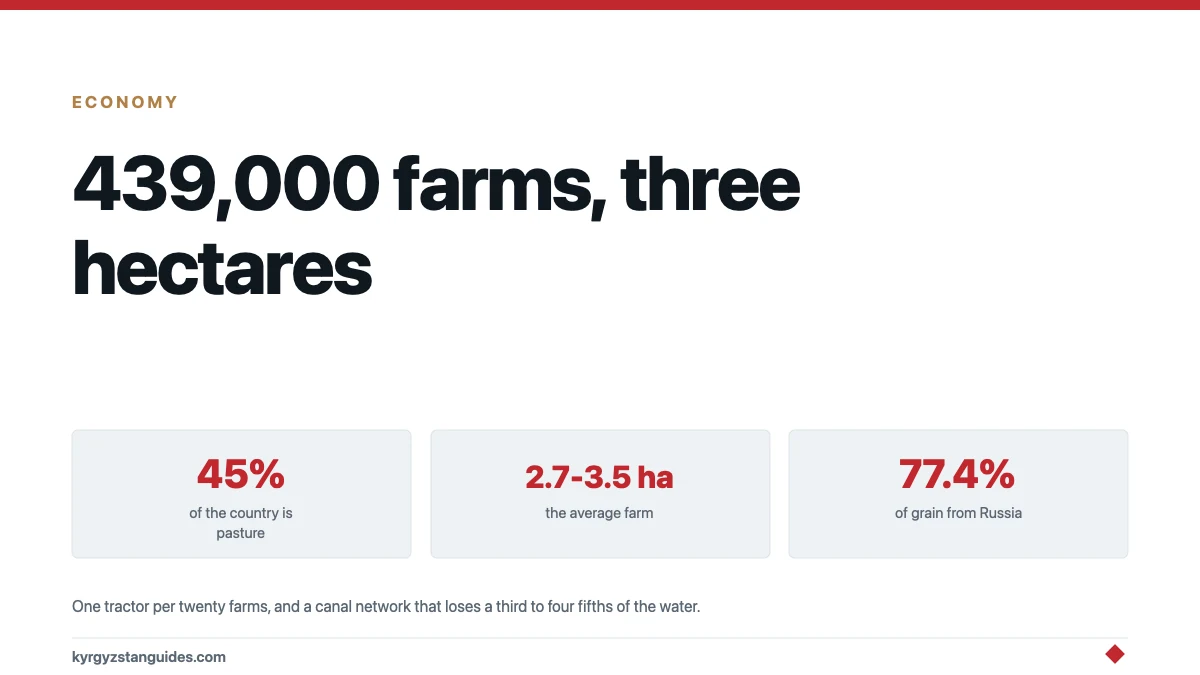
Kyrgyzstan has roughly 439,600 registered peasant farms, and the average one works between 2.7 and 3.5 hectares. Three hectares is a large garden. It is not a farm in any sense that supports mechanisation, crop rotation at scale, or a bank loan.
That fragmentation is the defining fact of Kyrgyz agriculture today, and it is the direct product of how land was privatised after 1991. The collapse itself we have covered in reading the ruins of Soviet agriculture; this post is about the structure that replaced it, and about the two things that will decide its future: who is allowed to own the land, and whether the water keeps arriving.
The two figures for average size, 2.7 and 3.5 hectares, come from different measures — all agricultural land versus arable land specifically — so the honest statement is a range rather than a number. The farm count dates to 2019 and I could not find a more recent one.
The land, by type
| Category | Area |
|---|---|
| Pasture | about 9.147 million ha — 45% of the entire country |
| Land classified as agricultural purpose | 6,753,913 ha |
| Irrigated land | about 1,024,800 ha |
| Irrigated arable land specifically | about 794,800 ha |
| Classified as degraded pasture | about 139,404 ha |
Nearly half of Kyrgyzstan is pasture. That single line explains the country's food system, its exports, its summer migration to the jailoo, and why the sheep matters more than the field.
One caveat: I could not find a clean national figure for total arable land independent of irrigation status. The irrigated subsets above are what the statistics committee publishes.
The ownership rule that is not negotiable
Foreigners cannot own agricultural land in Kyrgyzstan. Under the Land Code, only Kyrgyz citizens and domestic entities may hold farmland as freehold property. Foreigners may receive only temporary use rights capped at up to 50 years, and under the position reported in recent years foreigners are barred from leasing agricultural land or land near the border at all. President Japarov has stated publicly that land will not be handed to foreigners.
This is one of the most politically charged questions in the country, tied up with Chinese investment and with historical memory. If you discuss it with a Kyrgyz farmer, expect strong feelings and not much ambiguity.
I could not pin down the precise article and enactment date of the current Land Code provision, or establish exactly what the 2021–2026 amendments changed, so the substance above is well reported but the statutory citation is not something I can give you.
The water problem is the real one
Dams, canals and reservoirs here were built between the 1950s and the 1980s. Most of the network is now operating at or beyond its design life, and it leaks.
How badly is genuinely disputed, and the spread between official-adjacent estimates is remarkable:
| Estimate of irrigation losses / condition | Source framing |
|---|---|
| Water losses of 40–80% | interview with a water sector official |
| Over 70% of channels are earthen, filtration losses 35–40% | water sector reporting |
| Channels worn 50–60%, needing lining or concreting | water sector reporting |
| About 40% of channels require modernisation or major repair | exceeding normative service life |
A range from 35 to 80 per cent is not a measurement, it is an admission that nobody has measured the whole system. What every source agrees on is the age and the direction.
Rehabilitation has been running for a long time. The World Bank's Kyrgyz Republic Irrigation Rehabilitation Project began in October 1997, with a first phase on the Orto-Tokoi and Kara-Buura dams; later phases rehabilitated more canals and pumping stations, built river protection works and drilled 500 new wells. Nearly thirty years of rehabilitation and the network still loses somewhere between a third and four fifths of the water put into it.
Pastures are managed by committee, and the near ones are wrecked
The Law on Pastures No. 30 of 26 January 2009 is one of the more interesting pieces of Kyrgyz legislation. It made pastures the exclusive property of the state, created pasture user unions with executive bodies called jayit komiteti — pasture committees — and required five-year pasture management plans plus annual use plans.
The problem it was written to solve is a spatial one, and it persists. Pastures close to villages are overgrazed because that is where it is cheap and easy to keep animals; remote summer pastures high up are under-used because getting animals there costs time, labour and risk. So the land nearest people degrades while capacity sits idle two valleys away. Our post on the Kyrgyz village and the jailoo posts describe the seasonal movement this is meant to govern.
Machinery
The agriculture ministry reports over 92,000 units of farm machinery including more than 22,000 tractors and about 2,000 grain combines, with overall farmer equipment coverage around 71 per cent. Since 2011 more than 10,500 units worth 29 billion som have been distributed through Aiyl Bank and Eldik Bank. In a recent spring, 82 per cent of machinery was reported ready for fieldwork.
Divide 22,000 tractors by 439,600 farms and you get one tractor per twenty farms. That is the fragmentation problem expressed in iron: at three hectares, no individual farm can justify owning one.
On the average age of the Kyrgyz tractor fleet I found nothing. I found a Kazakh figure, which is a different country, and dropped it.
What actually grows, and the wheat problem
Sowing areas from 2024 and 2026 data: wheat between about 232,100 and 247,500 hectares depending on the year, maize for grain 113,300 hectares, potatoes 63,200 hectares, sugar beet 13,100 hectares. Barley and total fodder area I could not source.
Now the uncomfortable part. Kyrgyzstan's annual food wheat demand is roughly 850,000 to 900,000 tonnes, and around 50 to 55 per cent of consumption is imported. Self-sufficiency swings violently: about 92 per cent in 2020, below 50 per cent in 2021 after drought, back to roughly 80 per cent in 2022.
Yields are the constraint. Most farms harvest 20 centners per hectare or less, against about 30 centners needed for the crop to be profitable. The government's own target is only to reach 50 per cent self-sufficiency by 2030.
And here is the finding I did not expect. The assumption — including mine going in — is that Kyrgyz wheat and flour come from Kazakhstan. In January to June 2026, Kyrgyzstan imported 284,500 tonnes of grain, of which 220,200 tonnes, or 77.4 per cent, came from Russia. Kazakhstan remains a major flour supplier, with grain and flour exports to Kyrgyzstan rising 1.4 times to 504,000 tonnes between September 2025 and July 2026. But on grain specifically, the dominant supplier in the first half of 2026 was Russia, not the neighbour across the border.
A country where half of what people eat as bread arrives by rail from another state is exposed in a particular way, and it is worth knowing which state.
The productivity gap, stated bluntly
Agriculture employed about 16 per cent of the working population in 2025, down from around 31.6 per cent in 2014 and 20.3 per cent in 2018.
Its share of GDP is reported at 9.5 per cent for January–November 2024, on output of 115.9 billion som — though another report for the first half of 2024 puts it at just 6 per cent. Both are 2024 figures and they disagree, so the range is 6 to 9.5 per cent.
Either way, agriculture employs roughly two to three times the share of the workforce that it contributes to output. That is the definition of a low-productivity sector, and three-hectare farms with one tractor between twenty of them are why.
The water that will not be there
Kyrgyzstan's glaciers are the region's water tower, and they are going.
The loss estimates conflict and both should be stated: one source puts glacier loss at more than 16 to 17 per cent over the past fifty years, another at over 30 per cent. Projections are less divided — a further 36 per cent volume loss by 2050 even without additional warming, and up to 80 per cent of glaciers potentially gone by the end of the century under a roughly 5°C warming scenario. National average temperature has already risen from 4.8°C to 6°C over twenty years.
The change that matters for irrigation is not just volume but timing. Peak river flow on the Naryn and Talas has shifted about 50 days earlier. Water arrives before the crops need it.
There is a cruel intermediate phase in the modelling: river volumes may rise 7 to 20 per cent between 2030 and 2080 as melt accelerates, before long-term decline. So the water gets more abundant, then more uneven, then scarce — and the canal network losing a third to four fifths of it is the same network throughout. Our post on Toktogul and water politics covers the downstream diplomacy this implies.
FAQ
How big is the average farm in Kyrgyzstan?
Between 2.7 and 3.5 hectares depending on whether you measure all agricultural land or arable land specifically, across roughly 439,600 registered peasant farms as of 2019. That fragmentation is the direct legacy of post-Soviet land privatisation.
Can foreigners buy farmland in Kyrgyzstan?
No. Only Kyrgyz citizens and domestic entities can own agricultural land outright. Foreigners may obtain temporary use rights of up to 50 years, and reporting indicates they are barred from leasing agricultural land or land near the border. The President has stated publicly that land will not be transferred to foreigners.
How much of Kyrgyzstan is pasture?
About 9.147 million hectares, or 45 per cent of the entire country. Irrigated land totals around 1,024,800 hectares, of which about 794,800 hectares is irrigated arable land.
Does Kyrgyzstan grow its own wheat?
Only about half of it. Annual food wheat demand is 850,000 to 900,000 tonnes and roughly 50 to 55 per cent is imported. Self-sufficiency has swung from 92 per cent in 2020 to below 50 per cent in 2021 and back to around 80 per cent in 2022, and the government target is only 50 per cent by 2030.
Where does Kyrgyzstan import its grain from?
Mostly Russia, which is not the common assumption. Of 284,500 tonnes of grain imported in January to June 2026, 220,200 tonnes or 77.4 per cent came from Russia. Kazakhstan remains a large flour supplier, with combined grain and flour exports to Kyrgyzstan rising 1.4 times to 504,000 tonnes from September 2025 to July 2026.
How bad is the state of Kyrgyz irrigation?
Bad, though nobody agrees how bad. Estimates of water lost in the canal network range from 35 to 80 per cent across different official-adjacent sources. Over 70 per cent of channels are earthen, and the network was built between the 1950s and 1980s. World Bank rehabilitation work has been running since October 1997.
How will glacier melt affect Kyrgyz farming?
Glaciers have lost somewhere between 16 and 30 per cent of their extent in fifty years, with a further 36 per cent volume loss projected by 2050. River flow on the Naryn and Talas already peaks about 50 days earlier than it used to, so water arrives before crops need it. Modelling suggests river volumes rise 7 to 20 per cent between 2030 and 2080 before declining long term.