Independent travellers arriving here often assume they are among the few. The mountains are empty, the guesthouses are small, and the whole country feels undiscovered. Tourism is also a small employer next to the sectors that actually carry the economy — garment workshops, smallholder farming and labour sent abroad.
The statistics say something more complicated.
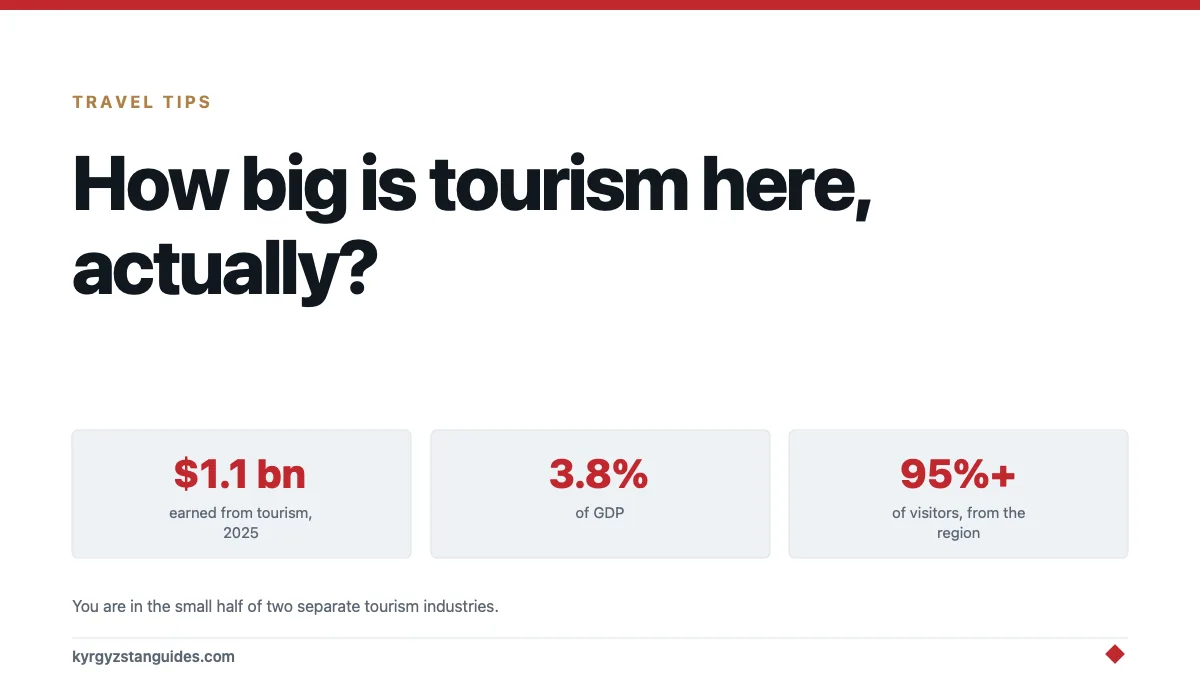
Kyrgyzstan earned close to $1.1 billion from tourism in 2025, and tourism accounted for 3.8% of GDP, up from 3.6% the year before. Visitor figures range from 5.31 million on one measure to 8.86 million border arrivals on another.
And more than 95% of foreign visitors come from neighbouring Central Asian countries and Russia.
That last number is the one that reframes everything.
Why the visitor numbers disagree
Two different things are being counted, and the gap between them is instructive.
Border arrivals count every entry by a foreign citizen. That includes traders crossing from Uzbekistan for a day at the Kara-Suu bazaar, labour migrants transiting, Kazakh families driving to Issyk-Kul for a weekend, and the same people crossing repeatedly.
Tourism figures attempt to count actual tourism activity, organised and unorganised, including domestic.
Neither is wrong. They measure different things, and the reported totals of 8.86 million arrivals against 5.31 million tourists reflect that rather than any error. Kyrgyzstan's own official tourism statistics publish the series.
Who actually comes
This is where the traveller's intuition breaks down completely.
| Origin | Share |
|---|---|
| Central Asia and Russia | over 95% |
| Of which Uzbekistan | the largest source |
| Kazakhstan | second |
| Russia | 5–6% |
| China | 1–1.5% |
Western, Indian, East Asian and other long-haul travellers are a rounding error in the national figures.
So Kyrgyzstan has two almost entirely separate tourism industries occupying the same country:
The regional one. Kazakh and Uzbek families driving to Issyk-Kul for beach holidays in July and August, staying in resorts and sanatoria along the north shore, eating at restaurants that cater to them. This is the overwhelming majority of tourism here by volume and by revenue.
The international one. A much smaller number of trekkers, cyclists, overlanders and yurt-stay travellers, distributed across the mountains, staying in guesthouses and CBT homestays.
You are in the second one, which is why the country feels empty to you while Cholpon-Ata in August is heaving.
The visa decision that made it possible
Worth isolating, because it's the single policy that created the international half of this industry.
Kyrgyzstan introduced visa-free entry for citizens of a long list of countries, at a point when its neighbours still required letters of invitation, agency handling or embassy applications. For a traveller planning a Central Asia route, that made Kyrgyzstan the easy country — the one you could simply fly to.
Combine that with community-based tourism providing somewhere to stay in towns that had no hotels, and the result is the overland circuit that now exists. Neither piece works alone: visa-free entry without accommodation is a country you pass through, and homestays without visa-free entry is a product nobody can reach.
Uzbekistan and Kazakhstan have since liberalised their own visa regimes substantially, which removes part of Kyrgyzstan's advantage. Our visa guide covers the current position, which changes and should be checked rather than assumed.
Where the money goes
Tourism revenue of around $1.1 billion sounds large. Set against the rest of the economy it isn't.
Remittances run at close to a fifth of GDP. Tourism is at 3.8%. Gold from a single mine is comparable to or larger than tourism in most years.
Passenger transport serving tourists generated nearly 17.3 billion som, roughly $197 million, in 2025. A reminder that a substantial share of tourism income is drivers, marshrutkas and taxis rather than hotels.
The Times of Central Asia reported the 2025 revenue figure, and the government's Sustainable Tourism Development Programme for 2025–2030 targets raising tourism to 7% of GDP by 2030. That is close to a doubling, and it is the policy driving a great deal of current infrastructure investment.
What this means for you
Your money matters more where it is rare. A guesthouse on the south shore in September earns from you what a north-shore resort earns from a hundred Kazakh visitors in July. In the mountains, foreign trekkers are the market.
Season matters enormously. July and August are the regional beach season, and Issyk-Kul's north shore is genuinely crowded. The mountains aren't. June and September are quieter everywhere.
Infrastructure is being built for a different visitor. New resorts, a bigger airport and beach development are aimed at the regional market. Trekking infrastructure grows more slowly. The US commercial guide to the sector is a reasonable summary of where investment is going.
Doubling tourism has consequences. A target of 7% of GDP means considerably more people in the same valleys, which is the context for our piece on litter and waste.
You're not a discoverer. This is worth saying plainly. Nowhere you can reach is undiscovered; it's simply visited by people from countries whose travellers don't write in English. The valley you have to yourself in June has Kazakh families in it in July, and had herders in it long before either of you.
Book ahead in season, not otherwise. North shore accommodation in July and August genuinely fills. Mountain guesthouses in June or September generally do not, and turning up is normal.
Why the honest number is useful
Because it corrects two opposite errors.
The first is thinking Kyrgyzstan is untouched. It's not. It receives millions of visitors and has a functioning, growing tourism economy with a national development programme attached.
The second is thinking tourism will solve the country's problems. At 3.8% of GDP it is a fraction of what labour migration delivers, and the country's young and growing workforce is far too large for tourism to absorb.
What tourism does well here is specific and real: it puts foreign currency directly into rural households, in places with almost no other income, without anyone having to leave the country. That is a narrower claim than the brochures make, and it's the one that holds up.
It's also the claim that depends entirely on how you travel. Money spent at a foreign-owned resort on the north shore does very little of that. Money spent on a homestay, a horse and a guide in Naryn region does almost all of it.
FAQ
How many tourists visit Kyrgyzstan?
Figures vary by methodology: around 5.31 million visitors in 2025 by one measure, against 8.86 million border arrivals by another, which counts every entry including repeat crossings.
How much does Kyrgyzstan earn from tourism?
Close to $1.1 billion in 2025, amounting to 3.8% of GDP, up from 3.6% the previous year.
Where do tourists to Kyrgyzstan come from?
Over 95% come from neighbouring Central Asian countries and Russia, with Uzbekistan the largest source, followed by Kazakhstan. Russia accounts for 5–6% and China 1–1.5%.
Is Kyrgyzstan crowded with tourists?
Issyk-Kul's north shore is busy in July and August with regional visitors. The mountains and most of the country remain quiet, which is why international travellers perceive it as empty.
Is tourism important to Kyrgyzstan's economy?
It's growing but modest at 3.8% of GDP, well behind remittances. The government's 2025–2030 programme targets 7% by 2030.
When is the quietest time to visit?
June and September avoid the regional beach season while keeping most mountain access open, offering the best combination of space and conditions.