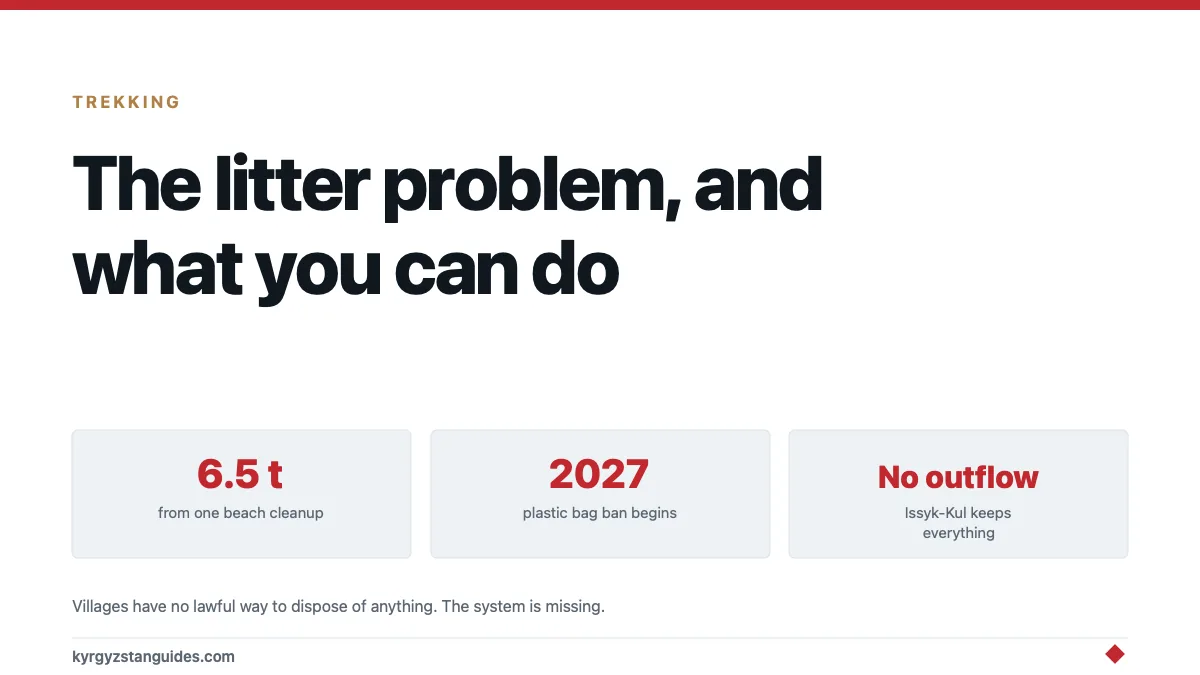
A beach cleanup at Issyk-Kul collected nearly 6.5 tonnes of rubbish, two-thirds of it glass and plastic. A single day's operation at Cholpon-Ata pulled 600 to 700 kilograms out of the water.
In August 2026 an initiative called Clean Depths of Issyk-Kul, backed by the Global Environment Facility and UNDP, began using drones to map rubbish accumulations on the lake bed so divers could extract it from pilot zones at Kara-Oy, Cholpon-Ata and Bosteri.
And from 2027, the sale, distribution and import of polyethylene bags is to be banned nationally, with the Issyk-Kul region specifically named.
This is a real and worsening problem, it is not primarily caused by tourists, and there are things a visitor can actually do about it.
Why it happens
Not carelessness, or not only. There is a structural cause and it's worth understanding before judging anybody.
Waste collection barely exists outside towns. A village with no municipal collection has no lawful way to dispose of anything. Historically this didn't matter, because a nomadic household produced almost nothing that did not rot or burn.
The packaging arrived faster than the system. Within thirty years a society whose waste stream was bone, ash, dung and wool acquired one full of plastic bottles, wrappers and bags. With no infrastructure built in between.
Burning is the default. In villages, rubbish is burned, which deals with the volume and produces its own air quality problem.
Tourism concentrates it. Jyrgalan, a village of about a thousand people, has become a trekking destination — and UNEP's reporting on a new waste facility there frames the problem exactly: visitor growth generating waste that a village of that size has no capacity to handle.
The lake is a closed system. Issyk-Kul has no outflow. What goes into it stays in it, permanently. That is the same property that makes it saline and unfreezing, and it applies to plastic.
Where you'll see it
Roadside pull-ins and passes. Anywhere vehicles stop.
Popular picnic sites near towns, especially at weekends in summer.
Beaches on the north shore during and after the July–August regional season.
Around yurt camps and trailheads, though less than you might expect, and the better operators manage it well.
Rivers, which move it from where it was dropped to somewhere else.
What you'll mostly not see is litter on high trekking routes. Serious trekking areas are comparatively clean, because the people who go there mostly carry things out.
What is being done
More than a visitor would guess.
The 2027 plastic bag ban, covering sale, distribution and import, with Issyk-Kul explicitly included. Enforcement raids against plastic bags in the region have already taken place.
Separate collection pilots. Containers for sorted waste have been installed at Issyk-Kul on a pilot basis.
Clean Depths of Issyk-Kul, using drone survey and diver extraction, backed by GEF and UNDP.
EU-supported beach cleanups, including the #EUBeachCleanup event that recovered over six tonnes.
Village-level waste facilities through UNEP and other agencies.
The scale is still small against the problem, and the projected trajectory is not encouraging: without change, tens of millions of tonnes of plastic are forecast to enter aquatic ecosystems globally each year by 2040.
The toilet paper question
Unglamorous, specific, and the thing most trekkers get wrong.
Toilet paper doesn't decompose at altitude in a cold dry climate. It sits there, goes white, and is still there next season. In popular valleys the accumulation behind every convenient boulder is genuinely unpleasant and entirely avoidable.
The options, in order of preference:
Carry it out in a sealed bag. This is what is done in managed wilderness areas everywhere and it isn't as bad as it sounds.
Burn it, only where it's safe to do so and not in dry grass or near juniper. Fire risk in these valleys is real.
Bury it deep, at least 15–20 cm, well away from water, if neither of the above is possible.
Never leave it under a rock. The rock does nothing.
The same applies to wet wipes, which do not degrade at all, and to sanitary products, which must be carried out.
Human waste itself should be buried 15–20 cm deep and at least 50 metres from any watercourse — which matters here because those watercourses are drinking water for the households downstream and for the animals on the pasture.
What you can actually do
Specific, low-effort, and it adds up.
Carry it out. All of it. Including organic waste, which doesn't decompose quickly at altitude and does attract animals.
Refuse bags. Bring your own. This is the single highest-impact habit and it's about to be law anyway.
A filter bottle instead of bottled water. Our tap water guide covers the treatment options. A traveller doing two weeks here on bottled water leaves behind something like thirty bottles in a country with no recycling.
Do not bury or burn. Burying at altitude does nothing; the ground is thin and animals dig.
Pick up a little more than yours. Not as a performance. Five minutes at a trailhead.
Ask your guesthouse where waste goes. It's a reasonable question and it signals that guests care, which is how operators start to invest in it.
Do not lecture. A visitor from a country with kerbside recycling telling a herding family about plastic isn't a good look, and the household burning its rubbish has no alternative. The system is missing, not the willingness.
Support the operators who manage it. Camps and guesthouses that pack waste out are absorbing a real cost. Notice it and say so.
Why it matters more here
Because of what Kyrgyzstan is selling and what the landscape actually is.
The country's tourism strategy targets 7% of GDP by 2030, roughly doubling the sector. More visitors in the same valleys, with the same waste infrastructure, is an arithmetic problem rather than a hypothetical one.
And the specific ecology is unforgiving. Issyk-Kul retains everything. Cold high valleys decompose organic matter very slowly. The glacier-fed rivers that carry waste downstream are the same ones supplying irrigation across three countries.
Nothing here is on a scale that makes a visitor's habits decisive. But a country of seven million receiving five million visitors is a place where individual habits scale fast.
FAQ
Is there a litter problem in Kyrgyzstan?
Yes, particularly around Issyk-Kul, roadside stops and picnic sites. Cleanups have recovered multiple tonnes from beaches and hundreds of kilograms from the lake in single operations.
Why is there so much rubbish in Kyrgyz villages?
Waste collection barely exists outside towns, and packaging arrived far faster than any disposal infrastructure. Burning is often the only available option.
Is Kyrgyzstan banning plastic bags?
Yes. From 2027 the sale, distribution and import of polyethylene bags is to be banned nationally, with the Issyk-Kul region specifically included.
What is Clean Depths of Issyk-Kul?
An initiative launched in August 2026 with GEF and UNDP support, using drones to locate waste on the lake bed and divers to remove it from pilot zones.
What should I do with my rubbish while trekking?
Carry everything out, including organic waste, which decomposes slowly at altitude. Do not bury or burn it.
How can travellers reduce their impact?
Refuse plastic bags, use a filter bottle rather than buying bottled water, carry out all waste, ask guesthouses how they dispose of it, and choose operators who pack waste out.