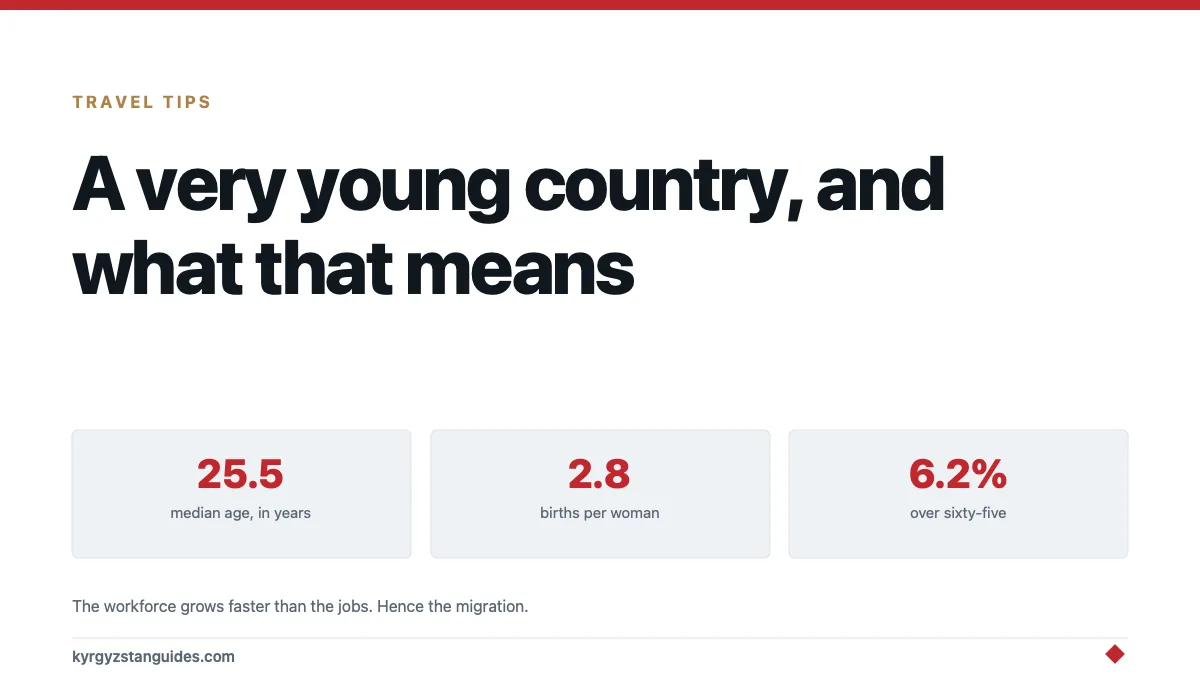
The median age in Kyrgyzstan is around 25.5 years.
For comparison, the median age in Germany is over 45, in Japan close to 50. Half of Kyrgyzstan is under twenty-six.
Nearly 24% of the population is under fifteen. Around 6% is over sixty-five. The fertility rate sits near 2.8 children per woman, well above replacement and among the highest in the former Soviet space.
This one fact explains more of what a visitor notices than any other statistic about the country.
The numbers
| Measure | Figure |
|---|---|
| Population | About 7 million |
| Median age | ~25.5 years (2026) |
| Fertility rate | ~2.8 births per woman (2023) |
| Under 15 | 23.6% |
| 15–64 | 62.9% |
| 65 and over | 6.2% |
| Life expectancy at birth | 71.7 years (2023) |
Figures come from UN Population Division and UNFPA data; UNFPA's country page and Our World in Data's demography profile hold the series.
What it looks like on the ground
Children everywhere. In villages, in bazaars, on the jailoo, in the street. This isn't selective attention; there genuinely are a lot of them.
Very few old people relative to what you expect. Six per cent over sixty-five is a small share, and it's one reason the country feels energetic rather than settled.
Schools running shifts. A system built for a smaller cohort, running two or three sessions a day in fast-growing areas. As covered in our pieces on education and Bishkek's novostroiki.
Young staff. The guide, the driver, the guesthouse manager and the person selling you a SIM card will frequently be in their twenties, which is part of why English is spreading as fast as it is.
Weddings constantly. A large cohort reaching marriage age at once means a very high density of toi in any given summer.
Why it matters economically
This is where it stops being a curiosity.
The workforce is growing faster than jobs. A country producing large numbers of young people needs to produce large numbers of jobs, and Kyrgyzstan does not. The gap is the direct cause of labour migration — several hundred thousand working abroad, and remittances near a fifth of GDP.
The dependency ratio is currently favourable. Almost 63% of the population is working age. Economists call this a demographic dividend, and it is a window rather than a permanent condition.
Education is the constraint. A young population is an asset only if it's educated into something. Kyrgyzstan's PISA performance suggests the system isn't currently converting the cohort into skills at the rate the numbers would allow.
Pressure on land and pasture. More households means more animals on the same degraded rangeland, and more construction on the edge of the capital. Worldometer's demographic series tracks the growth rate that drives both.
The part that isn't in the table
Two things the headline figures hide, and both matter.
The missing middle. A significant share of working-age Kyrgyz men (and increasingly women) aren't in the country. In some villages the twenty-to-forty bracket is visibly thin, with grandparents raising grandchildren while both parents are in Russia. The national age pyramid says the workforce is present. Walk through a village in Batken or Naryn and it isn't.
Urban and rural diverge. Bishkek's fertility and age profile look more like a middle-income city; rural Kyrgyzstan's look considerably younger with larger households. The national median is an average of two different demographic regimes, and the gap is widening as the capital absorbs migrants from the second one.
There is also a quieter trend worth noting: fertility here rose after the 1990s collapse rather than continuing to fall, which is unusual. The standard explanation is a mix of economic recovery, a pro-natal cultural shift after independence, and the return of religious observance. It isn't a settled question.
How it differs from the neighbours
Central Asia isn't demographically uniform, and the contrast is instructive.
Kazakhstan is wealthier, more urbanised and ageing faster. Tajikistan is younger still and poorer. Uzbekistan is much larger in absolute terms with a comparable age profile. Russia, the destination for most Kyrgyz migrant labour, has a median age near forty and a shrinking workforce, which is precisely why it absorbs Central Asian workers, and precisely why that relationship is likely to persist through political friction.
That last point is worth holding onto. The migration economy isn't only a Kyrgyz need. It is a demographic complementarity between a country with too many young workers and one with too few.
The window, and what closes it
Demographic dividends have a shape. A country with a large working-age share and few dependents has perhaps two or three decades in which it can grow fast, if the jobs and the education are there. Then the cohort ages, the dependency ratio reverses, and the opportunity is gone.
Kyrgyzstan is inside that window now. The question is what it does with it.
The honest assessment is uncomfortable. The economy is remittances, gold from one mine, and trade. None of those absorbs a large educated cohort. The gold is finite. The trade advantage was eroded by joining the customs union. The remittances depend on Russia's own demographic shortfall persisting and its politics staying tolerable.
The things that would change this — processing raw materials domestically rather than exporting them, an education system that converts the cohort into skills, the railway creating a genuine transit economy, are all in progress and none is resolved.
That isn't a pessimistic reading, just an unfinished one. A country with a median age of twenty-five has time. It doesn't have unlimited time.
What it means for a traveller
You'll mostly deal with young people. In tourism, in transport, in shops.
Family is the default social unit and it is large. Guesthouses will contain several generations and a lot of cousins. Our homestay guide covers what that means in practice.
Children are present at everything. Restaurants, weddings, long bus journeys, late evenings. Nobody segregates them, and nobody expects them to be quiet.
If you have children, you'll be received differently. See our family travel guide.
Asking about family is normal small talk. "Are you married? How many children?" arrives early in conversations and is not intrusive by local convention. A short honest answer is fine.
The country will look different in twenty years. A median age of twenty-five isn't stable. The cohort currently in school will be the workforce, and whether they're here or in Moscow, Seoul or Istanbul is the open question for this country.
One demographic marker worth reading alongside the age structure: 13% of women aged 20 to 24 were first married before 18 at the 2018 MICS survey, rising to 27% among those with only basic secondary education. Our page on ala-kachuu, the law and the data sets out what that survey does and does not measure.
FAQ
What is the population of Kyrgyzstan?
Around 7 million people, with a median age of roughly 25.5 years, making it one of the youngest countries in the former Soviet space.
What is Kyrgyzstan's fertility rate?
About 2.8 births per woman as of 2023, well above replacement level and high by regional standards.
How young is Kyrgyzstan's population?
Around 23.6% are under fifteen and only 6.2% are over sixty-five, with 62.9% of working age.
Why do so many Kyrgyz people work abroad?
The working-age population is growing faster than domestic employment, so a large share seeks work abroad, principally in Russia. Remittances amount to close to a fifth of GDP.
What is life expectancy in Kyrgyzstan?
About 71.7 years at birth as of 2023.
How does Kyrgyzstan's age profile affect travellers?
You'll deal mostly with young people in tourism and transport, children are present everywhere and at all hours, and questions about your own family are ordinary conversation.