Kyrgyzstan is an unusually good country to travel in with children, for a reason that has nothing to do with facilities.
Children here are a social asset. Arriving at a guesthouse with a five-year-old changes how you're received — doors open, people talk to you, your child is fed before you're and will probably be taken off to play with someone else's. In a country where independent travellers are sometimes treated as an economic category, a family is treated as a family.
The difficulties are real and they are specific. They are altitude, roads and distance, and none of them is about whether there is a high chair.
The altitude problem
This is the genuine constraint on a family itinerary here, and it's the one people plan around last.
Children are as susceptible to altitude illness as adults, and the symptoms are harder to read. A child too young to explain a headache shows loss of appetite, unexplained fussiness, irritability, or changes to sleep and activity. CDC guidance on travelling safely with infants and children sets out how this presents by age.
The practical rules, from the UIAA's advice on children at altitude and standard paediatric travel guidance:
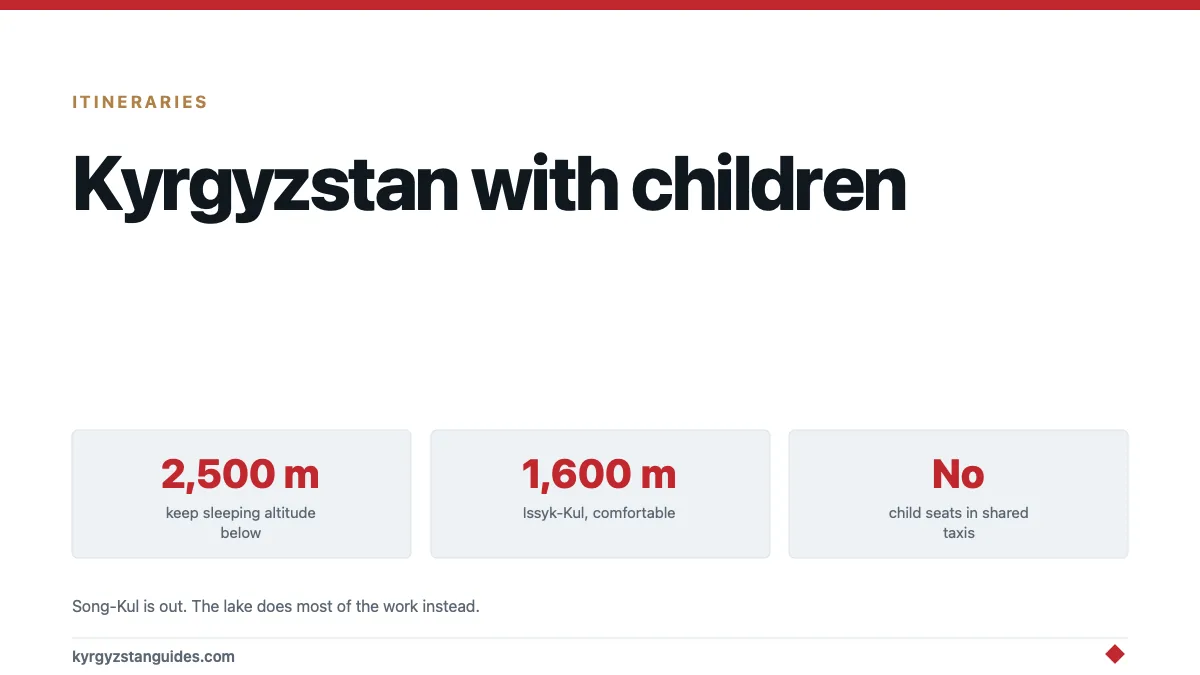
Prefer a sleeping altitude below 2,500 m with young children.
Do not sleep above 3,000–4,000 m with a preschool child.
Symptoms usually appear within 24 hours and are worst after the first night at a new altitude.
If a child has unexplained symptoms after ascending, descend. Do not wait to see.
Acetazolamide isn't approved for altitude illness in under-12s. Slow ascent is the tool you have.
Our altitude guide covers the adult picture.
What this rules out, honestly: Song-Kul at 3,016 m as a sleeping altitude for small children; Tash-Rabat at around 3,200 m; Kel-Suu; Pik Lenin base camp at 3,600 m; and most high yurt camps, which is a genuine loss because the yurt night is what many families come for.
What works instead
A great deal, and the lake does most of the work.
Issyk-Kul sits at about 1,600 m. That is a comfortable altitude for children, the water is warm enough to swim in during July and August, and Cholpon-Ata has beaches, a water park and the petroglyph field. Our Issyk-Kul guide covers the shore.
Ala-Archa, an hour from Bishkek at around 2,100 m at the gorge entrance, with short walks and a river. Our Ala-Archa guide has the options.
Lower yurt camps. They exist at 1,800–2,300 m around Issyk-Kul, in Jyrgalan and in the Chuy valley foothills. You get the experience without the altitude, and our yurt stay guide covers what a night involves.
Horses. Almost every child who rides a horse in a Kyrgyz valley remembers it. Short rides with a guide leading are standard and cheap.
Bishkek. Parks, an excellent zoo-free set of playgrounds, ice cream, and the aryk-shaded streets that make it walkable in summer.
Burana tower near Tokmok, a fortress-shaped thing children can climb, with a field of stone figures.
Arslanbob in the south, around 1,600 m, with walnut forest, waterfalls and warm weather.
Why children change the trip
Worth saying properly, because it's the actual argument for bringing them.
Kyrgyz society is built around extended family and children are everywhere in it. At weddings, at the table, on the jailoo, underfoot in every shop. A traveller with a child is legible in a way a traveller alone is not. The question "how many children do you have?" comes very early in conversations here, and having an answer opens the rest of it.
The practical effects are consistent:
You get invited more. Into houses, to tea, to sit down.
Your child will be taken. Picked up, carried off, fed, given sweets, shown the animals. This is normal and affectionate and you should let it happen.
Grandmothers will feed your child first. Every time.
People will tell you things. About their own children, their village, what school is like, who has gone to Russia. Our piece on labour migration describes an arrangement that comes up naturally in these conversations and rarely in others.
The trade is that you move more slowly and see fewer places. What you get instead is a different kind of access, and it isn't a consolation prize.
Roads and distance
The second real constraint.
Journeys are long. Bishkek to Karakol is six hours. Bishkek to Osh is ten to twelve. There is no comfortable way to compress this.
Roads are winding. Motion sickness is common and worth medicating for preemptively rather than reactively.
Shared taxis are not suitable for small children. No child seats, a driver paid by the trip, and four adults in the back. For families, hiring a car with a driver is the answer: more expensive, and worth it. See our getting around guide and marshrutka guide for what you're opting out of.
Bring your own car seat if your child needs one. They are not standard and not reliably available.
Plan two nights minimum in each place. A family itinerary with a drive every day won't work here.
Practical realities
Nappies, formula and baby food are available in Bishkek supermarkets and in larger towns. Brands are European and Russian. Stock up before going rural.
Medical care is limited outside Bishkek. Bishkek has private clinics of reasonable standard. Elsewhere, assume basic. This is the argument for proper travel insurance with evacuation cover, as covered in our mountain rescue guide.
Food is manageable but repetitive. Plov, noodles, bread, eggs, dairy, dumplings. Most children eat fine. Fussy eaters will eat a lot of bread and potatoes; our vegetarian guide covers the workarounds.
Homestay facilities are basic. Outside toilets, shared bathrooms, limited hot water. Read our honest homestay guide before booking one with a toddler.
Dogs. Livestock guardian dogs on pasture are working animals and should be given a wide margin with children. This is worth explaining to them in advance.
Sun. High altitude, thin air, strong UV. Hats and high-factor sunscreen, seriously, the WHO's guidance on UV is worth reading if you are heading above 2,000 m with small children.
Nobody minds noise. Children aren't expected to be quiet in restaurants or on transport, and nobody will look at you.
A workable two-week shape
Rough, and adjustable.
Bishkek, 2 nights. Parks, food, buy anything missing.
Ala-Archa, day trip or 1 night.
Burana and Tokmok, on the way east.
Issyk-Kul north shore, 4 nights. Swimming, beach, petroglyphs, a low yurt camp.
Karakol, 3 nights. Jeti-Oguz valley, hot springs, the wooden mosque and church, short walks.
Back via the south shore, 2 nights, quieter beaches and Barskoon.
Bishkek, 1 night before flying.
That keeps everything under about 2,000 m, keeps drives to three hours or less, and includes horses, swimming, a yurt and a fortress. Our itinerary guides cover the adult versions.
FAQ
Is Kyrgyzstan good for family travel?
Yes. Children are warmly received and the practical risks are manageable. The main constraints are altitude, long winding drives and limited medical care outside Bishkek.
What altitude is safe for children in Kyrgyzstan?
Guidance suggests keeping sleeping altitude below 2,500 m with young children and avoiding sleeping above 3,000–4,000 m with preschoolers. Issyk-Kul at around 1,600 m is comfortable.
Can children stay in a yurt camp?
Yes, if you choose a lower one. Camps around Issyk-Kul and in Jyrgalan sit well below the high-altitude camps at Song-Kul and Tash-Rabat.
How do I get around Kyrgyzstan with children?
Hire a car with a driver. Shared taxis and marshrutkas have no child seats and are uncomfortable for long mountain journeys. Bring your own car seat if you need one.
Are nappies and baby food available?
Yes in Bishkek and larger towns, with European and Russian brands. Buy what you need before heading into rural areas.
What should I watch out for with kids in Kyrgyzstan?
Altitude symptoms, motion sickness on mountain roads, strong high-altitude sun, livestock guardian dogs near herds, and untreated village water.