Booking sites describe homestays in Kyrgyzstan as authentic, warm and traditional. All of that's true. It is also a business operating almost entirely inside the informal economy, which is why you will rarely see a receipt.
What they do not tell you: where the toilet is, how you wash, what time you'll be woken, what happens if you don't eat the fat, and whether you're expected to make conversation for three hours.
This is the practical guide nobody writes, because it is unflattering to write and the reality is genuinely fine once you know it.
What you are actually booking
A room in somebody's house. Not a small hotel with a family running it — the family's home, with you in one of its rooms.
That means:
The family is present. Children, grandparents, neighbours coming in and out. You are not in a separate wing.
Meals are with the household, usually at a fixed time, usually in the main room.
There is one bathroom or none. Shared, and the queue in the morning is real.
Your room may be the main room. In smaller houses, the room you sleep in is the room the family uses during the day. You get it at night.
Bedding is often on the floor. Stacked mattresses and quilts — töshök: laid out in the evening and put away in the morning. They are more comfortable than they look.
The standard is set by the household rather than by a brand. Our community-based tourism guide explains why prices are consistent while quality isn't — the CBT network sets rates locally and rotates bookings between families rather than funnelling everyone to the best-reviewed house.
The toilet question
Dealt with directly, because everyone wants to know and nobody asks.
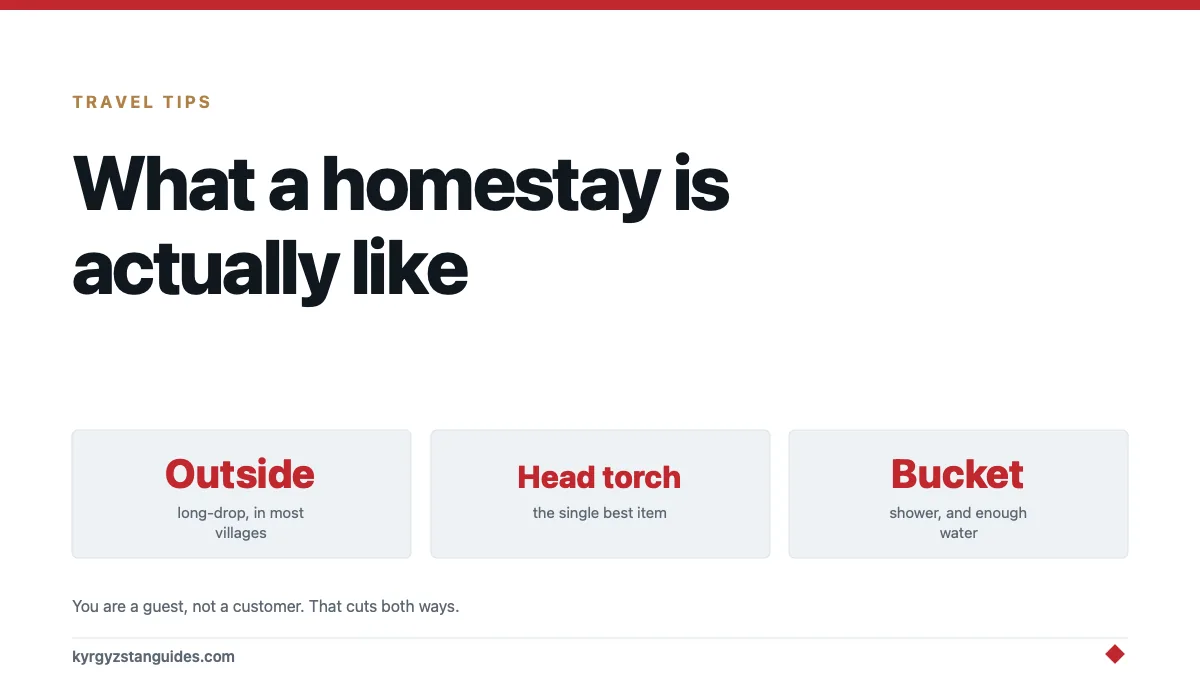
In villages, expect an outside long-drop. A small wooden or brick structure in the yard, often thirty or forty metres from the house, with a hole in a concrete or wooden floor. Usually clean. Usually no light.
Bring a head torch. This is the single most useful item in a rural homestay, for exactly this reason, at two in the morning, in winter.
Bring your own paper. It is frequently not provided. Buy a roll in any town and keep it in your bag.
Do not flush paper anywhere. There is a bin. Use it. This applies in town bathrooms too, where plumbing is narrow and blockages are somebody's afternoon.
Water safety. Village water frequently comes from a spring or a well and isn't treated. Our tap water guide covers this; the short version is filter or boil, and the WHO's guidance on drinking-water quality is the underlying standard.
Flush toilets exist in larger guesthouses, in Karakol, Bishkek, Cholpon-Ata and in newer builds. Ask when booking if it matters to you, and accept that the answer may be optimistic.
At yurt camps, it's a long-drop in a tent or hut, and in remote camps it may be a designated area. Our yurt stay guide covers those conditions.
Washing
Hot water is not continuous. Many houses heat water in a boiler, a tank or on a stove. There is a finite amount and you're sharing it.
The bucket shower is normal. A basin, a jug, warm water. It works perfectly well and uses far less water than a shower.
Ask before washing, particularly in the evening. "Can I shower?" gives the household a chance to say "in an hour, when the water is hot" rather than you discovering it cold.
Many houses have a banya. A small wood-fired bathhouse in the yard, and if it is being heated you will be invited. Take the invitation: our banya guide covers what to do.
Laundry. Ask. It will usually be done, by hand, and you should pay for it.
Food
You'll be fed a lot. More than you want. This is not negotiable and refusing is difficult.
Breakfast is substantial: bread, jam, butter, kaymak, eggs, sometimes porridge, always tea.
Dinner is the main event, and it will contain meat and fat. Sheep fat is prized, and being given a fatty piece is a compliment.
Vegetarians will struggle in villages. Not impossible (see our vegetarian guide) but say so at booking, clearly and in advance, and expect a lot of potatoes.
Tea is continuous. Your bowl will be refilled indefinitely. To signal you are done, place your hand briefly over the bowl or turn it over; our tea and bread customs guide covers the etiquette properly.
Do not waste bread. Bread is treated with real respect here: never placed face down, never thrown away.
The social part
This is what actually surprises people, more than the plumbing.
You're a guest, not a customer. The distinction is cultural and it cuts both ways. You will be looked after generously, and you are also expected to participate.
Sitting with the family is the expectation. Coming out of your room, eating, and staying for tea afterwards. Retreating immediately to your room after dinner reads as coldness.
Conversation may be limited, and that's fine. Silence at a Kyrgyz table isn't awkward. You don't have to fill it.
Bring something. Sweets, fruit, tea, or something small from your own country. This is not payment; it's what a guest does. The obligation runs both ways and it's old: a study of Kyrgyz nomadic food culture traces how the dastorkon, the spread laid for a guest, functioned in a society where turning a traveller away in the mountains could kill them. That is why refusing food here is harder than it sounds.
Photographs: ask. Especially of women and children.
Shoes off at the door. Always.
If you are given the place at the back of the room facing the door, you have been honoured. Take it, and see our tunduk and yurt guide for why that spot matters.
Practical packing for homestays
- Head torch. Non-negotiable. - Toilet paper and hand sanitiser. - Flip-flops for the yard and the shower. - A quick-dry towel. Often provided, often not. - Earplugs. Thin walls, early households, roosters. - A small gift for the family. - Cash in small notes. Most homestays do not take cards. See our paying guide.
Is it worth it?
Yes, and not for the reason usually given.
The argument for homestays is normally "authenticity", which is a word that should make anyone suspicious. The real arguments are simpler: the money goes to a household in a village with very few other income options, you will eat better than in most restaurants, and you will have conversations you couldn't have had any other way.
The cost is that you give up privacy, control over your schedule and reliable plumbing for a night or two.
That is a good trade. It's just worth knowing what the trade is before you make it, rather than discovering it in a dark yard at two in the morning without a torch.
FAQ
What is a homestay in Kyrgyzstan?
A room in a family's own house, with meals taken with the household. It isn't a small hotel; the family lives there and you're a guest in their home.
Do Kyrgyz homestays have flush toilets?
Often not in villages, where an outside long-drop in the yard is standard. Flush toilets are common in larger guesthouses and in towns. Ask when booking if it matters.
How do you shower in a Kyrgyz homestay?
Frequently with a basin and jug of heated water rather than a running shower. Hot water is limited and shared, so ask before washing rather than assuming.
What should I bring to a homestay?
A head torch, toilet paper, flip-flops, a quick-dry towel, earplugs, cash in small notes, and a small gift for the family.
Can vegetarians stay in Kyrgyz homestays?
Yes, but say so clearly at the time of booking. Village cooking is meat-centred and improvising on arrival usually means a lot of potatoes.
Is it rude to stay in my room?
Somewhat. Sitting with the family for meals and tea afterwards is expected, and retreating straight to your room after dinner is read as unfriendly.