If a Kyrgyz host pours your tea bowl only half full, don't take it as stinginess. It is the opposite: a half-full piala means the host intends to keep refilling it, which means they want you to stay. A bowl filled to the brim is the quiet signal that the visit is over. This single custom explains more about Kyrgyz hospitality than any guidebook paragraph, and it is the first thing worth learning before you sit down at anyone’s table.
The second thing is bread. In Kyrgyzstan, bread (the round tandyr-baked lepyoshka above all) is treated as close to sacred. It is never placed upside down, never left on the ground, never thrown away casually. Get these two things right, tea and bread, and you can fumble everything else at the table and still be forgiven warmly.
Tea isn't a drink, it's the setting
Kyrgyz people drink tea constantly — before meals, during meals, after meals, and in between as its own event. Black tea dominates in the north, green tea (kok chai) is more common in the south around Osh, and in many homes tea comes with milk, and occasionally a pinch of salt in the more traditional preparation called atkan chai. The pot never really leaves the table. If you're invited into a home, a yurt, or even a roadside acquaintance’s orbit, tea appears within minutes, and refusing it outright reads as refusing the relationship.
You don't need to drink much. That is the useful secret. Accepting the bowl, taking a few sips, and letting it be refilled once or twice satisfies the ritual completely. Nobody is counting your milliliters; they're counting whether you sat down.
The half-full piala, explained
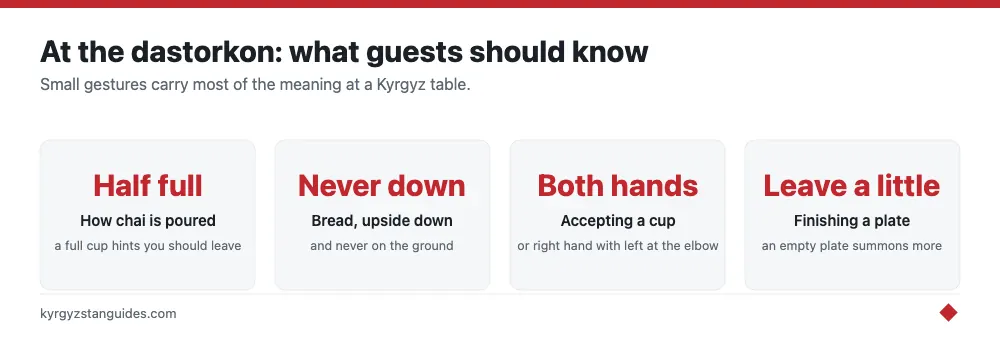
The piala is the handleless bowl tea is served in, and the pouring rules around it are genuinely consistent across the country. A respectful host pours a small amount, often a third to half of the bowl, so the tea stays hot and so the act of refilling can be repeated. Every refill is a small renewal of the welcome. Guests are poured for; reaching for the teapot to serve yourself in someone’s home is unnecessary and slightly graceless, though nobody will scold a foreigner for it.
When you have truly had enough, the polite signals are to leave the bowl full, place your palm flat over it, or simply say “rakhmat” (thank you) with a small shake of the head. Tipping the bowl slightly or turning it over is understood in some families as a firm “I am done,” but the palm-over-bowl gesture is the safest universal move.
Why bread is sacred
Nan, bread, carries a weight in Kyrgyz culture that surprises most visitors. The reasons are layered: Islamic tradition treats bread as a blessing from God, and the older nomadic economy treated grain as scarce and precious in a way meat never was. The result is a set of rules that Kyrgyz children absorb before they can read, and that travelers should absorb before their first guesthouse breakfast.
- Never place bread upside down. Flat side up is how it rests on any table.
- Never put bread on the ground, and never step over it. If a piece falls, it is picked up promptly.
- Do not throw bread in the trash in front of your hosts. Leftover bread is dried, fed to animals, or set aside — not binned.
- Bread is usually torn by hand and shared, not cut and hoarded. Breaking the lepyoshka and distributing pieces often opens the meal.
- Do not seal a guest visit without tasting at least a piece — bread and salt are the classic minimum of hospitality.
Lepyoshka and boorsok
The everyday loaf is the lepyoshka (Kyrgyz: nan or tokoch), a dense round bread with a stamped, decorated center, baked against the wall of a tandyr oven: part of the flatbread-making and sharing culture that UNESCO inscribed as intangible cultural heritage in 2016. Fresh from the bazaar it's excellent (chewy rim, crisp base) and costs pocket change. The celebratory bread is boorsok: small squares or diamonds of dough fried in oil until puffed and golden. Boorsok is scattered generously across the table at any festive gathering, and frying a batch is itself a way of marking an occasion. Our advice: eat boorsok warm with homemade cream and jam, and accept that you won't stop at three. For a wider tour of what lands on Kyrgyz tables, our Kyrgyz food guide covers the full spread from beshbarmak to kurut.
The dastorkon: how to behave as a guest
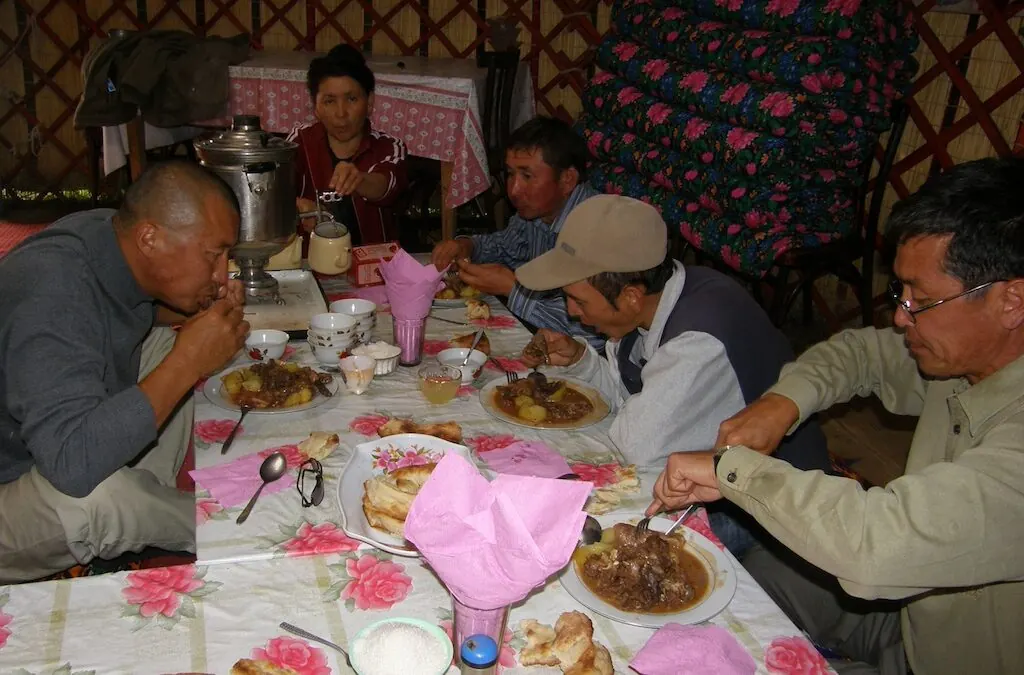
The dastorkon is the tablecloth (spread on a table or, traditionally, on the floor) and by extension the whole laid-out meal. Being invited to one is common in Kyrgyzstan; hospitality toward guests is close to a civic religion, a value inherited directly from nomadic life, where turning away a traveler could be a death sentence in winter. That inheritance is explored more in our nomadic culture guide, but at the table it translates into a few practical rules.
- Shoes off at the door, always. Slippers are often provided.
- Wait to be seated. The place of honor (tör), farthest from the door, goes to elders and honored guests, you may be steered there; accept graciously.
- Do not step on or over the dastorkon, and avoid pointing your feet at it when sitting on the floor.
- Let elders start. Eat with your right hand where hands are used.
- Try a little of everything offered. Declining a dish entirely is harder to smooth over than taking a token spoonful.
- Expect insistence. “Eat, eat!” is not pressure, it is politeness. A gentle refusal repeated twice is perfectly acceptable.
- At the end, follow the omin: palms briefly raised then drawn down over the face, a short blessing that closes the meal. Guests are welcome to join the gesture quietly.
A small gift for the household, fruit, sweets, something from your country, is appreciated but never demanded. What is quietly noticed is how you treat the bread and whether you sat long enough for a proper round of tea.
Where you will meet these customs
Everywhere, honestly, but most intensely outside Bishkek. Guesthouse breakfasts in Karakol, shepherd camps in the mountains, and yurt stays around Song-Kul all run on the same grammar of tea, bread, and the dastorkon. If you are planning nights in a yurt, our yurt stay guide covers the practical side; the etiquette above covers the human side. Neither requires perfection (Kyrgyz hosts are famously generous with foreigners’ mistakes) but knowing the rules changes you from a spectator into a guest.
FAQ
Do I have to finish every bowl of tea I am poured?
No. Refills are the point, not volume. Sip, let it be refilled once or twice, then place your palm over the bowl or leave it full to signal you are done. Nobody expects you to keep pace with the hosts.
What if I don't drink black tea at all?
Accept the bowl anyway and take a token sip, or politely ask for hot water or green tea — most households have both. The gesture of joining the table matters far more than what's in your piala.
Is it rude to refuse food at a dastorkon?
Refusing everything is awkward; refusing seconds is completely fine. Take small amounts of what you can eat, praise the bread, and decline gently with a hand on your chest. Dietary restrictions, stated simply, are respected — vegetarians should still expect gentle astonishment.
What should I never do with bread in Kyrgyzstan?
Never place it upside down, never put it on the ground or step over it, and never toss it in the trash in front of others. If you have leftover bread, leave it on the table, your hosts will handle it properly.
Much of this is carried in the language itself: see Kyrgyz proverbs, with literal translations and the collections they come from.
The table has its own rules, and they are stricter than they look: see Kyrgyz hospitality rules for the seating order and the ranked meat portions.
On whether you are expected to drink, and on the bata that closes every meal, see toasts, bata and alcohol in Kyrgyzstan.