There is no single dish you can point at and call Kyrgyz breakfast. That sounds like a dodge, so here is the useful version: the morning table is assembled rather than cooked. Bread, something dairy, something sweet, and tea. The cooking, if any, happened yesterday. What changes between a Bishkek flat, a Naryn guesthouse and a summer yurt is not the structure but the fat content.
If you have booked a homestay and you are trying to picture what arrives, picture a low table with six or seven small dishes already on it before anyone sits down.
The four things that are always there
Bread comes first, and it is usually two kinds at once: a round tandyr loaf torn by hand, and a bowl of boorsok, the little fried dough squares. Both are set out the night before in many houses. Boorsok is not a breakfast food specifically, which is the point that confuses visitors. It is the default bread of every occasion, and breakfast is an occasion. We wrote about why it turns up at births and funerals alike in the piece on boorsok, Kyrgyz fried bread.
Then the dairy. This is where the morning gets interesting and where most translations fail you.
Then something sweet to put on the bread: jam, honey, or the sugar bowl. Kyrgyz jam is thin and whole-fruit, closer to preserved fruit in syrup than to a spread, and you spoon it rather than smear it.
And tea. Always tea, usually black, usually refilled by whoever is nearest the pot. How much goes in the cup is a social signal rather than an oversight, which is explained in Kyrgyz tea and bread customs.
Kaymak means two different things, and nobody warns you
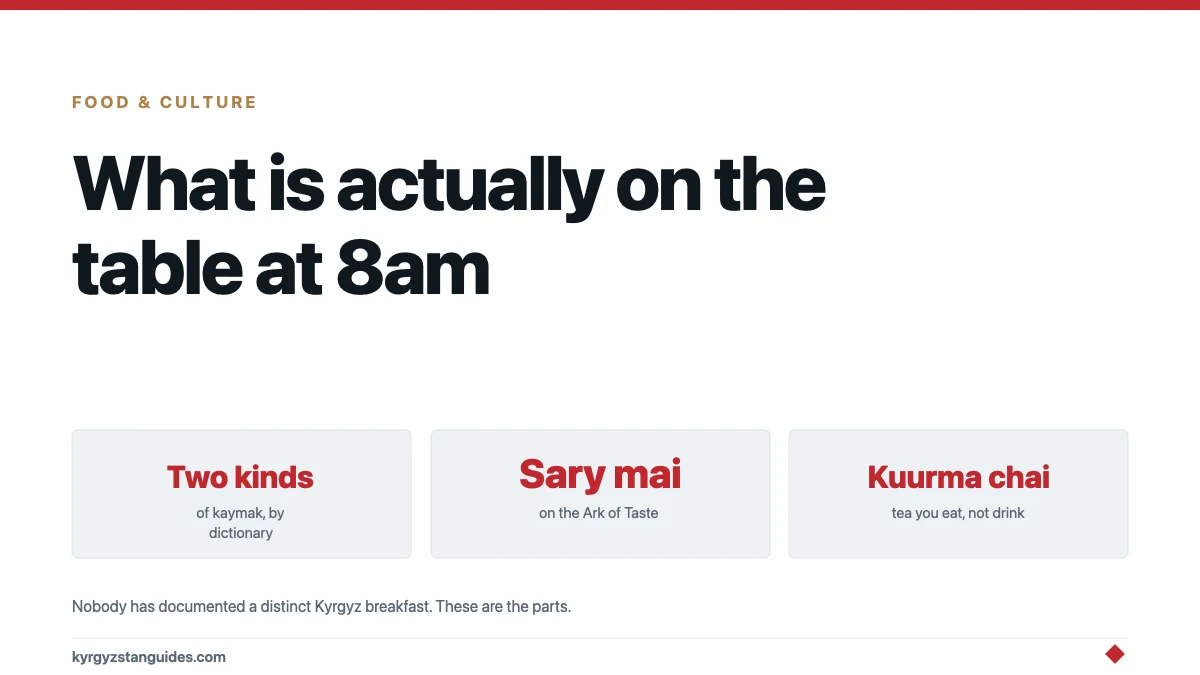
Ask for kaymak and you may get either of two products. The Kyrgyz explanatory dictionary carries both senses: the skin that forms on top of milk that has been boiled and left to stand, and the cream that separates off raw milk. They are not the same thing on the tongue. The boiled version is thicker, slightly cooked-tasting, and holds its shape on a spoon. The raw-milk version is looser and tastes of the grass the animal was eating.
Neither is clotted cream, and neither is sour cream, though menus in Bishkek translate kaymak as both. If a guesthouse in the mountains hands you a bowl of something the colour of old ivory with a wrinkled surface, that is the boiled kind, and it is the one worth crossing a room for.
Spread it thick on hot bread and put honey on top of it. That combination is the actual centrepiece of a good Kyrgyz breakfast, and it is the reason nobody in the house is worried that there is no cooked dish.
Sary mai, the one item with international recognition
Sary mai means yellow fat. It is clarified butter made from yak milk in the north of the country, and it is the only breakfast-table item from Kyrgyzstan that carries any formal protection: it sits on the Slow Food Ark of Taste, the catalogue of foods at risk of disappearing.
It is intensely yellow, which comes from the yak's diet, and it is strong. A first spoonful tastes almost cheesy. It goes into tea more often than onto bread, which brings us to the part of Kyrgyz breakfast that visitors genuinely do not expect.
Tea you eat with a spoon
There is a family of morning dishes built by putting bread into tea rather than beside it. Kuurma chai and etken chai are the names you will hear. The base is milk tea, salted rather than sweetened, with butter or sary mai melted into it. Bread or boorsok goes in and softens. You eat it with a spoon.
To a European palate the salt is the shock, not the butter. It reads as soup for the first three mouthfuls and then it stops being strange. In a cold guesthouse at 2,800 metres it is also, quite plainly, the correct thing to be eating, which is an argument no amount of describing will win for you in advance.
This is winter and mountain food. Order it in a Bishkek café in July and you will get a blank look. Stay in a yurt camp near Song-Kul in September and it may be the only hot thing on offer before you start walking. See staying in a yurt in Kyrgyzstan for what else changes about meals up there.
Kattama, when somebody has made an effort
Kattama is the one item that is genuinely cooked to order. It is a layered flatbread: dough rolled thin, brushed with fat, coiled, flattened and fried, so it comes apart in sheets. Some versions have onion or herbs worked into the layers.
It takes time, which is why it appears at weekend breakfasts and for guests rather than on a Tuesday. If kattama arrives, you are being treated well.
The boorsok you are eating is one of several
Boorsok is not one recipe. Kyrgyz has separate words for the variants, and the differences are real:
| Name | What changes | Result |
|---|---|---|
| Süt boorsok | Made with milk | Softer, richer, browns faster |
| Achytkan boorsok | Yeasted dough | Puffed, hollow, bread-like |
| Chiy boorsok | Unleavened, cut small | Dense, chewy |
| Kyrtyldak boorsok | Rolled very thin | Crisp, shatters |
The crisp kind is the one that gets crumbled into tea. The yeasted kind is the one piled into a mountain at a celebration. Knowing the difference is not essential, but asking which one you are eating is a reliable way to get a long and cheerful answer from whoever cooked it.
What it costs if you are buying it yourself
Breakfast from a bakery is the cheapest meal in the country. At Arzu, the bakery chain you will pass constantly in Bishkek, a 200-gram bag of boorsok was 140 som in late September 2026. A tandyr loaf from a bazaar stall runs roughly 25 to 50 som depending on size and city, and honey is the item that will actually cost you something, particularly if it is the white sainfoin honey covered in our guide to Kyrgyz white honey.
A guesthouse breakfast is normally included in the room rate. Where it is charged separately, 150 to 300 som is the usual band, and it will be more food than you can finish.
The drinks that are not tea
Two fermented grain drinks belong to the morning as much as to any other hour, and both have unusual status.
Maksym, made from roasted grain, was inscribed on the UNESCO Representative List of the Intangible Cultural Heritage of Humanity in 2025 — the knowledge and practice of making it, formally recognised. Jarma, its close relative, is on the Slow Food Ark of Taste as a summer drink. Both are sold chilled from street tanks in Bishkek from about May, both taste sour and faintly of bread, and neither is an acquired taste people acquire quickly. Try them cold on a hot morning rather than as a first experiment at eight in the morning in a cold room.
An honest limitation
Nobody has published a proper survey of what Kyrgyz households actually eat at breakfast, by region or by season. What is written above is assembled from dictionary definitions of the dishes, the two international listings, current bakery prices, and the consistent shape of the meal as it is described across the country. Where a claim about a specific region would have needed a source we do not have, it is not here.
If you want one thing to ask for: kaymak with honey, on bread still warm. Everything else on the table is optional.
FAQ
Is there a traditional Kyrgyz breakfast dish?
Not a single defining one. Breakfast is an assembled meal: bread and boorsok, a dairy item such as kaymak or sary mai, jam or honey, and tea. The only routinely cooked-to-order item is kattama, a layered fried flatbread, and it tends to appear for guests or at weekends.
What is kaymak in Kyrgyzstan?
It is a rich dairy topping for bread, but the word covers two products. Kyrgyz dictionaries define it both as the skin formed on boiled milk and as cream separated from raw milk. The boiled version is thicker and holds its shape; the raw version is looser. Menus translate both as cream or sour cream, which is why it varies so much between places.
Why is the tea salty?
Kuurma chai and etken chai are milk teas made with salt and butter rather than sugar, and bread is soaked in them. They are eaten with a spoon and belong to cold weather and mountain households. Ordinary black tea, unsalted, is what you will be served in cities.
Is Kyrgyz breakfast vegetarian?
Usually yes by default, since the standard table is bread, dairy, jam and tea with no meat. The butter-and-milk basis means it is not vegan. Our guide to vegetarian food in Kyrgyzstan covers the rest of the day, which is harder.
How much does breakfast cost in Kyrgyzstan?
A bakery breakfast is very cheap: boorsok was 140 som for 200 grams at Arzu in September 2026, and a bazaar tandyr loaf is roughly 25 to 50 som. Guesthouse breakfasts are usually included; where charged separately, expect 150 to 300 som.
What is sary mai?
Clarified butter made from yak milk in northern Kyrgyzstan. The name means yellow fat, and it is listed on the Slow Food Ark of Taste as a food at risk of disappearing. It is strong, deep yellow, and used in tea at least as often as on bread.