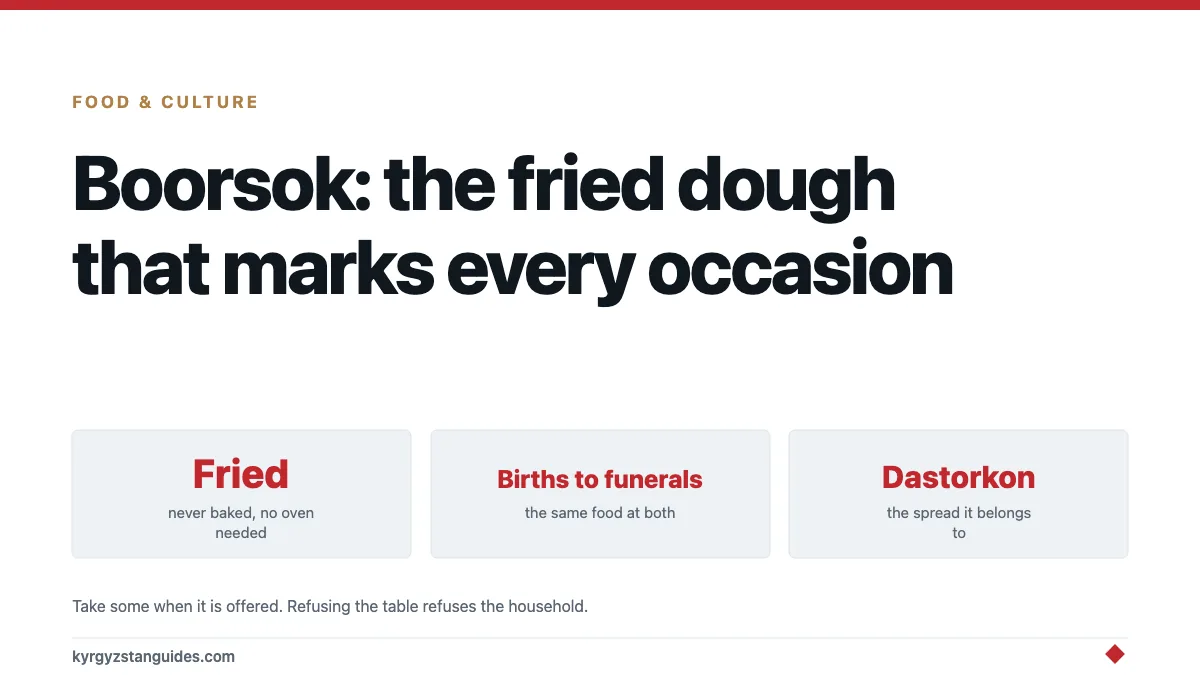
Boorsok is small fried dough (squares, diamonds or rounds of leavened flour dropped into hot oil until they puff) and it turns up on the table at births, weddings, holidays, ordinary afternoon tea and funerals alike. That range is the interesting part. The same food marks the happiest event a family has and the worst one.
If a bowl of it appears in front of you in a guesthouse, you're not being given a snack. You are being given the standard opening move of Kyrgyz hospitality, and there's a right way to receive it.
What it actually is
Flour, water or milk, yeast, salt, sometimes a little sugar or butter. The dough is rolled, cut into small pieces, and deep-fried until golden and hollow-ish inside — crisp outside, soft in the middle, and much lighter than it sounds on paper.
It is not sweet, and it is not chak-chak. People coming from a doughnut expectation are always slightly thrown by the first one, because boorsok is bread that happens to be fried, not a pastry. It's eaten with tea, with jam and cream, alongside a meal, or simply because it's on the table.
Shape carries meaning. The cut isn't random. Different occasions call for different forms, and in some families the shape signals what the gathering is for, which is one of those details you'd never notice unless someone pointed it out.
The dastorkon it belongs to
You can't really separate boorsok from the spread it sits on.
The dastorkon is the laid table, cloth, tea, bread, sweets, dried fruit, nuts, cream, jam, and boorsok almost always among them. It gets set out for guests, and it gets set out generously, often well beyond what anyone will eat. That excess is the point: the table is a statement about the household, not a calculation about appetite.
Our guide to Kyrgyz tea and bread customs covers the wider etiquette — how tea is poured, why your cup is filled only part way, what to do with the bread. Boorsok sits inside all of that.
Why it's at funerals too
This is the part that surprises visitors, and it's worth understanding rather than stepping around.
When someone dies, a Kyrgyz family keeps a dastorkon laid for about a week, and again on the memorial days that follow. Guests come, guests are fed, and boorsok is part of what's served alongside beshbarmak and the rest. Atlas Obscura's piece on the dish records the belief underneath it plainly enough: feeding people is a charitable act, and the charity is understood to benefit the soul of the person who died.
The phrase that gets used is that the soul must not go hungry.
There's also the smell. Frying dough produces a very particular, carrying smell, and in a good deal of Central Asian and wider Turkic practice that rising smell is itself part of the offering, the thing that goes upward while the food stays on the table.
So boorsok isn't a celebration food that happens to appear at funerals. It's an occasion food, and a funeral is an occasion.
The same bread, half a continent wide
Boorsok isn't a Kyrgyz invention, and noticing that tells you something about who these people are related to.
The Kazakhs make baursak. Tatars, Bashkirs and Turkic communities across Russia and further west make versions under near-identical names. Mongolian and Uzbek kitchens have close relatives. It's a steppe food in the proper sense — the dough keeps, the frying is fast, and none of it needs an oven, which matters a great deal if your kitchen moves twice a year.
That last point is the one worth sitting with. Bread baked in a tandyr needs a fixed clay oven and therefore a fixed village. Bread fried in a pan over a fire needs nothing that cannot be loaded onto a horse. Kyrgyz cuisine is full of this logic once you start looking for it, food designed around portability, preservation and animals rather than around fields. A historical study of the transformation of Kyrgyz nomadic food culture makes the same point with other dishes: gulazyk, a dry nutrient-dense powder that keeps for months on the move, and kurut, milk dried into hard cheese that needs no refrigeration and no shop.
Quantities carry meaning too. Boorsok for a specific occasion is traditionally made in set amounts rather than "however much fits", and in some households the number is fixed by custom rather than by how many guests are coming.
If you're handed some
You'll be. Guesthouses, homestays, yurt camps, anyone's kitchen you end up in. This is the default thing put in front of a guest.
Take some, even if you're not hungry. Refusing the dastorkon outright reads as a refusal of the household, which isn't what you mean. Taking two pieces and a cup of tea is a complete and sufficient response.
Use your right hand. Don't reach across other people for the bowl. And don't clear the table of the last few pieces on the assumption that finishing it's polite — it isn't a plate to be emptied.
If you're offered a seat at a memorial gathering, which does happen to travellers staying in villages, the answer is to accept, sit quietly, eat a little, and follow whoever is next to you. Nobody expects a foreigner to know the form. They will notice whether you took it seriously.
Where you'll meet it
Everywhere, is the honest answer, but some settings more than others.
Jailoo yurt camps make it constantly, it keeps for days, it doesn't need refrigeration, and it fills people who have been outside. Village homestays will put it out with morning tea. Bazaars sell it by weight, warm, in bags, and it's the best cheap thing to have in a rucksack on a long marshrutka ride. Any holiday, Nooruz especially, means large quantities of it.
Restaurants in Bishkek serve it too, though the version that comes on a plate in a national-cuisine restaurant is never as good as the one someone's grandmother made an hour ago.
Can you make it at home?
Yes, and it travels better as a recipe than most Kyrgyz food does, because the ingredients are things you already have.
The technique is unremarkable — a soft yeasted dough, rested until it rises, rolled to around a centimetre, cut, and fried in deep oil hot enough to puff it fast rather than soak it. Too cool and you get grease; too hot and you get raw middles. Work in small batches.
What you can't import is the setting. Boorsok eaten standing in a kitchen at home is fried bread. Boorsok on a dastorkon in a yurt with the wind up outside is the thing itself, and our Kyrgyz food guide has more on where the rest of the cuisine actually lives.
FAQ
What is boorsok?
Boorsok is Kyrgyz fried bread, small pieces of leavened dough, cut into squares, diamonds or rounds and deep-fried until puffed and golden. It's savoury rather than sweet, and it's a standard part of the dastorkon, the spread laid out for guests.
What is boorsok served with?
Tea, almost always, plus jam, clotted cream, honey, dried fruit and nuts. It's also served alongside main dishes at large gatherings, and eaten on its own as an everyday snack.
Why is boorsok served at Kyrgyz funerals?
Because feeding guests is understood as a charitable act that benefits the soul of the person who died — the saying is that the soul must not go hungry. Families keep a dastorkon laid for about a week after a death and again on memorial days.
Is boorsok sweet?
No. There may be a little sugar in the dough, but boorsok is fried bread rather than a doughnut. If you're expecting something sweet, the first piece will be a surprise.
Do I have to eat it if it's offered?
You should take some. Refusing the dastorkon entirely reads as refusing the household's hospitality. Two pieces and a cup of tea is a perfectly adequate response, whatever your appetite.
Where can I buy boorsok in Kyrgyzstan?
Any bazaar sells it warm by weight, which makes it the best cheap food to carry on a long road journey. Guesthouses, homestays and yurt camps all make their own, and national-cuisine restaurants in the cities serve it too.