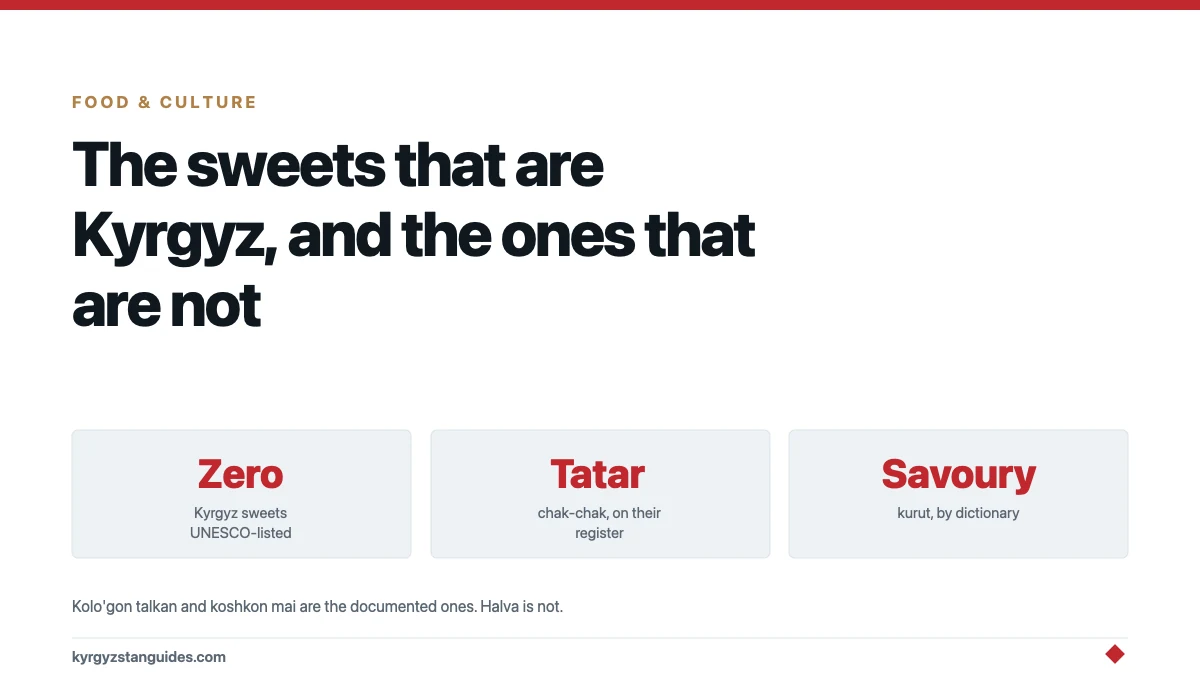
Start with the finding that surprised us. We went looking for a Kyrgyz sweet with any form of official recognition — a UNESCO inscription, a Slow Food listing, a national register entry — and there is not one.
Kyrgyzstan has sixteen entries on the UNESCO intangible cultural heritage lists. Two of them concern food or drink: flatbread-making culture, inscribed in 2016, and the traditional knowledge of making maksym, the fermented grain drink, inscribed in 2025. The full list is public on the UNESCO country page. No confectionery, no dessert, nothing sweet.
The Slow Food Ark of Taste, which catalogues foods at risk of vanishing, holds a small Kyrgyz set: the grain drink jarma, yak-milk sary mai, the Arslanbob walnut, the dried kandek apricot from Batken, and the Turkestan barbel. Two nuts and fruits, a fish, a butter and a drink. Again, no sweet.
That absence is not a judgement on the food. It is a fact about how Kyrgyz sweet-making works, and once you understand it the rest of this makes sense.
Kyrgyz sweets are grain, fat and sugar, not confectionery
There is no tradition here of a pastry counter. The sweet things in a Kyrgyz household are built from the same three materials as everything else on the table: roasted grain, dairy fat, and something sweet added at the end.
Talkan is the base of most of it. Grain — usually wheat or barley, sometimes maize — is roasted and ground to a coarse flour. On its own it is nutty and dry. Mixed with cream, butter or milk and sweetened, it becomes a thick paste eaten by the spoonful. This is the closest thing to a national sweet, and it is a paste in a bowl rather than an object on a plate.
Koshkon mai works the same way from the fat end: butter combined with talkan or flour and sweetened, worked until it holds together. It carries a specific social role, and it is worth being precise about what that role is. The jentek toi, the feast held after a birth, is built around butter: the best-documented custom is that sary mai is put into the newborn’s mouth first and then given to the oldest person in the house. Koshkon mai is reported in connection with the same occasion, worked and handed round as a sweet. Either way it is a food tied to an event rather than to a shop, which is the pattern across almost everything sweet in Kyrgyz cooking.
Both of these keep. That is the design. A food that survives a season in a felt-walled house without refrigeration is a food built for a mobile life, which is the through-line of the Kyrgyz nomadic culture guide.
The kurut confusion
English-language pages regularly describe kurut as a sour sweet or a Kyrgyz candy, presumably because it arrives as small white balls that look like something from a confectioner.
It is not sweet. Kyrgyz dictionaries define kurut purely as dried salted curd — a dairy preservation product, salty and sharp, made by draining fermented milk and drying the result hard. There is no sweet sense of the word.
If someone hands you one at a bazaar and you are expecting sugar, you will make a face, and they will enjoy that. Eat it the way it is intended: in small bites with tea, or dissolved into a broth. We go into the wider dairy family in the guide to Kyrgyz dairy.
Chak-chak is Tatar
This one matters because chak-chak is sold in Kyrgyzstan, appears on Kyrgyz restaurant menus, and gets written up in English as a Kyrgyz dessert.
Chak-chak — fried dough strands bound together with honey syrup — is Tatar. It is documented as such in Tatarstan, where it sits on the republic's own heritage register, and it is treated as a national dish there rather than as a regional Central Asian one. It spread through the Russian Empire's Tatar communities and reached Kyrgyzstan that way.
The confusion is understandable, because Kyrgyzstan has its own fried dough, and it is everywhere. But boorsok is not chak-chak. Boorsok is savoury or plain, cut into squares or diamonds, and eaten with everything from tea to meat. The documented difference in the sweetened versions is that the Tatar preparation is bound with honey while the Kyrgyz sweet variants are made with sugar in the dough. The whole boorsok story is in our boorsok guide.
Eating chak-chak in Bishkek is fine. Calling it Kyrgyz is not accurate.
What about halva, and jent
Halva is sold in every bazaar in the country, in slabs, usually sunflower-seed based. It is a Middle Eastern and Persian-origin confection distributed across the whole region, made in Kyrgyzstan and consumed enthusiastically in Kyrgyzstan, but it is not a Kyrgyz invention and nobody in the country claims otherwise.
Jent is the harder case. It is a pressed sweet of millet or wheat with fat and sugar, and it is usually attributed to Kazakh cuisine. Kyrgyz has the word jentek for the post-birth celebration, and the two words look related, but a shared root does not establish that the sweet is Kyrgyz. We could not find a Kyrgyz dictionary entry for jent as a food. Treat it as a regional sweet with a Kazakh attribution rather than a Kyrgyz one.
Fruit, nuts and honey are the real sweet course
Here is the thing the search for a Kyrgyz dessert misses. In a Kyrgyz house, what comes out with tea at the end of a meal is dried fruit, nuts, jam and honey — and those are the items the country is genuinely known for.
The Batken apricot is a named variety on an international register. The Arslanbob walnut comes from the largest wild walnut forest on earth, harvested each autumn by thousands of people, which we covered in the Arslanbob walnut harvest. Kyrgyz white honey from sainfoin is a specific, identifiable product with a real price premium, described in Kyrgyz white honey.
So the sweet course exists. It is just not made in a kitchen.
The boorsok record
One piece of sweet-adjacent trivia worth having. On 21 March 2018, at the Nooruz celebrations, 800 kilograms of boorsok were fried and served in a single mass preparation — the largest recorded at the time.
Nooruz is when to see this kind of thing. The whole country cooks in public on 21 March, sumolok cauldrons go on the fire, and the volume of fried dough produced is difficult to overstate.
Buying sweets as a gift
If you want to take something home, the ranking is not close.
Honey first, provided you can carry liquid. Dried apricots from Batken second. Walnuts third. Talkan is interesting and cheap and almost nobody outside the region has tasted it, but it looks like a bag of brown flour and needs explaining.
Skip the imported chocolate and the shelf-stable wafer cakes in every shop. They are Russian, Kazakh or Turkish products sold in Kyrgyzstan, and you can buy the same thing at home.
Bazaar prices move with the season, particularly for fruit and nuts after harvest. Osh Bazaar in Bishkek is the usual place to buy, and the usual place to be charged a tourist rate if you accept the first number.
FAQ
What is the traditional Kyrgyz dessert?
There is no single one. The closest is talkan, roasted ground grain mixed with butter, cream or milk and sweetened into a thick paste, and koshkon mai, a sweetened butter-and-grain preparation associated with the jentek celebration after a birth. Neither is a plated dessert; both are eaten by the spoonful with tea.
Is chak-chak a Kyrgyz sweet?
No. Chak-chak is Tatar and is registered as heritage in Tatarstan. It is widely sold and eaten in Kyrgyzstan, having spread through Tatar communities across the former Russian Empire, but it is not a Kyrgyz dish. Kyrgyzstan's own fried dough is boorsok, which is usually plain or savoury.
Is kurut sweet?
No. Kurut is dried salted curd, and Kyrgyz dictionaries give no sweet sense of the word. It is salty and sharp, eaten in small bites with tea or dissolved into soup. The round white shape leads English-language sources to describe it as a candy, which is wrong.
Are any Kyrgyz sweets UNESCO-listed?
No. Kyrgyzstan has sixteen entries on the UNESCO intangible heritage lists, of which only two concern food or drink: flatbread-making culture, inscribed in 2016, and the making of the grain drink maksym, inscribed in 2025. There is also no Kyrgyz sweet on the Slow Food Ark of Taste.
What is talkan?
Roasted grain — wheat, barley or maize — ground to a coarse flour. Plain, it is nutty and dry and is used as a base for drinks and porridges. Mixed with dairy fat and sugar it becomes the country's nearest equivalent to a dessert, and it keeps for a long time without refrigeration.
What sweet food should I buy as a souvenir from Kyrgyzstan?
Sainfoin white honey if you can carry liquid, dried kandek apricots from Batken, and Arslanbob walnuts. All three are distinctive to the country and the apricot and walnut are both on the Slow Food Ark of Taste. Avoid the imported chocolate and wafer cakes, which are not local products.